
There’s one thing you never want to break with customers and prospects: trust. In a mobile landscape that’s rife with spam and smishing (SMS phishing attacks), recipients are wary of any message they receive that doesn’t look legitimate. Even if you have good intentions and design SMS messages with trust in mind, recipients may delete or ignore your messages if there’s any room for doubt (as they should; that’s just good cybersecurity practice).
One way to solve this problem is by using Rich Communication Services (RCS). RCS allows you to deliver an app-like experience on mobile without requiring recipients to download anything. This means you can send rich-media messages that feature your business’s official branding, including the name, logo, and brand colors, in the native messaging application, which can demonstrate legitimacy to recipients and help them feel more confident in engaging with your business via text.
To use these features, you must first apply for RCS agent verification and go through an RCS brand approval process. The process is not complicated, but there are a few best practices and RCS agent registration steps you can follow to streamline it and start using RCS messaging as soon as possible. With this in mind, let’s explore what it means to be a verified RCS sender, how to register an RCS agent, and how you can start sending compliant, branded messages that build trust and engagement with customers and prospects alike.
What Does It Mean to Be a Verified RCS Sender?

One of the major advantages of RCS messaging is the verified profile that comes with it. All organizations that want to use RCS messaging must go through an RCS agent verification process. This process requires completing a variety of tasks and adhering to carrier-specific rules to verify that your business is legitimate and trustworthy.
Being a verified RCS sender signifies that your organization has been validated by carriers. It shows users that you have undergone a carefully designed process to vet your legitimacy and earn verification.
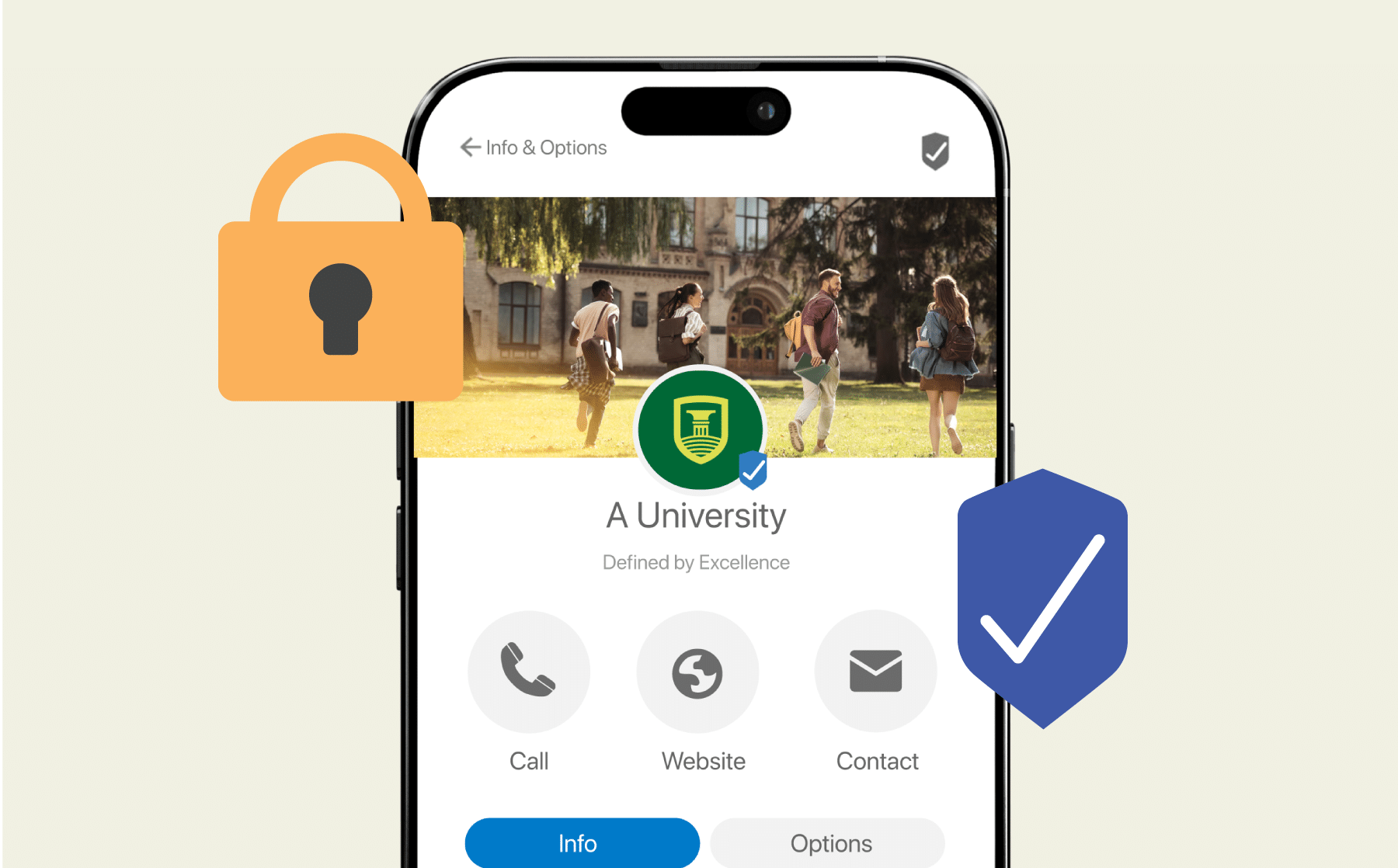
As a verified RCS sender, you receive a verified profile that displays your organization’s official branding. When messaging with a user, they’ll see your official company name, logo, and brand colors as well as a symbol, like a verified checkmark within a shield, confirming that your company has been validated.
With RCS, you can send personalized, rich-media messages to users, complete with branded CTA buttons, chats, and other high-resolution imagery. These features, when combined with a verified brand checkmark, go a long way toward fostering recipient trust and encouraging engagement. Plus, your verified sender badge and all your branding are automatically displayed in the native messaging application, so recipients can see your trust signals immediately without having to hop between apps to verify your legitimacy.
The verified profile is only one of many RCS verified sender benefits, but it’s perhaps the most important benefit when it comes to user trust and engagement. Think of it like 10-digit long code or short code registration for SMS messaging; it’s a verification process that can help you maintain compliance and prove to customers and prospects that your organization is trustworthy, credible, properly vetted, and worth interacting with.
Why Verified RCS Status Matters for Trust, Engagement, and Compliance
According to the Anti-Phishing Working Group (APWG), a not-for-profit association focused on eliminating cybercrimes related to phishing, SMS phishing (also known as smishing) volumes have risen year over year, with steady 30–40% growth quarter over quarter. In Q1 2026, APWG reports that phishing attacks have risen more than 13% since Q4 2025, from 850,000+ attacks to more than 970,000 in Q1 2026.
Smishing accounts for about a third of phishing attacks, often taking two formats: scams and impersonation. Scams via text usually hinge on inciting immediate action from a user (e.g., sending a fake bank alert that scares the user into sharing their sensitive account information), while impersonations typically focus on convincing the recipient that they are dealing with a legitimate business when they really aren’t. Both formats exploit the user’s trust in SMS.
Due to the volume of smishing attacks and spam associated with SMS messaging, many users may be skeptical about sending or receiving texts from an organization, even if that organization has undergone the vetting process to earn 10-digit long codes or short codes. This can make it difficult to achieve the click-through rates you want, which can affect sales and customer satisfaction, and cast doubt on your interactions and communications with recipients.
RCS messaging solves many of these problems through RCS agent verification. Because senders must undergo verification, recipients are much more likely to trust messages and engage with them. Plus, due to compliance requirements, recipients must opt in to receive RCS messages, so there’s already an expectation of engagement. In other words, by earning a verified RCS status, you can better navigate the tricky threat landscape of texting, build trust with prospects and customers, and encourage more interactivity with recipients.
Requirements for Becoming a Verified RCS Sender
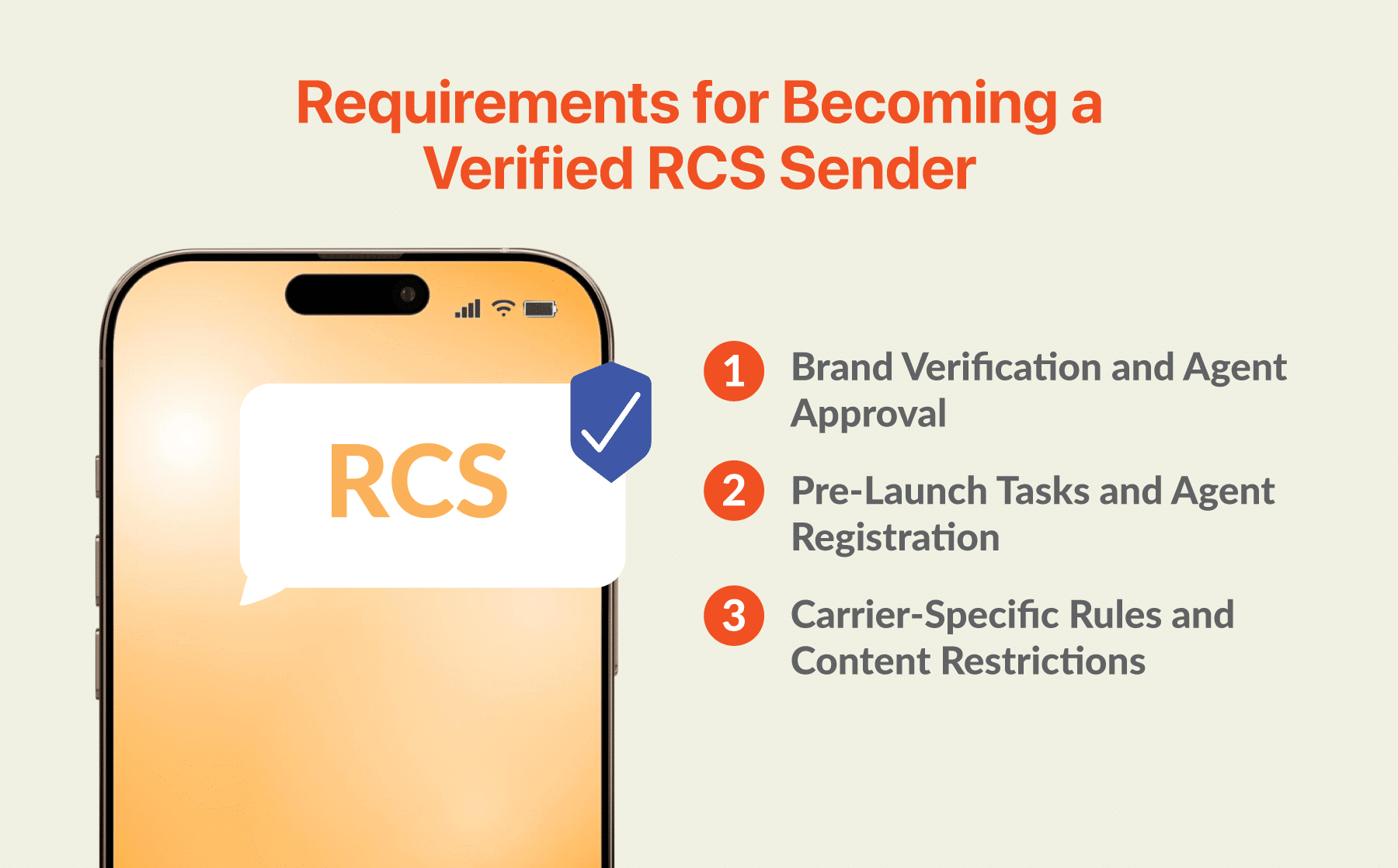
Before applying for RCS agent verification, you’ll want to understand the requirements for becoming a verified RCS sender. Typically, there are three categories of requirements to address: brand verification and agent approval, agent registration, and carrier-specific rules and restrictions.
Brand Verification and Agent Approval
Prior to launching your RCS agent, you must go through an RCS brand approval process to verify the legitimacy of your business. Typically, this process is handled by an authorized brand representative who works for the platform provider you’re using. They will confirm your agent information and your right (or your messaging partner’s right) to manage the agent and send messages on your brand’s behalf.
For this process, you will need to show proof of legal registration for your business. This includes legal proof of your business being registered in your country, such as a certification of registration, a business registration number, an authorization letter, or other supporting documentation. You must also write your exact brand name, website name, logo, and other business details (e.g., business address, domain name, contact information, etc.) exactly as they appear in your registration documents.
Your RCS agent branding must also align with the business information you provide. If everything looks good and accurate and the brand representative can verify your business is legitimate, they will approve your agent for RCS messaging.
Pre‑Launch Tasks and Agent Registration
In addition to RCS brand approval, you’ll need to complete several pre-launch tasks. For example, you must clearly define all agent information, including the agent’s display name, a description of your brand, your brand colors, brand images and logos for the agent, contact information for recipients (e.g., email addresses and customer service or sales phone numbers), and any other relevant brand assets or agent information.
You also need to provide a robust privacy policy, an opt-in/opt-out clause and flow (e.g., what happens if a user opts in or out), and terms of service information. It’s also a good idea to test your agent prior to registration and approval to ensure everything works reliably.
Other information you may need to prepare ahead of agent registration includes:
- List of countries you want to operate your agent in
- Points of contact at your company who will be in charge of the agent
- Types of interactions your agent will have with users
- Instructions for how reviewers can access your agent to test and evaluate it
Carrier‑Specific Rules and Content Restrictions
Wireless carriers must also approve your RCS agent after brand approval. Carriers tend to have a more rigorous vetting process to ensure trusted RCS business messaging on their network, and they often have specific requirements and rules for messaging. For example, they may assess your billing category and your messaging use cases to make sure the channel stays secure and spam-free.
To help streamline carrier approval, you should prepare the following:
- An SMS fallback strategy. Carriers often require a fallback strategy to ensure recipients can receive messages even if their device does not support RCS. Define what triggers a fallback message and create SMS or MMS fallbacks to demonstrate to the carrier that you are a trusted sender.
- RCS messaging use cases. Carriers want to understand how you will use RCS, what type of messages you’ll send, and why you’ll be sending those messages. As such, prepare clear use cases that explain these details, and create sample messages to showcase what type of communications you’re envisioning.
- A demo or example. You can show carriers how serious you are by presenting a professional demo of your RCS messaging. This can take the form of screenshots, a short video, or an interactive sandbox that walks the reviewer through the types of rich media you’ll use and how your opt-in/opt-out flow will work.
Carriers may also have strict content restrictions. For example, they may require specific formats, file sizes, pixel dimensions, and ratios for assets. They may also establish a certain messaging frequency to cut down on spam. Make sure to adhere to these restrictions, and avoid overly pushy marketing language to help gain approval.
How to Become a Verified RCS Sender: Step‑by‑Step Guide

What, exactly, do you need to do to become a verified RCS sender? Thankfully, the process is not complicated. Following these RCS agent registration steps can help set you up for success:
- Understand the requirements for becoming a verified RCS sender. To ensure the RCS agent verification process goes smoothly and quickly, take the time to understand all the requirements prior to submission. Map out what documentation you need to create and who will be responsible for overseeing tasks, and gather all details about your business, brand, and RCS plans into one, organized location.
- Register your organization. If your business has not been legally registered, make sure to go through that process first, and be ready to present registration at the time of submission to prove your legitimacy. If you have been approved for SMS messaging, such as for 10-digit long codes or short codes, presenting the approval can help streamline carrier approval, as they’ll know you’ve been vetted previously.
- Create your RCS agent profile. Look up an example of an RCS agent profile and look at the profile requirements. Then, fill out every field to the best of your ability. This includes outlining the RCS agent name, writing a description, adding your logo, and creating brand assets and visuals that align with file requirements.
- Define use cases and opt-in agreements, and prepare documentation. Create messaging use cases that clearly explain your intent for RCS (e.g., promotions, lead generation, conversations, transactions, etc.). You should also define and map out your opt-in/opt-out flow in addition to your privacy policy. Align these with your use cases to present realistic scenarios that demonstrate how interactions will play out. Prepare any additional documentation in an organized format, as well, to help streamline approval.
- Submit your application for brand authorization. Once you have everything prepared, it’s time to submit your application for RCS brand approval. A brand representative will then review your materials, which can take about a week or two.
- Submit your application for carrier verification. Next, you’ll have to submit an application for RCS agent approval with your wireless carrier. This process can take longer, sometimes multiple weeks, due to carriers having more rigorous approval processes to ensure compliance with messaging rules and restrictions.
- Note that, depending on the carrier or RCS provider, you may only need to submit one application for brand authorization and carrier verification, which can simplify the RCS messaging approval process.
- If rejected, revisit and revise your applications. In some cases, your applications may be denied or rejected, and the carrier or brand representative may request changes or additional information. For example, you may need to add clarity around your messaging use cases, better align your branding with your business information, or adjust your opt-in/opt-out flow, but typically, these changes are minor and can be resolved quickly.
- If approved, launch your verified RCS agent. Once you’ve addressed any feedback, resubmitted your application, and received approval, you’ll be deemed a verified RCS sender. Your RCS agent will receive the verified brand checkmark on your profile, and you’ll be approved to start messaging. After launch, it’s time to start experimenting with RCS messaging. Make sure to monitor your delivery and engagement rates, keep an eye on recipient feedback, such as spam complaints, and adjust your messaging strategy accordingly.
Once approved, you won’t need to go through the verification process again unless you change your brand name, add a new carrier, or make other major modifications to your business, brand, or messaging use cases.
For more information on getting started with RCS, download our Guide to RCS Agent Submission.
Why Partner With a Reliable RCS Provider
While not complicated, the RCS messaging approval process can still be intimidating to navigate if RCS is new to you. RCS hasn’t been around for very long, though, so this is a common feeling to have. RCS agent verification can also be time-consuming as you work to meet the requirements. Working with a reliable RCS provider can solve these challenges. RCS providers are experts in the space; they spend the majority of their time navigating this new frontier and helping brands take advantage of RCS verified sender benefits.
TrueDialog, for example, is built for large, fast-growing organizations in highly regulated industries. Our team can set you up for RCS success and help you build a reliable, scalable RCS infrastructure that can grow with your business. As RCS experts, we can help you create your RCS agent profile, organize all the documentation you need for verification, and submit your applications so you can get started with RCS messaging as soon as possible.
In addition, we understand the importance of working seamlessly within your existing environment and the rigorous security and compliance requirements you must operate under, whether you’re a small company or a global enterprise. TrueDialog meets strict security standards, including SOC 2 Type II and TX-RAMP, and uses an ISO-certified cloud data center. We also offer single sign-on and multi-factor authentication, single- and double-opt-in consent, and comprehensive opt-out records, among other safeguards to protect your data. These protections and best practices can help keep you compliant with industry regulations.
A reliable RCS provider like TrueDialog can provide guidance post-verification, too. For example, we can assist with your campaigns and suggest best practices for RCS messaging. Plus, the TrueDialog RCS composer makes it easy for teams to design and preview messages, incorporate brand assets, and launch campaigns with rich-media content. This enables you to effortlessly create engaging messaging experiences on your own, so you can quickly build and launch RCS campaigns as you see fit.
Embrace Verified RCS Messaging to Build Engagement
Trusted RCS business messaging can help your customers and prospects feel comfortable and confident in engaging with your business via text. In a mobile landscape where texts are often viewed with skepticism and doubt due to security concerns and rampant spam, being an RCS-verified sender can not only help you reach customers but also be a competitive advantage that helps your business stand out.
Plus, RCS messaging can help you serve a wider audience and bridge communications gaps in a broader omnichannel marketing strategy. RCS agent verification is only the first step in building a seamless messaging experience, one that enables you to send high-resolution media, imbue your messages with a new level of trust and interactivity, and drive higher conversion rates.
Want to experience RCS messaging in action and see how it could benefit your business? Request a Demo.
FAQs
How do I become an RCS-verified sender?
To become an RCS-verified sender, you must undergo an RCS messaging approval process that includes verifying the legitimacy of your business, your brand, and your use cases for messaging customers and prospects. You must pass brand verification, agent approval and registration, and carrier approval before you can use an RCS agent.
For more information about how to become verified and take advantage of trusted RCS business messaging, read our RCS masterclass guide.
What are the requirements for RCS agent approval?
To earn RCS agent approval, you must present the following in your application:
- Legal proof of business
- Exact brand details and business information
- Clearly defined agent information
- Brand assets that match file requirements
- A robust privacy policy
- A terms of service agreement
- Opt-in/opt-out information and flow
- An SMS fallback strategy
- RCS messaging use cases
Following these RCS agent registration steps can help you achieve RCS brand approval and RCS agent approval, but this list is not exhaustive. Requirements may vary from provider to provider and carrier to carrier.
How long does RCS verification take?
RCS verification can take anywhere from 8 to 10 weeks on average. Working with a reliable RCS provider can help streamline the process and ensure you have all the resources you need to earn RCS agent verification as soon as possible.
Why should I work with an RCS provider to launch my agent?
RCS providers are experts in a rapidly evolving messaging landscape. They know how to navigate changes and streamline the agent approval process, so you don’t have to worry about the minutiae and can instead focus on taking advantage of RCS verified sender benefits.
TrueDialog, for example, can help your business create its RCS agent profile, organize the documentation you need for verification, and oversee your approvals to get you started with RCS messaging ASAP.
RCS providers can also provide post-verification support. Once your agent has launched, they can offer guidance and best practices around RCS messaging campaigns and help you integrate new rich media into your conversations to enhance engagement with recipients and drive conversions, among many other benefits.