Text messaging has become one of the primary channels consumers prefer for hearing from businesses. Over half of consumers have said they’re fine with receiving text messages from brands. At the same time, the security risks of texting are a cause for concern. 75% of respondents in a recent security survey said they’d encountered smishing.
On the one hand, enterprise text messaging has become a business necessity — at least if you care about meeting consumers where they are. On the other, you have to carefully consider the risks that can come with business texting and how best to manage them. One of the best ways to provide the messaging services your customers want, without introducing unnecessary risk, is to start using RCS (rich communication services) encryption.
What is RCS Messaging?
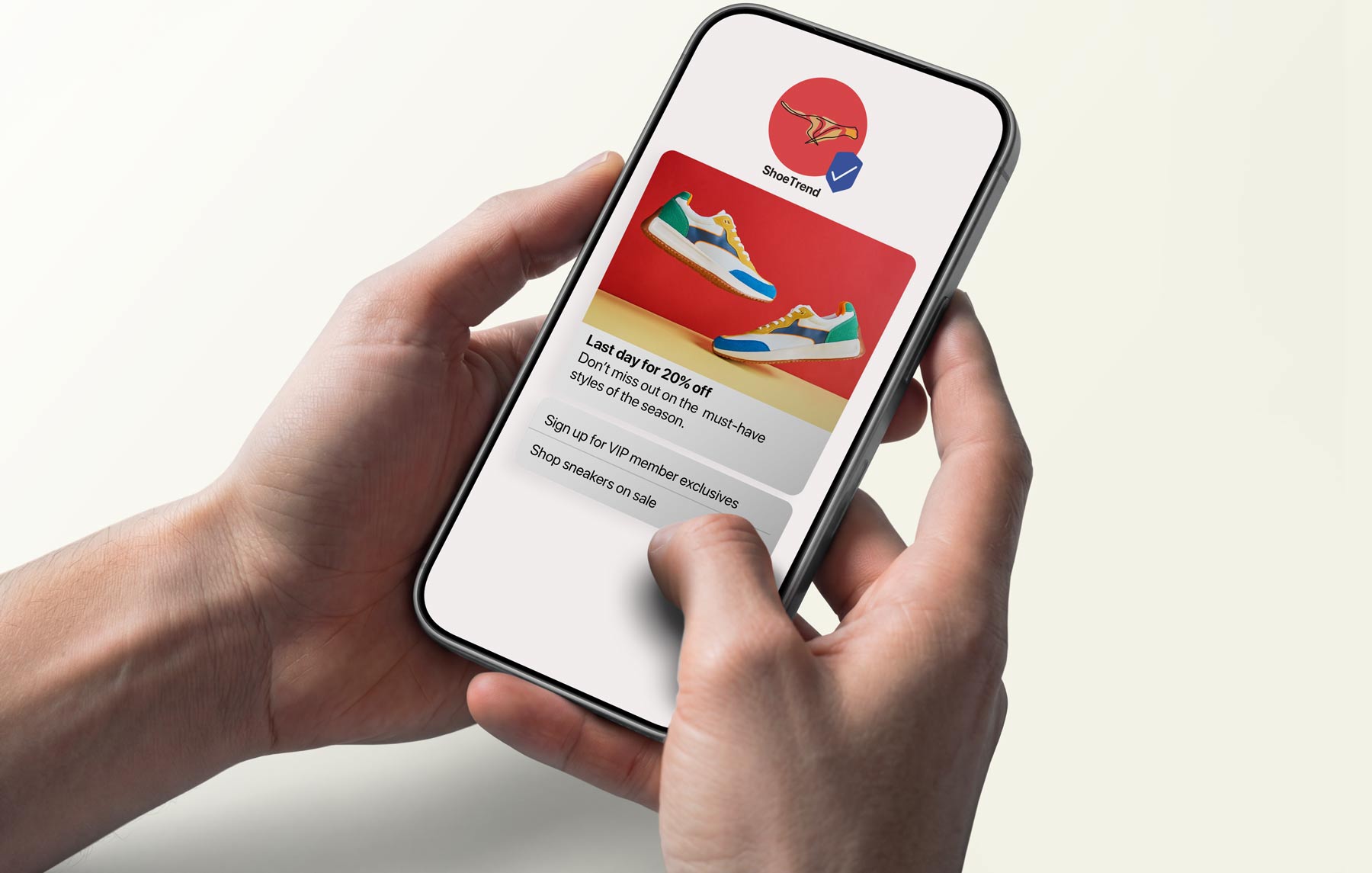
RCS messaging is a relatively new messaging protocol that lets you add more rich media features to the text messages you send. With RCS, you can include high-resolution images, videos, carousels, buttons, and read receipts. Beyond that, it gives businesses a way to more clearly show your branding with each message — you can show up as a verified sender under your brand name, with your logo and colors rounding out the full experience.
But one of the most important things that makes RCS messaging a compelling option for enterprise use cases is the level of security RCS encryption provides.
How RCS Encryption Works: End‑To‑End vs In‑Transit
Encryption uses complex algorithms to encode the original message you send while it travels from one device to another, transforming the message back into its original form once it reaches its destination. RCS encryption ensures that no one can access the information included within your message until it reaches the end user’s device.
All RCS messages include some level of encryption, which provides security and privacy for every message you send using the protocol. But there are two main types of encryption RCS can use, depending on the types of networks and devices used by sender and recipient and what they support:
- In-transit encryption: All RCS messages are encrypted in transit, meaning that the message will always be encrypted when moving between different nodes. But the process of sending enterprise text messages often means the message moves between multiple networks (messaging platform, carrier, device, etc.). The message may be decrypted at some point in the process before reaching the destination, but should still be secure from any unauthorized access.
- End-to-end encryption (E2EE): End-to-end encryption is the most secure possible way for a message to be sent. It means the message is encrypted from the moment it leaves your platform until the moment it reaches your recipient’s device. When all apps and devices involved support it, RCS messages already use E2EE. And support for E2EE is growing, meaning that a larger share of RCS messages will have this level of encryption over time.
Best Practices to Secure Your Business RCS Messages
Using RCS encryption already means your business messages will be secure, but there are a few extra steps you can take to further boost the level of security, privacy, and trust you bring to enterprise text messaging.
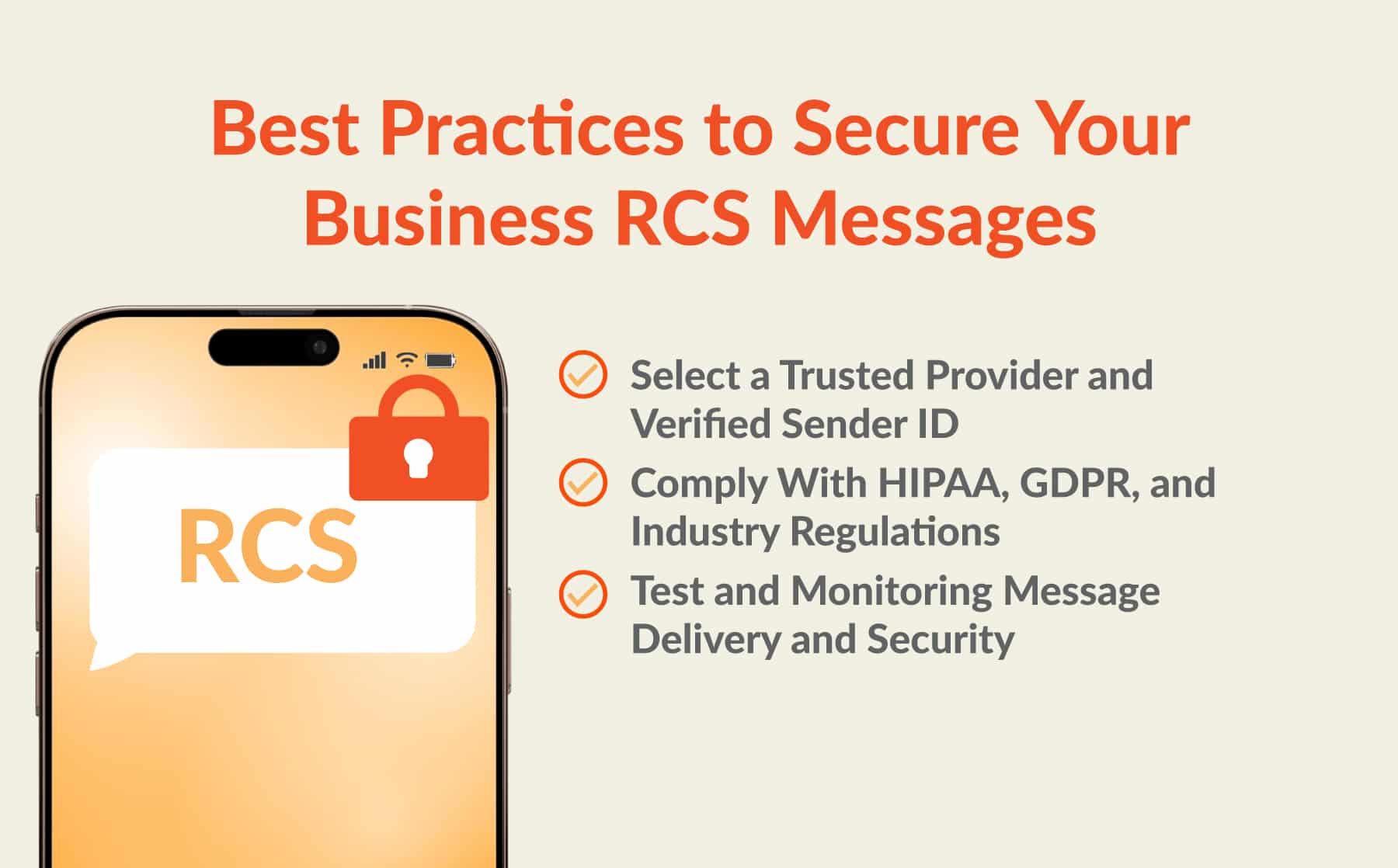
Selecting a Trusted Provider and Verified Sender ID
The first step to getting started with RCS is choosing the right business text messaging platform that supports RCS. Not only will an enterprise platform provide the features you need to easily send RCS messages and track their success, but a trusted provider will also generally offer high-level security and compliance features.
The right RCS platform will also help you through the process of registering your RCS Agent, so you can become a Verified Sender. A Verified Sender ID signals to recipients that carriers have authenticated your brand, letting them know you’re a legitimate provider who can be trusted. Your messages will show up with your brand name, along with your logo and colors, making it clear that you’re trustworthy (and not a scammer masquerading as your brand).
Complying With HIPAA, GDPR, and Industry Regulations
Brands should always strive to maintain ethical messaging practices, and part of that is making sure your messaging strategy complies with all federal and industry regulations. The good news is that most text messaging providers will have expertise and features that make it easy for you to stay compliant with minimal extra work on your part. Nonetheless, you’ll want to familiarize yourself with all relevant regulations and make sure you’re following them.
When choosing your provider, consider:
- Do they have features to help you explicitly request consent before adding someone to your list?
- Is their platform designed to respect opt outs immediately?
- Can they demonstrate familiarity with GDPR (General Data Protection Regulation), as well as any more local legislation you may need to comply with, like the CCPA (California Consumer Privacy Act)?
- Do they have expertise with any industry-specific regulations you may need to follow, like HIPAA (Health Insurance Portability and Accountability Act)?
It’s also important to understand that RCS has a different set of rules around promotional versus transactional messaging, so you need to make sure the type of message you send matches the type of RCS Agent you’re using.
All of this is a lot easier to stay on top of with a platform designed specifically for enterprise messaging. When compliance is largely built into how the platform works, your part in maintaining it becomes much simpler.
Testing and Monitoring Message Delivery and Security
Once you have all the basics set up, you may want to run some tests before you launch your first RCS campaign. You can use internal mobile devices to test out signing up for your list, and viewing how your messages look on each device. Try to use different types of devices for testing, to make sure your RCS messages look the way you want both on Android, iOS, and other systems. Confirm that all devices receive a confirmation message after the initial sign-up, and check that the unsubscribe process works as well.
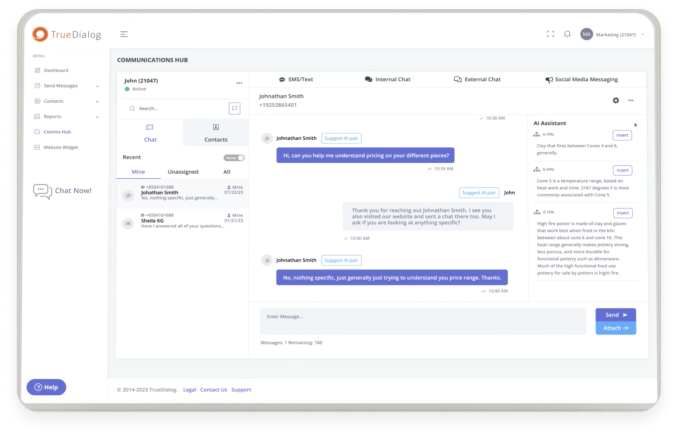
Once you start launching campaigns, you want to keep an eye on your analytics and reports to track message delivery and security on an ongoing basis. This is another area where choosing the right text messaging platform is paramount. Look for a product that provides documentation of opt-ins and opt-outs to help you stay on top of consent regulations. You should also be able to access rich analytics that help you track message deliverability and opens, so you know how often consumers are seeing the messages you send.
RCS vs SMS, WhatsApp, and Other Channels: Security Comparison
Switching to RCS does require an upfront cost and time investment that may give you pause. To help you understand why it’s worth the trouble, consider how it compares to the other main messaging channels available. Here’s a rundown of how RCS compares to SMS and OTT (over-the-top) apps like WhatsApp on security.
RCS vs SMS
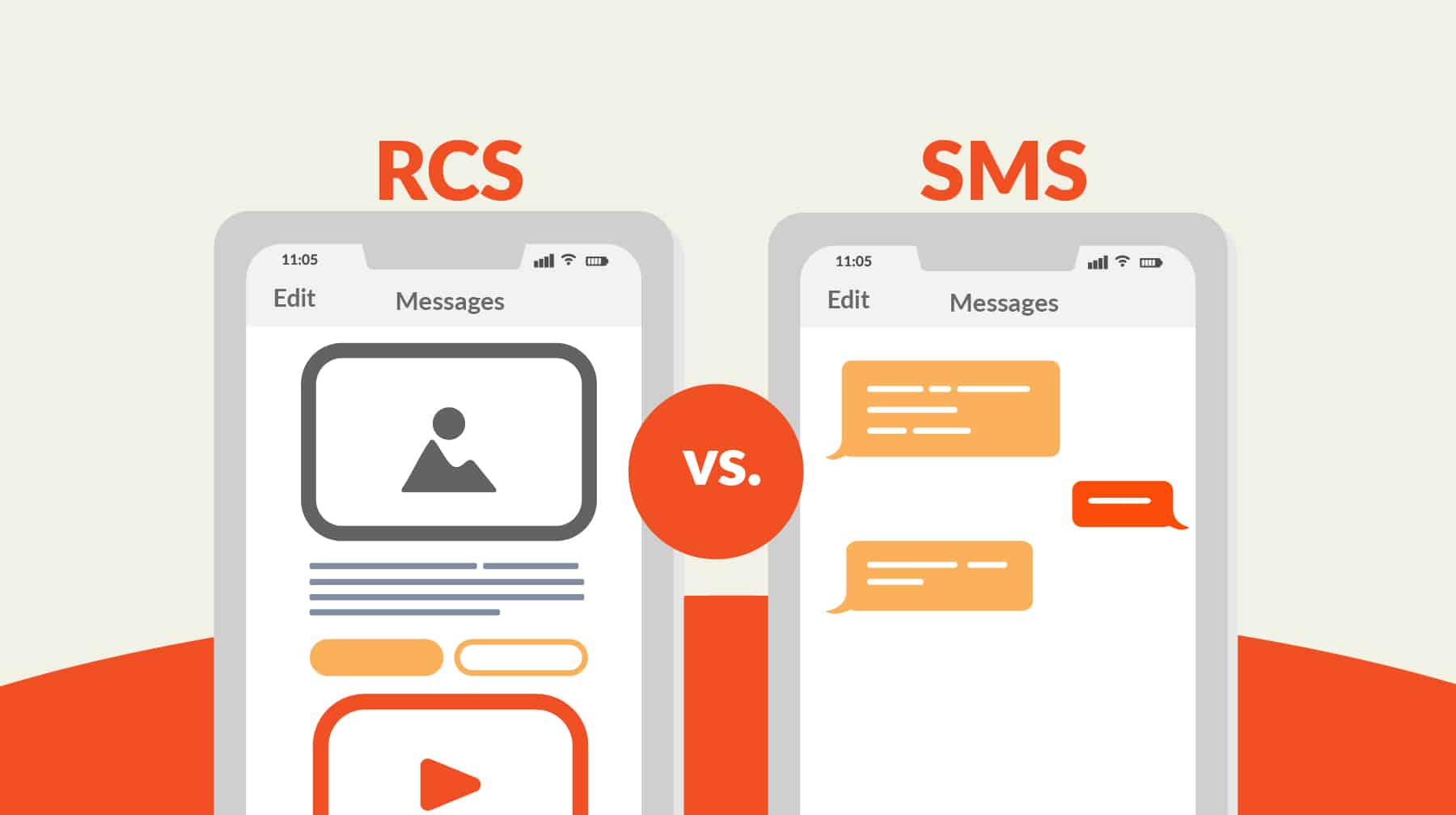
SMS (short message service) has been the go-to standard for text messaging — for users and businesses alike — for many years now. And SMS still has its place. But when you compare RCS versus SMS, the former offers a significant improvement.
SMS depends on SS7(signaling system number 7), a telecommunication protocol developed decades ago that doesn’t provide any way to encrypt messages in transit. RCS instead uses TLS (transport layer security) by default, a security protocol that encrypts data as it moves between the device and network.
RCS vs OTT Apps
RCS resembles OTT apps in some of the features it offers, like the ability to share multimedia content and enable two-way interactivity. Unlike RCS, OTT apps require users to download a standalone app in order to receive messages. Because the app provides a closed ecosystem, most are able to offer end-to-end encryption, making them a strong choice for security.
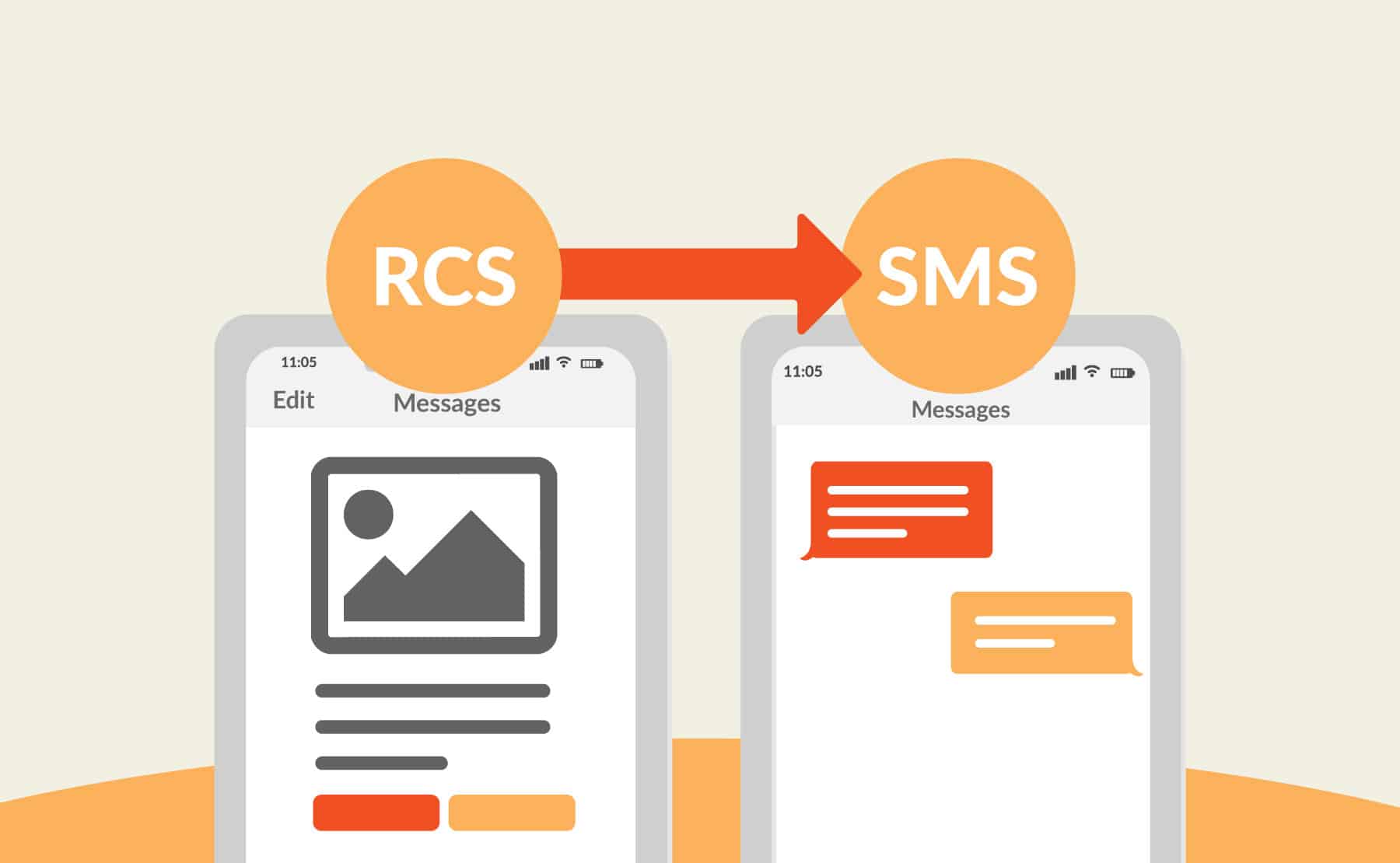
RCS is beginning to offer E2EE in more cases though, as more carriers come on board. By offering in-transit encryption in all scenarios and E2EE in many, RCS is safe by most meaningful standards. Part of what makes RCS a better option for many businesses is that it doesn’t require users to download a specific app. Not all your customers will have WhatsApp on their phone, but a growing number will be able to receive RCS messages, and those that can’t yet will be able to get an SMS message as fallback.
Industry Applications of Secure RCS Messaging

RCS messaging is a compelling option for companies across industries, but its encryption features make it especially valuable in cases where privacy and security are more important.
Finance and Banking Use Cases
For companies in financial services and banking, RCS opens up new opportunities for secure ways to communicate with your customers. You can safely use the technology to send:
- Fraud warnings when you identify suspicious activity on an account
- One-time passwords or two-factor authentication codes to help customers securely access their accounts
- Payment reminders
- Links to activate a new credit or debit card
- Account updates, like balance notifications or notices when new documents are available
- Promotions to encourage customers to upgrade or open new accounts
As long as customers opt into receiving the type of messages you send, RCS messaging lets you provide consumers convenient options right on their mobile devices.
Healthcare and Government Communications
Healthcare companies have to be cautious about how they communicate with patients, in order to stay on the right side of HIPAA legislation, and government entities also face high standards around security and privacy when communicating with consumers. RCS is a good option for many use cases in these areas as well, such as:
- Confirmation messages when an appointment is scheduled, along with reminders when the date is approaching
- Notices about how to check-in for appointments in advance, with links to any forms they need to fill out
- Followup messages with links to care instructions or other next steps
- Billing notifications with details on how to pay
- Surveys to collect feedback about the patient’s experience and preferences
- Updates for health and public safety campaigns
- Messages to encourage recommended vaccines, as well links or attachments to vaccination records
- Emergency updates for public safety concerns like natural disasters
With health and government messaging, the stakes are often high. You can make sure any important messages that don’t require encryption are set up to send as SMS for any users with devices that don’t yet support RCS.
Retail and eCommerce Customer Engagement
RCS is also a great option in the retail space, since it helps you demonstrate clearly who you are and that your messages are legitimate so consumers feel comfortable engaging with them. Some retail use cases to consider include:
- Personalized promotions, like product offers based on past purchases
- Abandoned cart reminders
- Real-time updates on orders, such as confirmations, shipping
- updates, and delivery tracking
- Loyalty program updates, like updating customers on the number of points they have or alerting them to exclusive events for members
- Customer support and exchange requests
- Order followups like review requests or reminders for items that
- are regularly re-ordered
Using RCS for these use cases has the potential to increase sales and improve customer loyalty. By reaching people directly on their phones and providing a secure way to interact with you, you make the decision to keep buying your products and engage with your brand convenient and accessible.
The Future of RCS Security and Encryption Standards
Mobile providers and carriers have been working toward offering RCS with end-to-end encryption for some time, and they’ve already come very close to making it universally available.
As of May 2026, Apple and Google officially announced their plans to begin rolling out E2EE RCS messaging support between iOS and Android devices. According to Statcounter, iOS and Android devices cover 63.08% and 36.85% of the U.S. market respectively, putting their total combined share at over 99%.
That doesn’t quite mean that 99% of people in the US have access to E2EE RCS messaging now, people still need to have carriers that support it and have updated to the most current version of messaging on their phone. But it means that the vast majority of people with a smartphone in the US will soon be able to to receive E2EE RCS messages.
Get Started with RCS Now
Any businesses that were waiting on the protocol to be more widely adopted before embracing it have no reason to wait any longer. RCS encryption is secure, but beyond that it also provides you with rich, interactive features that can help you create more engaging messages for your audience. And if you choose TrueDialog® for your enterprise messaging platform, getting set up with RCS is fast and easy.
FAQs
-
Is RCS secure?
Yes. All RCS messaging is encrypted in transit, and a growing portion of RCS messages have end-to-end encryption.
-
Is RCS messaging encrypted end-to-end?
RCS messaging is often encrypted end-to-end, but not quite 100% of the time. In some cases, carriers or devices don’t support end-to-end encryption (yet). But that’s changing quickly and more RCS messages will be E2EE encrypted in the near future.
-
How does RCS encryption compare to SMS and WhatsApp security?
RCS encryption is much more secure than SMS, which doesn’t offer any encryption at all. WhatsApp currently fully supports end-to-end encryption, making it a bit more secure than RCS, which supports in-transit encryption in all cases and end-to-end in most cases.
-
Is RCS safe for banking, healthcare, or other regulated industries?
Yes. Because RCS messaging is encrypted, it’s a secure choice for regulated industries that require a high level of privacy.
-
What happens when a customer’s device doesn’t support RCS encryption?
With a good text messaging platform, like TrueDialog, you can make sure that any time a customer can’t receive an RCS message because of their device or carrier, they’ll instead receive an SMS version of the message.