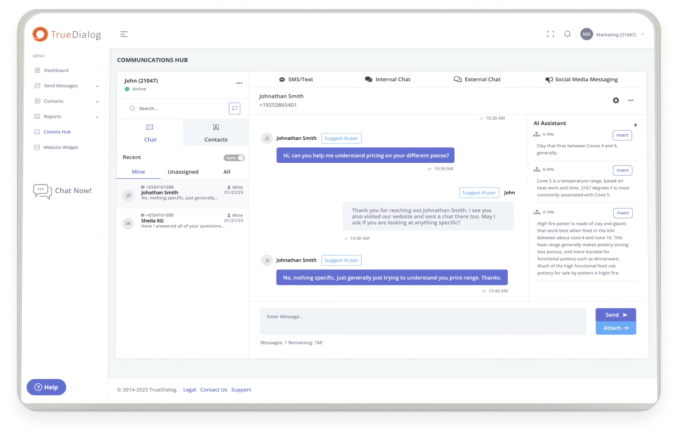


Identifying the best Twilio alternative depends on your particular needs. If your priority is a text messaging platform that’s easy for marketers to use, TrueDialog, SimpleTexting, and EZ Texting are top choices. If you’re looking for more direct Twilio competitors that offer a developer-friendly API, Plivo, Telnyx, Bandwidth, Sinch, and Vonage are worth checking out. For an enterprise Twilio alternative that offers global multi-channel messaging at scale, Infobip and Bird are good options to consider.
If Twilio is no longer working for your team and you’re ready to evaluate your options, this guide will walk you through some of the best Twilio alternatives to consider and why. [a][b]
Twilio Alternatives: Quick Look
| Product | Best For | Platform or API | Customer Support | Notable customers | Support model |
|---|---|---|---|---|---|
| TrueDialog | Enterprise teams wanting an intuitive SMS, MMS and RCS platform with white-glove customer support and intuitive pricing – whether you use our platform or API – or both! | Both | Includes 100% human, U.S.-based support on every plan, staffed by a team with deep SMS expertise – available to all customers by phone, email, or support ticket. TrueDialog answers 90% of tickets within an hour and resolves 98% within 24 hours. | Plans start at $119/month for unlimited users with no additional fee for setup/ integration or markup on carrier fees | Hilton, Coca-Cola, Kansas City Chiefs, Minnesota Wild |
| SimpleTexting | Small businesses wanting an easy-to-use platform for mass texting | Platform | Live chat and phone, but doesn’t publish a response-time guarantee. | Uses a pay-as-you-go model with channel costs billed separately from the platform fee | Telekom Deutschland, Niva Health Insurance |
| EZTexting | Small businesses and nonprofits who want both ease of use and advanced features | Platform | Live chat and a ticketing system, plus a 24/7 self-serve help center. User reviews, however, frequently cite frustration reaching support as message volume grows. | Carriers set pricing, and businesses must request a quote to see RCS costs for domestic traffic | Clairns, Nespresso, Micromania-Zing (GameStop), Doorlist |
| Plivo | Businesses that want a solution similar to Twilio, but more cost effective | API | Ticket portal only and triages issues by priority. Paid support plans set response-time targets; the free tier has none published. | Follows a pay-as-you-go usage-based pricing model with an additional annual fee and carrier surcharges | Has not publicly named its RCS customers |
| Telnyx | Multi-channel support in one platform and carrier-grade services | API | Chat, email, and phone support on every plan, with no extra fee or published response-time SLA. | Has a tiered pricing model with different costs for “Basic Rich” and “Rich Media,” and also charges setup fees in some markets | Has not publicly named its RCS customers |
| Bandwidth | Organizations wanting APIs for voice, messaging, and emergency services | API | Phone, chat, and email support free on every plan. Paid Silver and Gold tiers add SLA-backed response times, higher-level escalation, and a dedicated customer success manager. | Pricing varies by carrier and market, with carrier pass-through fees and verified sender profiles billed as add-ons | Has not publicly named its RCS customers |
| Sinch | Enterprise organizations wanting a CPaaS that brings multiple channels into one place | API | Phone support only during regional business hours, backed by a ticketing system, with no published coverage or response-time SLA. | Pricing varies by destination, and brands are only billed for delivered messages | Amphia Hospital |
| Vonage | Businesses wanting voice, messaging, and video capabilities with global coverage | API | The free tier includes only chat and web support. Reaching email, phone, a dedicated support engineer, or an account manager requires upgrading to a paid Essentials, Premium, or Enterprise plan. | Pricing is not published, and businesses must request a quote | Subway, DHL Express |
| Infobip | Enterprise companies wanting to create omnichannel customer journeys on a global scale | Platform | Support in 14+ languages, plus a dedicated support engineer on enterprise plans, and reports a 90% CSAT internally, though it doesn’t publish response-time SLAs. | Pricing is not published, and businesses must request a quote | Has not publicly named its RCS customers |
| Bird (MessageBird) | Omnichannel communications from a single API | Both | Tiered support by paid plan but doesn’t publish response times or hours on its public pages, so getting specifics means talking to sales. | Advertises transparent pricing, but does not have a published U.S. rate | Has not publicly named its RCS customers |
The Best Twilio Alternatives for SMS

Even if you have a team of great developers on staff, you don’t want them to get bogged down dealing with requests about your messaging platform. A product that’s designed directly for messaging teams — that’s intuitive and requires no coding skills — can make life easier for both your messaging and IT teams.
If that sounds like the right kind of messaging solution for you, these are some of the best Twilio alternatives for your needs.
1. TrueDialog: Best for enterprise teams wanting an intuitive SMS platform
TrueDialog is an enterprise-grade business texting platform that helps organizations improve deliverability, ensure compliance, and send effective text messages with engaging features like rich media and polls. Whether you’re running SMS marketing, customer support, student engagement programs, or sales outreach, TrueDialog is an enterprise Twilio alternative that’s fast and easy to get set up with, including connecting it to your CRM (customer relationship management platform).
Who it’s Best For:
TrueDialog is a strong choice for enterprise organizations wanting an easy-to-use text messaging platform, particularly those in highly regulated industries like healthcare and financial services where compliance features matter most.
Pricing:
Pricing starts at $119 a month, with the most popular plan for enterprise at $900 a month.
Pros:
- Product Breadth: In addition to an API, TrueDialog offers its own platform and native integrations with the most popular CRMs, including Salesforce, HubSpot, and Microsoft Dynamics 365. That makes integration easy to set up, and enables marketing teams to manage omnichannel campaigns and collaborate more easily with sales and customer service.
- Deliverability: TrueDialog runs on its own owned messaging infrastructure and pairs it with TrueDelivery®, its proprietary AI deliverability engine, to review messages before they’re sent — cutting false positives by 50–80% in beta testing, so more messages land instead of getting caught in carrier spam filters.
- Ease of use: The TrueDialog platform is intuitive enough to use that most teams can get started on day one with minimal training. The setup process is fast and easy, and ongoing maintenance needs are minimal. The API is RESTful, and the documentation is clear, easy to understand, and helpful.
- Customer support: Where Twilio charges extra for dedicated customer support, TrueDialog includes it in the price. Support is 100% human, based in the U.S., staffed by people with deep SMS expertise — 90% of tickets answered within an hour, 98% resolved within 24.
- Compliance-ready: TrueOptOut® uses ML-powered intent detection to catch opt-out requests standard keyword matching misses, with an immutable audit trail on every decision — on top of SOC 2 Type II, TX-RAMP Level 1, and ISO 9001 certifications. That’s a real edge for regulated industries.
- RCS (Rich Communication Services): verified branded sender, rich media carousels, quick-reply buttons, and read receipts, all inside the customer’s native messaging app, with automatic fallback to SMS if their device or carrier doesn’t support it. TrueDialog offers native RCS support today, built through its no-code Visual RCS Composer, so marketing teams can launch branded, interactive campaigns without a developer building anything from scratch.
- Unlimited Users: TrueDialog charges for messages sent and for the long code, short code and/or RCS agent used to send the message. Teams can have any number of users on the system at no additional charge.
Cons:
-
- Text-messaging focus: TrueDialog is an SMS platform first and foremost, meaning it’s designed to prioritize text messages more than other communication channels like email and voice.
- US and Canada only: Currently, TrueDialog is focused on helping businesses in the US and Canada.
What Makes It Different:
TrueDialog is designed for communication users — and for developers — making it easy both to get started with and to use day-to-day. The company provides helpful, human support to all customers at no extra cost. And the platform offers several proprietary features including TrueDelivery® (to ensure more of your messages reach the intended recipient), TrueOptOut® (to make sure you catch every opt-out, not just the ones that use standard keywords), and TrueConnect (to make every text visible across every CRM and tool you already use — no middleware, no manual logging).
2. SimpleTexting: Best for small businesses wanting an easy-to-use platform for mass texting
SimpleTexting is an intuitive mass texting platform for small businesses that offers support for MMS, SMS, automated messaging, and tools to help customers build a messaging list.
Who it’s Best For:
SimpleTexting is a strong choice for small businesses sending up to about 3,000 messages a month that want a messaging platform that’s easy to get started with and use.
Pricing:
SimpleTexting uses credit-based pricing, along with charges for the numbers you use and number of teammates that use the platform. Their website gives $39 a month for 500 message credits a month, as an estimate for a typical monthly price.
Pros:
- Ease of use: SimpleTexting has an intuitive interface that’s easy for small business employees to learn and use, even if there aren’t developers on staff.
- Quick setup: Getting started with SimpleTexting is generally fast and easy, with very little technical setup involved.
- Customer support: User reviews of SimpleTexting frequently mention how responsive and helpful their customer service staff is.
Cons:
- Does not support RCS: SimpleTexting offers support for MMS and SMS, but doesn’t yet offer RCS (Rich Communication Services).
- US and Canada only: SimpleTexting only works with customers in the US and Canada.
- Many integrations require Zapier: While SimpleTexting offers a large number of integrations, in most cases, you have to use the third-party tool Zapier to connect them.
What Makes It Different:
SimpleTexting puts what differentiates it right in the name: it’s a “simple” solution. It’s simple to use and offers the main basic features a small business interested in texting. It’s not the most feature-rich solution, but for businesses that want a Twilio alternative for SMS that’s straightforward and intuitive, it’s a good choice.
3. EZTexting: Best for small businesses and nonprofits who want both ease of use and advanced features
EZTexting is a user-friendly text messaging platform that offers bulk messaging along with some more advanced features like automatic translation, payment links, and automated workflows.
Who it’s Best For:
EZTexting is best for small businesses and nonprofits with smaller send volumes that want a platform that’s easy to set up and use, but also provides more advanced features like automated workflows
Pricing:
EZTexting’s pricing starts at $25 a month for the most basic plans, with additional fees based on factors like the number and type of messages you send
Pros:
- Quick setup: Getting started with EZTexting is fast and easy for most customers.
- User-friendly: Reviewers praise EZTexting’s intuitive user interface.
- Automation features: EZTexting lets users set up automated workflows, manage a campaign schedule, and use AI tools for suggested composition and replies.
Cons:
- Confusing pricing: EZTexting’s pricing structure includes fees that make it hard for users to know what to expect come billing time, which can complicate an organization’s ability to scale affordably.
- SMS focus: EZTexting primarily offers support for text messaging, to the exclusion of other types of channels like voice or email.
- Not built for enterprise: While EZTexting can promise TCPA compliance, they lack some features that may be important to enterprise clients like an uptime guarantee and ISO 9001 certification.
What Makes It Different:
EZTexting falls somewhere between the other Twilio competitors in this category: it’s built for small businesses rather than enterprise, but offers more advanced features than SimpleTexting. Features include automated translation services for six languages and text-to-pay links that make it easy to solicit donations.
4. Plivo: Best for businesses that want a solution similar to Twilio, but more cost effective
Plivo is a CPaaS provider that provides APIs for both voice and text messaging. The platform lets customers build conversational AI agents to help handle calls and text message interactions with customers.
Who it’s Best For:
Plivo is a good choice for small businesses and mid-market companies with strong developers wanting a solution that combines voice and SMS capabilities.
Pricing:
Plivo offers pay-as-you-go pricing based on the number and length of calls, messages, and conversations you use. SMS rates start at $.0077 per message.
Pros:
- Call quality and delivery rates: Reviewers say Plivo provides strong call quality and impressive delivery rates for messages.
- Pricing: For its feature set, Plivo has competitive pricing that typically comes to around a third less than Twilio.
- Quick setup: Migration from Twilio is easy because of how similar the platforms are.
Global: Plivo offers global coverage, including over 200 countries.
Cons:
- Learning curve: Some users complain that Plivo’s user interface is unintuitive and takes time to learn.
- Support complaints: Some reviewers complain about the quality and responsiveness of Plivo’s customer support.
What Makes It Different:
Part of Plivo’s appeal as a Twilio alternative is that its functionality is similar, but it comes at a much lower price point. For organizations that like how Twilio works and don’t want to spend too much time learning something new, Plivo is the easiest way to decrease your costs.
5. Telnyx: Best for multi-channel support in one platform with carrier-grade service
Telnyx offers APIs for multiple channels including voice, SMS, email, and WhatsApp. Telnyx owns carrier licenses in over 30 countries, which means they have more control over deliverability and how calls and messages are priced, letting them provide competitive rates.
Who it’s Best For:
Businesses with strong developers who can prioritize competitive pricing and control over simplicity.
Pricing:
Telnyx offers usage-based rates. Message pricing starts at $.004 per message.
Pros:
- Multichannel: Telnyx offers support for multiple channels including email, voice, SMS/MMS, WhatsApp, and even fax.
- Global: Telnyx provides coverage for over 230+ countries and holds carrier licenses in over 30.
- Customer support: According to reviews, Telnyx has a strong reputation for customer support.
- Competitive pricing: Because they own their own network, Telnyx can offer lower rates for calls and messages than many competitors.
Cons:
- Slow onboarding: Some reviewers complain about the time it takes to get started with Telnyx.
- Confusing pricing: Reviewers also complain about the confusing pricing structure.
- Complexity: Telnyx only makes sense for businesses that have experienced developers.
What Makes It Different:
One of the biggest differentiators for Telnyx is that the company owns its own communications infrastructure, meaning they can cut out the middle man, deliver better prices, and promise higher delivery rates.
6. Bandwidth: Best for organizations wanting APIs for voice, messaging, and emergency services
Bandwidth offers voice and messaging APIs, along with a trusted network for communications related to emergency services. Their messaging APIs support SMS, MMS, and RCS.
Who it’s Best For:
Bandwidth is another API provider that owns their own network, which means they can promise reliable services for organizations that need a trusted network for emergency communications.
Pricing:
Bandwidth uses a volume-based pricing model. Message rates start at $.004 per message.
Pros:
- Owned network: Bandwidth’s owned Tier 1 network promises reliability, particularly for high-stakes messages like emergency services.
- Proven record: Bandwidth’s customers include some of the biggest enterprise companies, like Google and Microsoft, which points to a proven reputation.
- Customer support: Many reviews mention account managers that are supportive and helpful.
Cons:
- Support system: While reviewers praise Bandwidth’s support staff, many complain about having problems with the company’s ticketing system for support.
- US focus: While Bandwidth’s network does reach over 65 countries, their focus is ultimately more on serving the US.
What Makes It Different:
Like Telnyx, one of the big selling points Bandwidth offers is owning their own network, which makes them a reliable option for organizations that want voice, emergency, contact center, and messaging services all in one solution.
7. Sinch: Best for enterprise organizations wanting a CPaaS that brings multiple channels into one place
Sinch lets businesses consolidate all their cloud communications channels into one place. They offer enterprise-level compliance and SLAs (service-level agreements), and support SMS, RCS, MMS, WhatsApp, email, and voice.
Who it’s Best For:
Sinch is a good option for enterprise businesses that have strong compliance needs and prefer one platform for all their communications channels.
Pricing:
Sinch’s most basic plan starts at $99 a month, but enterprise clients will need to get in touch with sales for a custom quote.
Pros:
- Ease of use: Many reviewers find the platform intuitive to learn and use.
Multiple channels: Sinch offers broad channel coverage, including SMS, RCS, MMS, WhatsApp, email, and voice. They also provide a single API that covers 13 messaging channels. - Strong compliance and SLAs: For enterprise organizations and businesses in regulated industries, Sinch provides the highest levels of compliance and SLAs to make sure all your bases are covered.
Cons:
- Not good for small business: While they offer a small business plan, the platform’s complexity and cost mean it’s not usually a good fit for small businesses.
- Customer support: Reviewers are mixed on the company’s customer service — some have good experiences, others complain about support that’s unhelpful and unresponsive.
- Longer setup: Sinch typically involves a longer onboarding process than other Twilio alternatives on this list.
What Makes It Different:
Sinch’s main standout feature is the breadth of channel coverage the tool offers, making it easy for customers to manage many communication channels through one provider. The product is also notable for addressing challenges many enterprise companies care about with strong compliance features and SLAs.
8. Vonage: Best for businesses wanting voice, messaging, and video capabilities with global coverage
Vonage offers Communications APIs that cover multiple messaging channels (including SMS, RCS, MMS, WhatsApp, and Facebook Messenger), voice, and video calling.
Who it’s Best For:
Vonage is a good choice for businesses that want to prioritize video as well as messaging and voice, especially if they’re interested in global coverage.
Pricing:
Vonage has a usage-based pricing model. The Messages API starts at $.00129 per message.
Pros:
- Easy to use: Many reviewers find Vonage easy and straightforward to use, once they’ve learned how.
- Impressive documentation: Reviews also praise how extensive and helpful the resources for developers are.
Cons:
- Learning curve: Some reviewers note that the platform takes time to learn before they get used to it.
- Technical issues: Several reviews note technical issues like dropped calls that have a negative impact on business.
- Customer support: A number of reviews complain of issues with getting proper support when there’s a problem.
What Makes It Different:
Vonage is notable for including support for video along with messaging and voice. The company also has a strong reputation for creating helpful developer resources and documentation that make setup and ongoing use easier.
9. Infobip: Best for enterprise companies wanting to create global omnichannel customer journeys
Infobip sells a communications platform that enables cross-channel customer experiences. They support many channels, including SMS, MMS, voice, live chat, RCS, email, and WhatsApp.
Who it’s Best For:
Infobip is a solid choice for businesses with a global presence that want one channel for all their customer communications and AI agents to reduce human labor.
Pricing:
Infobip uses a pay-as-you-go pricing model where rates vary based on channel type and country. Businesses interested in custom pricing can contact the company for more information.
Pros:
- Broad channel coverage: Infobip supports many different channels that are popular with consumers, including messaging channels, voice, email, and some social platforms.
- AI/automation forward: The Infobip platform lets you create AI agents to manage many customer issues automatically, cutting down on the time human employees spend.
- Global reach: Infobip offers coverage in over 190 countries.
Cons:
- Expensive: Infobip can be pricey, and some customers find the pricing model confusing.
- Slow support responses: Many reviewers complain that Infobip’s customer support team is slow to respond when issues arise.
What Makes It Different:
One of the biggest reasons to consider Infobip is its broad coverage — both in terms of channel options and geographic regions.
10. Bird (formerly MessageBird): Best for omnichannel communications from a single API
Bird offers one API that covers multiple channels, including SMS, WhatsApp, Facebook Messenger, email, and chat. It brings customer conversations all into one inbox, so teams can manage an omnichannel strategy in one place.
Who it’s Best For:
Bird is best for mid-market and enterprise businesses wanting an omnichannel solution for customer communications.
Pricing:
Bird has a pay-as-you-go pricing model. SMS rates start at $.0035 per message.
Pros:
- Omnichannel: Bird brings multiple channels into one platform, including SMS, RCS, voice, email, WhatsApp, and Apple Messages.
- Single API: Bird offers one API for SMS, WhatsApp, and email.
- Single inbox: Teams using Bird can access communications from all their different channels in one shared inbox, enabling an omnichannel customer communication strategy.
Cons:
- Buggy: Reviewers complain about the software having bugs that make it hard to use consistently.
- Customer support issues: Many reviews complain about issues receiving customer service.
Technically complex: Bird is not the best choice for beginners or marketers with limited technical skills.
What Makes It Different:
Bird’s selling point is making it easy to manage multiple important channels through one API, meaning teams can provide omnichannel support with fewer vendor relationships.
FAQs
What can I use instead of Twilio?
Twilio has many alternatives with similar SMS functionality. Depending on your business needs, some popular options include: TrueDialog, SimpleTexting, EZ Texting, Plivo, Telnyx, Bandwidth, Sinch, Vonage, Infobip, and Bird.
Who are Twilio’s largest competitors?
Some of the top Twilio competitors in the CPaaS space include Plivo, Telnyx, Bandwidth, Sinch, and Vonage. Other popular options for communications platforms include TrueDialog, SimpleTexting, EZ Texting, Infobip, and Bird. [c][d]
Why is Twilio so expensive?
Twilio combines a pay-per-use pricing model with a number of different fees for services like premium customer support, carrier surcharges, and phone number rental. The costs can quickly add up, especially for growing brands.
Is Plivo cheaper than Twilio?
Yes, Plivo is generally cheaper than Twilio. For example, sending an SMS with Plivo starts at $.0077 per message versus $.0083 with Twilio.
Is there a Twilio alternative for non-developers?
Yes, businesses looking for a communications or messaging platform that’s easy for non-developers to use have options like TrueDialog, EZ Texting, and SimpleTexting.
What is the best Twilio alternative for SMS marketing?
The best Twilio alternative for SMS marketing depends on your particular needs, but some of the top SMS platforms in the space include TrueDialog, SimpleTexting, and EZ Texting.
Next Steps if TrueDialog Sounds Like a Fit
If the description of TrueDialog in this guide sounds like the solution you’re looking for, set up a demo to learn more.