

In an era when cold, impersonal customer service interactions and stale marketing messages have become the norm, people are craving richer, warmer, more interactive brand experiences. And RCS for business (RBM) can help your brand create those personalized, one-on-one connections at scale.
But the first step to succeeding with this new texting standard is finding an RCS provider that meets all of your organization’s needs.
To help you make the best choice, we’ve rounded up the top enterprise RCS vendors and compared them across important criteria, including support, pricing, branding capabilities, and more.
What is RCS?
Rich Communication Services (RCS) is a next-generation messaging protocol that businesses can use to send branded, media-rich, interactive messages to Android and Apple devices through a verified sender identity. It offers modern, app-like interactions in a native messaging interface without requiring your audience to download another app.
If you’re interested in learning more about how RCS works (and what it looks like), check out our Ultimate Guide to Getting Started with RCS.
How We Compared These Providers
Choosing a new service provider is almost always a project, but it’s especially challenging when you’re investing in a platform you’ll rely on to engage directly with your audience. After all, communication technology needs to be reliable (so you can make sure your messages reach your contacts), intuitive (so your team can pick it up quickly), and your provider needs to have expertise in your industry.
To zero in on the best RCS providers for business use, we carefully evaluated several platforms’ RCS infrastructure, customer support model, pricing, and ease of use. We also explored providers’ case studies, success stories, and reviews to understand which verticals they serve and whether they meet their customers’ expectations.

Top RCS Providers for Business, Ranked
TrueDialog
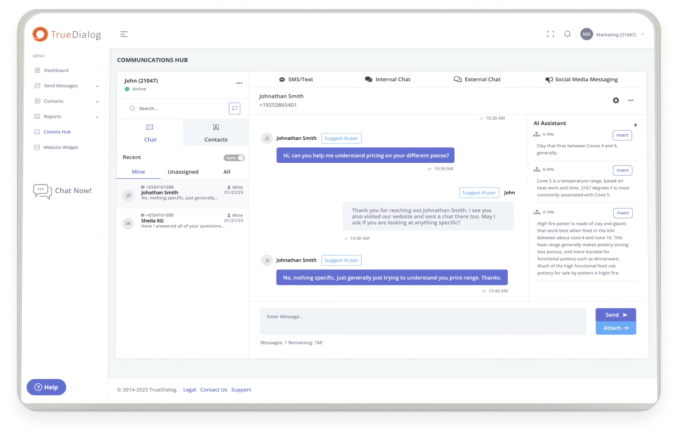
A long-time leader in enterprise SMS marketing, TrueDialog has invested significant time and effort in building an ultra-powerful, user-friendly RCS solution. Its no-code Visual RCS Composer makes it easy to build media-rich campaigns in minutes, and its award-winning U.S.-based support team provides direct, real-time access to experts via phone, email, ticket, or text. The platform also offers transparent pricing with no additional fees for adding new users. Existing customers can easily start using RCS because it’s built directly into the platform (i.e., no separate purchase needed).[a]
Infobip
As a veteran RCS service provider, this UK-based platform has offered RCS services around the world since 2018 and claims to have supported RCS campaigns in more than 60 countries. Additionally, the Infobip team supports its customers with carrier agreements and compliance, and offers a guided web form process for sender registration.
That said, the provider’s pricing structure can get complicated (RCS delivery costs are billed separately from the platform fee) and rates can vary by destination. Additionally, its RCS product is part of an omnichannel suite designed for global enterprises, which can be overkill for organizations with a primarily U.S.-based audience.
Sinch
Sinch is a enterprise-grade messaging platform that offers APIs for developers looking to build better products. The Sinch team claimed its place in RCS by publishing several useful resources, and its case studies boast impressive numbers — especially in the retail space.
On the flip side, although Sinch shares its RCS per-message fees for international traffic, it’s hard to estimate total cost. And organizations have to request a quote to get pricing details for domestic traffic. Additionally, most of Sinch’s success stories are from the European market.
Twilio
Like the other providers on the list, Twilio’s RCS product helps businesses set up a branded RCS Agent and automatically falls back to SMS when a recipient’s device or carrier doesn’t support RCS messaging. The platform offers a developer API to manage contact consent across SMS, MMS, and RCS, and it has a large developer ecosystem for custom builds.
However, while Twilio’s solution is powerful, it can be harder to get off the ground without a team of developers ready to do the heavy lifting. Additionally, former customers are frustrated by Twilio’s support (which can be challenging to access), and its usage-based pricing can make billing complex.
Vonage (Ericsson)
Telecom giant Vonage (purchased by Ericsson in 2022) offers a messaging API that supports both standard SMS and RCS. The platform also includes Vonage Verify, where customers can easily submit their brand for RCS verification, along with a default agent they can use until verification is complete. This way, organizations don’t have to wait until they have their own branded and verified RCS Agent to send interactive, rich messages to their audiences.
That said, because Vonage is an API-first platform, it’s challenging to hit the ground running without the right development resources.
Bird
Bird (formerly MessageBird) offers enterprise-grade compliance, global reach, and Flow Builder, a no-code, visual automation builder that helps businesses develop omnichannel workflows. The provider issues a test API key to developers to get started.
However, some customers have given Bird a low rating for customer support, citing a complex setup process and slow ticket resolution times. Additionally, the platform charges for features like verified sender profiles, dedicated short codes, and priority routing as add-ons. And since this European brand is less focused on the U.S. market, organizations with a large North American presence may want to look elsewhere.
CM.com
Another Netherlands-based RCS service provider, CM.com has plenty of RCS experience because many of its customers are in the European market, where RCS has been the norm for several years. The platform first announced its RCS product in 2020 and has refined it over time. One major advantage of working with this provider is its fair billing model: conversational messages are billed per delivery if there’s no reply and only per conversation when a contact responds.
The challenge is that, while it’s a great fit for European brands, CM.com has less proven experience supporting U.S.-based organizations with RCS. There’s limited information about RCS coverage and support in the U.S. market.
LINK Mobility
A Norwegian provider, LINK Mobility has emerged as a European leader in RCS. The platform boasts more than 47,000 customer accounts and sends more than 10 billion messages per year. LINK also offers powerful reporting and analytics and provides both a developer-friendly portal and an intuitive web platform, depending on customer needs.
But like other providers on our list, LINK has a smaller U.S. presence, which could be an issue for U.S.-based organizations. Additionally, the brand doesn’t publish pricing information, so you’ll need to contact their sales team to get those details.
Route Mobile
Route Mobile’s RCS Business Messaging Hub enables businesses to send rich media messages across a broad, global network and offers QR Codes that open an RCS chat where users can browse products, access support, or make payments. It also includes AI chatbot integrations so brands can quickly send high volumes of personalized messages.
However, the provider doesn’t publicly share pricing details (aside from noting that costs depend on volume and business requirements). Additionally, while Route Mobile largely serves brands in India and emerging markets, it appears to have less experience supporting North American organizations.
Gupshup
Like the other RCS providers on the list, Gupshup offers a product designed to boost customer engagement and help organizations make the most of media-rich, interactive messaging. Juniper Research also named this brand as an “established leader” in RCS for business.
But, like Route Mobile, Gupshup primarily serves India-based enterprises and organizations in other emerging markets. Brands that need a provider with more experience supporting the U.S. market may prefer a different solution.
RCS Provider Comparison Table
Here’s a table that showcases all of the above RCS messaging platforms compared by key criteria:
| Provider | RBM support | Network model | Verified sender support (branded experience) | Pricing model | Notable customers | Support model |
|---|---|---|---|---|---|---|
| TrueDialog | Yes, offers native RCS/RBM support with a no-code Visual RCS Composer and automatic SMS fallback. Also offers RCS in its API | Acts as a Communications Platform as a Service (CPaaS), so messages don’t need to be routed through a third-party aggregator | Yes, supports brands in applying to be a verified sender with a registered RCS Agent with an easy tool for adding colors, logo, and more | Plans start at $119/month for unlimited users with no additional fee for setup/ integration or markup on carrier fees | Hilton, Coca-Cola, Kansas City Chiefs, Minnesota Wild | Has an award-winning U.S.-based white-glove support team that resolves 98% of tickets within 2 hours |
| Infobip | Yes, has offered RCS since 2018 and delivered billions of RCS messages worldwide | Acts as an aggregator/CPaaS and claims to maintain over 800 direct operator connections | Yes, offers a self-service RCS Agent registration | Uses a pay-as-you-go model with channel costs billed separately from the platform fee | Telekom Deutschland, Niva Health Insurance | Offers managed support, though some customer reviews mention long response times |
| Sinch | Yes, offers RCS via an API with SMS/MMS fallback | Acts as an aggregator/CPaaS, and also sells RCS enablement and monetization support to mobile operators | Yes, offers a dashboard for building a brand profile or an API to configure the profile programmatically | Carriers set pricing, and businesses must request a quote to see RCS costs for domestic traffic | Clairns, Nespresso, Micromania-Zing (GameStop), Doorlist | Provides account-based support as well as a public help center, though some reviews mention lengthy downtime |
| Twilio | Yes, supports RCS with automatic SMS/MMS fallback | Acts as a developer-first aggregator/CPaaS | Yes, but does not onboard senders programmatically at scale | Follows a pay-as-you-go usage-based pricing model with an additional annual fee and carrier surcharges | Has not publicly named its RCS customers | Has a tiered support model, with the lowest tier offering only web and email-based support and an estimated three business day resolution time |
| Vonage | Yes, offers RCS (via an API) that runs on Google’s RBM servers | Acts as an aggregator/CPaaS, and is owned by Ericsson (a network-equipment vendor) | Yes, supports custom branded RCS Agents and offers a “default agent” brands can use while they await verification | Has a tiered pricing model with different costs for “Basic Rich” and “Rich Media,” and also charges setup fees in some markets | Has not publicly named its RCS customers | Offers a tiered support model based on coverage speed and channels, with the free tier offering only web and chat support (and only during standard business hours) |
| Bird | Yes, offers RCS with automatic SMS fallback | Acts as a CPaaS and claims to have direct carrier partnerships in major markets | Yes, supports branded RCS Agents with a simple setup within its workspace | Pricing varies by carrier and market, with carrier pass-through fees and verified sender profiles billed as add-ons | Has not publicly named its RCS customers | Does not publish details about support, though customer reviews score the company low on ticket resolution and mention fees for basic support services |
| CM.com | Yes, has offered RCS since 2020 and predominantly serves the European market | Acts as a CPaaS with operator partnerships | Yes, supports branded RCS Agents with a convenient setup workflow | Pricing varies by destination, and brands are only billed for delivered messages | Amphia Hospital | Offers self-service support with AI chatbot handover to human support during business hours, but some customer reviews mention delayed responses |
| LINK Mobility | Yes, has emerged as a leader in RCS, especially for the European market | Google-certified provider that acts as a CPaaS and works with mobile network operators in Europe | Yes, offers setup support so brands can get verified by Google and mobile networks | Pricing is not published, and businesses must request a quote | Subway, DHL Express | Provides a hybrid customer support model with both human assistance (in your local language) and AI-powered support, though some reviews mention delayed responses |
| Route Mobile | Yes, supports RCS with the majority of its clients in India and emerging markets | Acts as a CPaaS and is owned by Proximus (a carrier group) | Yes, offers verified sender support as part of its core features | Pricing is not published, and businesses must request a quote | Has not publicly named its RCS customers | Relies heavily on conversational AI for customer support, though reviews mention it has reliable assistance |
| Gupshup | Yes, offers RCS and primarily serves organizations based in India | Acts as a conversational platform/aggregator with operator partnerships | Yes, supports branded RCS Agents setup via its onboarding framework | Advertises transparent pricing, but does not have a published U.S. rate | Has not publicly named its RCS customers | Uses conversational AI-powered customer support, and customer reviews mention slow turnaround and inconsistent responses |
Why TrueDialog for Enterprise RCS
As you can see, when it comes to choosing a reliable RCS provider, TrueDialog’s breadth of choice is hard to beat.
First, RCS is included in the existing platform, so customers can start using RCS without re-platforming or buying a different product. Additionally, the visual RCS composer makes it easy to build media-rich messaging campaigns without developer support. For companies wanting an API for its developers, TrueDialog’s API has RCS included, with RCS planned for Salesforce, HubSpot, and Microsoft Dynamics integrations. You never need to worry about surprise fees since TrueDialog doesn’t charge for setup or integrations, or add markups on carrier fees.
You’ll also have the peace of mind and reliability that comes with enterprise-grade compliance and infrastructure. And unlike many competitors, TrueDialog gives every customer access to our award-winning, U.S.-based, human-first support team — no matter which plan you choose. Finally, with automatic SMS fallback, you can rest assured that your messages will always reach your audience, even if their device or provider doesn’t support RCS messages.
In other words, if you’re looking for an RCS service provider that can scale with your organization and provide reliable, hands-on support when you need it most, TrueDialog is the leading choice.
Ready to learn more? Request a demo to see TrueDialog RCS business messaging in action.
FAQ
What’s the best RCS provider for enterprise businesses?
Based on criteria like reliability, support, pricing transparency, and customer sentiment, TrueDialog is the best RCS provider for enterprise businesses.
Is RCS better than SMS for business messaging?
While SMS is still an excellent option for reaching audiences with short, timely messages, RCS lets businesses deliver a richer, more immersive brand experience within their audience’s texting inboxes. RCS business messaging supports longer messages, high-resolution images, high-definition videos, PDFs, GIFs, and customized call-to-action buttons, plus branded and verified sender profiles.
What should you look for in an RCS provider?
When comparing RCS providers, businesses should consider platforms’ RCS infrastructure, customer support model, pricing, and ease of use. It’s also a good idea to check customer reviews to make sure the provider you choose has a positive track record serving organizations like yours.