

The best marketing leaders are also the most discerning. And while much of that comes from years of honing your intuition, it’s also about avoiding shiny object syndrome and instead making decisions using something much more concrete: cold, hard data.
So while we could spend hours singing the praises of Rich Communication Services (RCS) and lauding the slick, modern messaging experience it enables, seasoned marketers know the real proof is in the numbers. (After all, it doesn’t matter how flashy and powerful something is if it doesn’t move the needle.)
Fortunately, one of the greatest benefits of RCS as an enterprise text messaging channel is that it allows you to track and measure far more than traditional SMS texting. And in this blog post, we’re sharing exactly how to measure RCS success so you can determine what’s working and make decisions with confidence.
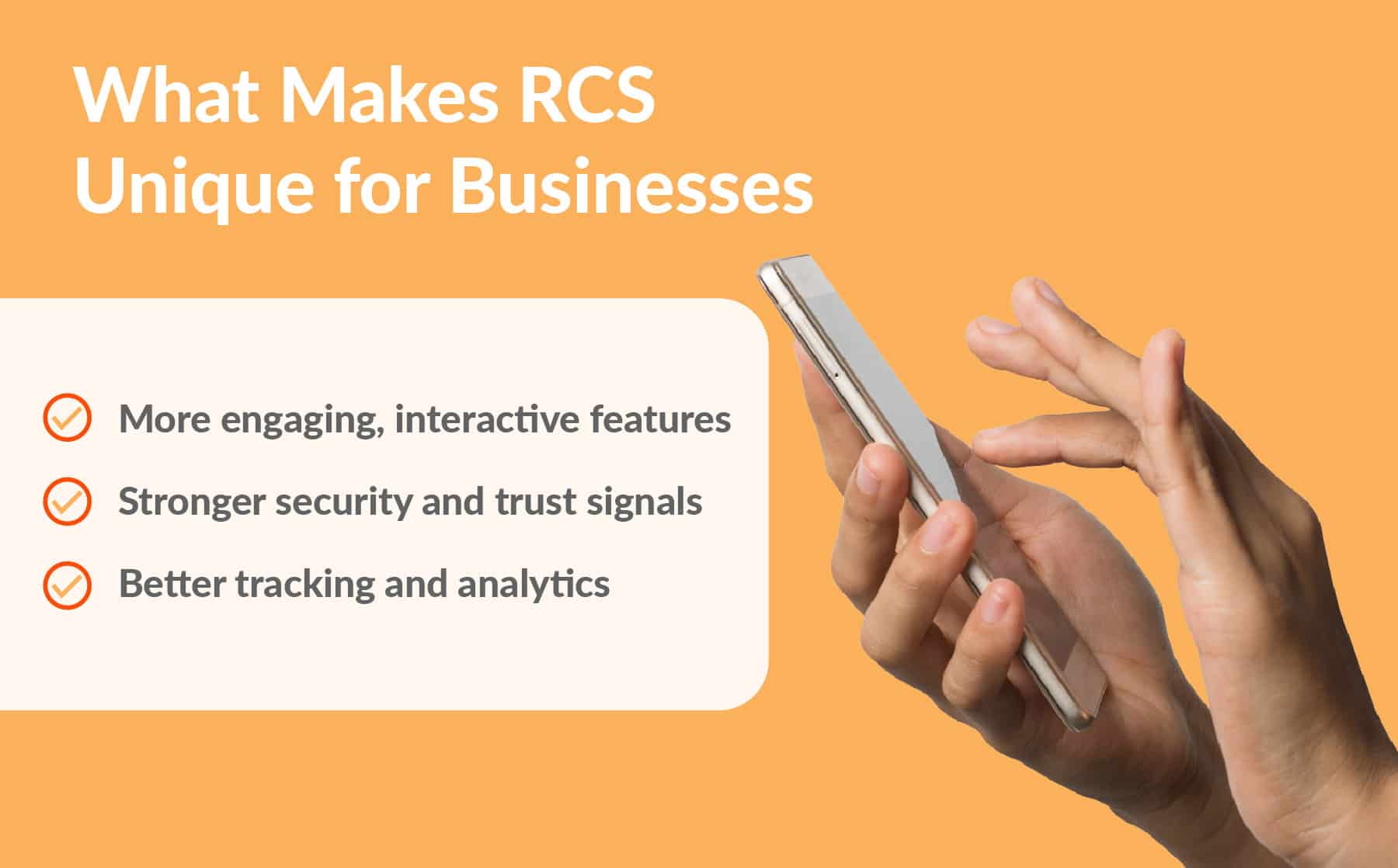
What Makes RCS Unique for Businesses
Before we jump into tracking RCS success metrics and setting KPIs, let’s back up a bit. If you’re still new to the idea of RCS, you’re probably wondering what makes it so great, and why it seems every brand is suddenly clamoring to adopt it.
RCS is a newer messaging protocol that allows businesses to deliver rich, highly immersive communication experiences directly to their audience’s regular texting inbox. It looks and feels like a cutting-edge third-party app, but doesn’t require your contacts to download anything special. So long as they have an RCS-compatible device and a mobile carrier that supports it, they’ll automatically receive these types of messages.
While RCS has been around for a while and has enjoyed widespread adoption in the EU and the U.K. for over a decade, it’s only recently become popular in the U.S. and as a marketing and business communication channel. (And that’s largely because it took several years for mobile carriers to align on RCS and even longer for Apple to support it.) Now, it’s taking off.
There are a few reasons RCS is great for business use:
-
More engaging, interactive features
With RCS, you can send high-resolution images, GIFs, PDFs, image carousels, and high-definition videos. You can also include customized CTA buttons and one-tap reply buttons that make it easy for recipients to respond, as well as message reactions, typing indicators, and read receipts to make conversations feel more genuine.
-
Stronger security and trust signals
RCS communications are encrypted in transit, and end-to-end is also available (in supported apps), which helps keep conversations private and secure. Plus, as a verified sender, you can include your brand’s logo and colors in the messaging experience, along with a verification checkmark that shows your brand has been approved by mobile carriers.
-
Better tracking and analytics
RCS offers greater visibility into how your messages are performing, including metrics like open rates, response rates, and click-throughs, as well as insights into how people interact with specific elements (such as how many people tapped a quick-reply button).
Setting Goals and Defining RCS Campaign KPIs
There’s no singular “best” way to track RCS campaign performance. For most organizations, it comes down to your unique objectives and what you hope to accomplish by sending RCS messages to your audience. For instance, a healthcare organization sending appointment reminders will have different goals than a sports venue promoting ticket sales.
In other words, the first step in how to measure RCS success is to define what success looks like for your organization and the specific campaign you’re sending.
Start by identifying your primary objective. For example, do you want to increase conversions, boost engagement, drive event attendance, or reduce call volume for your customer support team? Clarifying this up front will help make sure you’re tracking the metrics that truly matter (rather than just vanity metrics that won’t inform your next move).
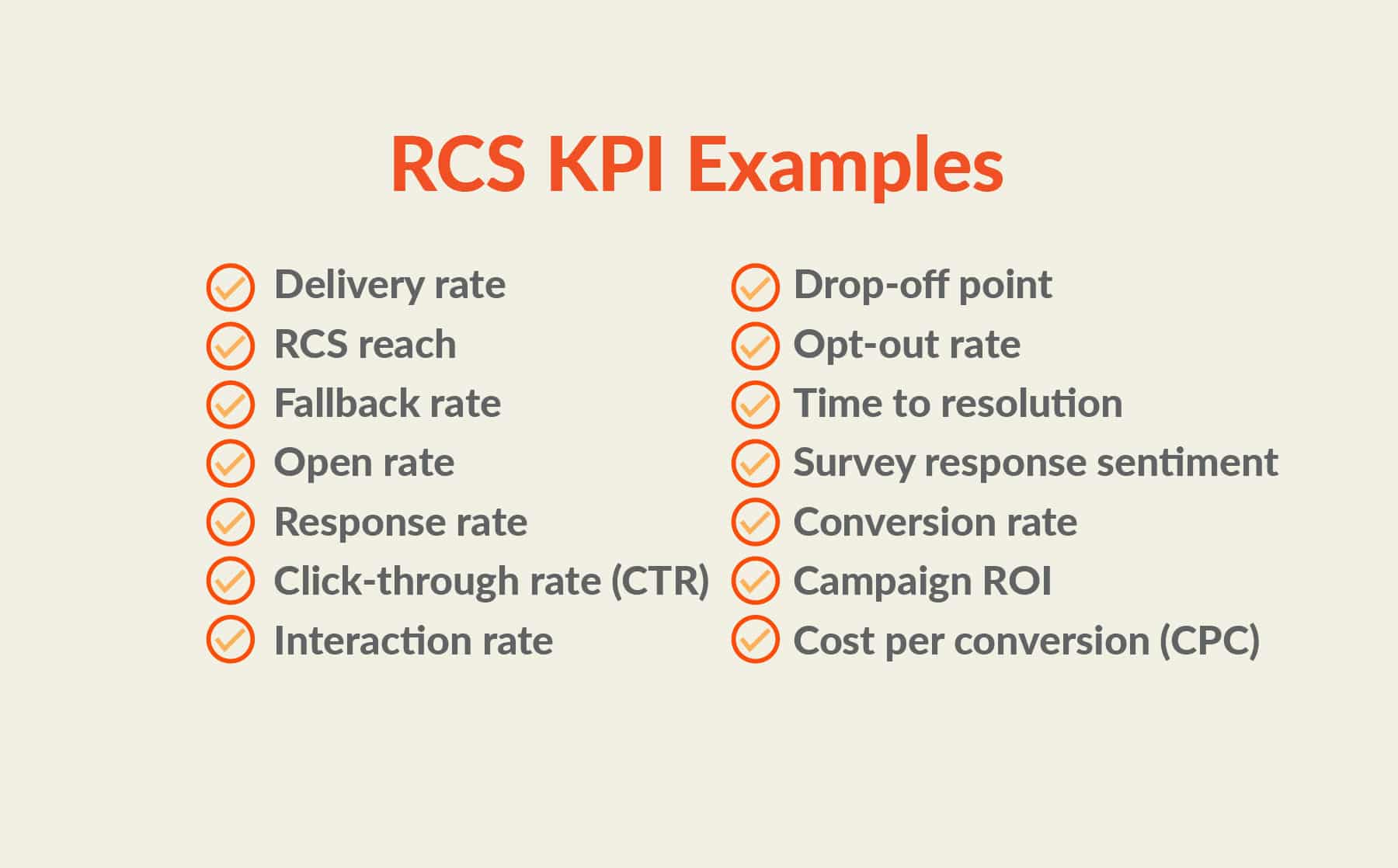
Here are several RCS KPI examples:
-
Delivery rate
This is the percentage of messages that your brand successfully delivered (out of the total number of messages you sent). It’s a standard texting metric that you can also track with SMS campaigns.
-
RCS reach
This is the percentage of messages delivered as RCS (out of the total number of messages sent).
Remember that some members of your audience may use a carrier or device that does not yet support RCS. In those cases, using SMS fallback ensures they’ll still receive the message even if it’s stripped of any rich elements.
-
Fallback rate
This is the percentage of messages delivered as SMS/MMS (i.e., the opposite of RCS reach).
-
Open rate
This is the percentage of messages your audience opened or viewed.
-
Response rate
This is the percentage of recipients who replied to a message you sent.
-
Click-through rate (CTR)
This is the percentage of recipients who tapped a CTA button or link within a message you sent.
-
Interaction rate
This is the percentage of recipients who engaged directly with an interactive element in a message you sent, such as a carousel or quick-reply button.
-
Drop-off point
This is the moment a recipient in a multi-step journey stops engaging with your content. For example, a contact might tap a quick reply button but stop engaging after you send a response.
-
Opt-out rate
This is the percentage of recipients who unsubscribe after receiving a text or campaign. It’s a great metric for identifying when a message was irrelevant or ill-timed, or when you’re bombarding your audience with too many messages.
-
Time to resolution
This is the time between a customer’s request for assistance and the resolution of their question or concern. It helps determine when your customer service team is backlogged.
-
Survey response sentiment
This method of gauging audience sentiment is helpful because it’s also highly customizable. For example, if you want to measure customer service satisfaction, you might follow up on a support request with the survey question, “Please rate your customer service experience on a scale of 1 (Terrible) to 5 (Wonderful).”
-
Conversion rate
This is the percentage of recipients who complete an action (such as scheduling an appointment, clicking a link, or completing a purchase).
-
Campaign ROI
This is the total revenue earned from a campaign. It’s usually measured as:
[(Total Revenue – Total Cost) / Total Cost] × 100 = ROI
-
Cost per conversion (CPC)
This is the number of conversions, relative to the amount spent on the campaign. RCS marketing ROI is usually measured as:
Total Campaign Spend / Total Conversions = CPC
Tools and Methods to Track RCS Metrics

Now that you have a better idea of what to track, the next step is to plan how you’ll monitor and measure these metrics. Because RCS supports so many more elements than traditional text messaging, it’s important that you adopt the right tools and strategies to track RCS campaign analytics.
Analytics Platforms and Dashboards
Most enterprise RCS providers offer built-in analytics dashboards that allow you and your team to monitor your campaigns in real time. (It’s worth noting that your SMS platform may already do this if they also support RCS.)
Additionally, so long as your texting solution integrates with your CRM and marketing automation tools, you can connect RCS data to broader performance-tracking efforts and gain a more complete understanding of your performance across larger marketing and customer support initiatives. (Which can be more useful in informing big-picture decisions than viewing RCS performance in isolation.)
For example, a university might track how many prospective students clicked a link in an RCS campaign versus an email campaign to understand which channel various segments prefer. Or, a healthcare organization might track patient sentiment from an RCS survey as part of a larger effort to improve patient satisfaction.
ROI Calculations and Revenue Impact Metrics
It’s always a good idea to track how your efforts impact revenue — especially because it’s one of the first things executives will ask to see. And it’s usually the best way to justify budget increases.
Calculating ROI on an ongoing basis can help your organization determine whether your efforts are driving measurable value and demonstrate their importance in achieving broader business goals. That said, there are a few ways to calculate ROI. Once again, your method will depend on your organization, what you’re hoping to accomplish, and how you manage your marketing and communications efforts.
For example, calculating ROI involves comparing campaign revenue against total campaign costs, but what you consider campaign costs can vary. For some organizations, that includes messaging fees and platform expenses, while others may also factor in internal resources (such as creative development).
Of course, ROI is just one impact metric. In some cases, you might want to evaluate more specific metrics, such as whether a campaign reduced call volume or time to resolution (thereby freeing up agent resources), sped up payment collection, or increased customer retention.
Session Duration, Engagement, and Conversion Metrics
One of the greatest advantages of RCS is that it not only allows you to create more immersive and engaging experiences but also provides greater insight into how your contacts interact with each element of those experiences.
For example, in addition to sending a high-resolution carousel of product images, you can also track how many contacts engaged with the carousel, which cards they viewed, and whether or not they clicked any CTAs. You can also track session duration to determine how long your audience engages with a conversation flow and when they’re most likely to drop off.
And often, by connecting your RCS analytics tools to your existing tech stack, you can understand how those interactions affect engagement throughout the entire customer journey. For example, you can see whether rich media engagement correlates with faster purchases, or whether contacts with longer RCS session durations are more or less likely to call customer support.
Advanced Strategies to Improve RCS Performance
Once you’ve chosen the metrics you want to measure and chosen your RCS campaign tracking tools and strategies, and measured long enough to have baseline data, it’s time to start looking for opportunities to optimize your performance.
Here are two things you can do to help you drive better results:
A/B and Holdout Testing
Tests are crucial to success in RCS, especially in the beginning when you’re still learning what works and what doesn’t. Because there are so many elements (such as rich visuals and customizable interactive experiences), and because even small adjustments can have a significant impact, you’ll want to experiment to better understand what your audience prefers.
With A/B testing, you can compare two variations of your campaign, such as CTA button copy, media type, send times, or offer type. For example, a sports team might test whether a highlight-reel video or a static graphic is more effective at driving traffic to a ticket sales page.
Holdout testing, on the other hand, involves intentionally withholding a campaign from a portion of your audience and then comparing outcomes between those who received the message and those who did not. For example, a software company might test whether people who received reminders 24 hours and 1 hour before a webinar were more likely to attend than those who received only a 1-hour reminder.
Personalization and Audience Segmentation
As a marketing leader, you know that generic messaging rarely delivers the same results as communications tailored to your audiences’ unique needs and preferences. And with RCS, there are plenty of ways to personalize experiences for your contacts.
For example, you can use purchase history to influence recommendations and compile custom product carousels based on what they’re most interested in. Or, you might tailor offers and visuals to different geographic locations. For example, a fintech platform might send educational content about disaster recovery loans to contacts in areas recently hit by severe weather, or create customized maps of nearby ATMs for each metro area it serves.
Future Trends in RCS Analytics
We’re already seeing businesses of all sizes drive some pretty incredible results with RCS, and expect to see even more as adoption continues to rise. But simply launching an RCS campaign isn’t always enough to move the needle — you also have to carefully test, track performance, and optimize as you go. And knowing how to measure RCS success will help ensure you get the most out of your efforts and unlock the full potential of this incredible messaging protocol.
Ready to see what RCS can do for your organization? Request a demo to discover the power of RCS first-hand.