

For marketing and business leaders, Rich Communication Services (RCS) can feel like a dream come true.
This newer texting protocol gives you an instant, direct line to your audience that looks and feels like a sleek, modern app experience, complete with high-quality visuals and interactive features, delivered straight to their native text messaging inbox. Plus, messages come from a verified brand profile, alleviating any suspicion of spam or scams. What’s not to love?
Of course, despite its mesmerizing benefits, launching RCS doesn’t guarantee success. As with any new technology or tool, there are ways to do it right and ways to do it very, very wrong.
Today, we’re walking through some of the most dangerous RCS mistakes brands can make so you can avoid them from the jump.
Why RCS Campaigns Fail Without a Clear Goal
First, the most important thing you can do when you begin building your RCS campaigns is to set a well-defined goal. In fact, many of the mistakes we highlight below are a direct result of failing to define a campaign’s purpose, and taking the time to do so can prevent a lot of headaches down the road.
When you don’t set a clear objective, there’s a good chance that you and your team will waste a lot of time and energy spinning your wheels in too many directions. In our experience, brands new to RCS sometimes try to do too much at once, then become frustrated when their results fall short of expectations.
On the flip side, knowing what you want to accomplish will help make sure your efforts are well aligned and that you’re building the right experience and measuring the appropriate metrics. And the more specific you can make your goal, the better you’ll set yourself up for success. (For example, a healthcare organization may create an RCS campaign to reduce missed appointments, while a sports venue might use RCS messages to boost ticket sales and upgrades.)
With a concrete goal in mind, teams can effectively segment their audience, create relevant visuals, write compelling CTA copy, and choose appropriate KPIs. It helps everyone stay on track and also makes it easier to identify what you need to optimize to improve your results over time.
Common RCS Campaign Mistakes that Undermine Performance
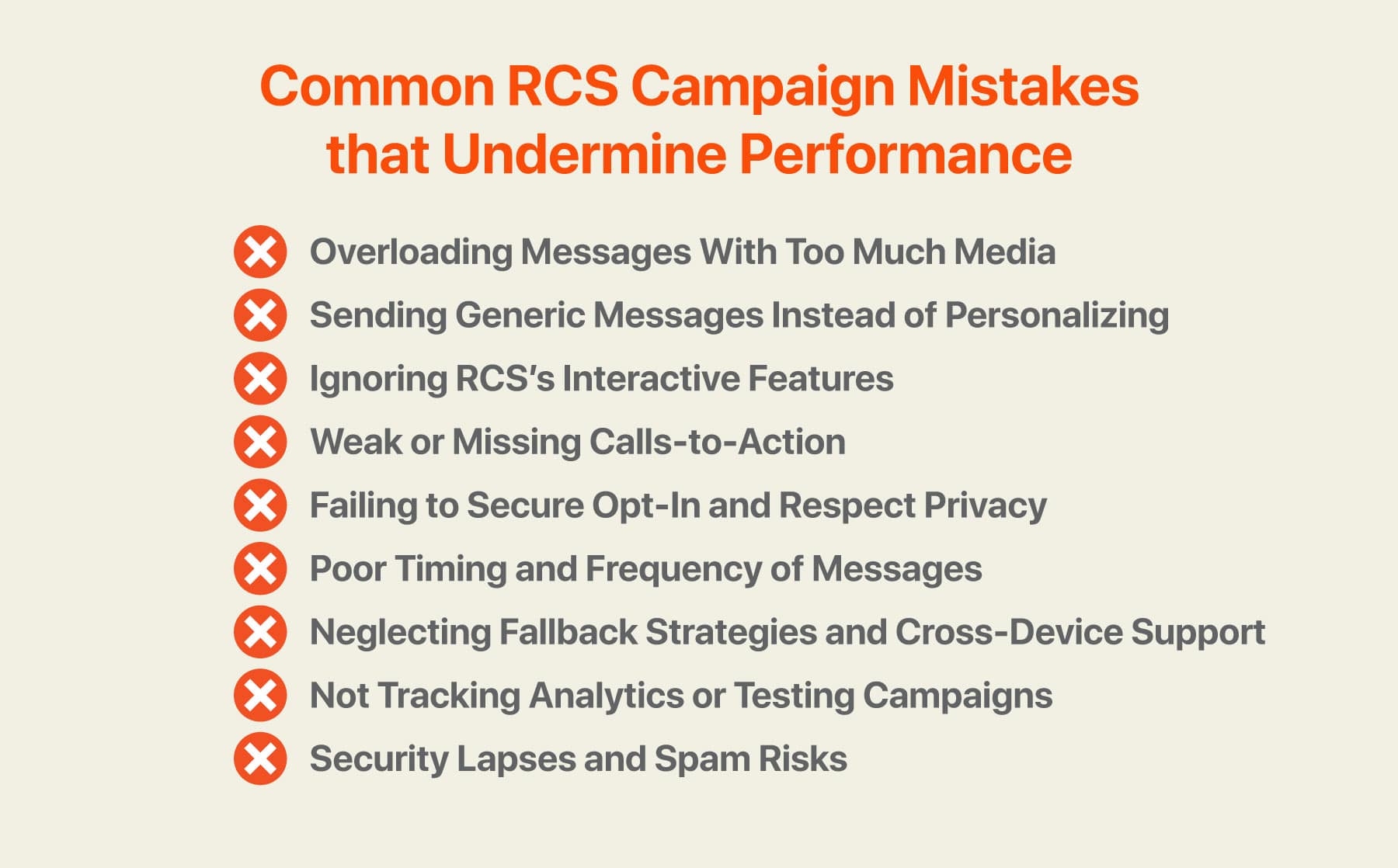
It can be incredibly frustrating to invest time and resources into learning about, building, and launching a promising initiative, only for it to fall flat – especially in a time when marketing and communications teams are feeling pressured to stretch their budgets more than ever. (In fact, even the suggestion that RCS could flop is enough to keep some brands from adopting it.) But the truth is, when RCS doesn’t pan out the way an organization expects, there’s usually a pretty good (and entirely avoidable) reason.
To help you get the most from RCS and generate better ROI from your campaigns, take time to consider these common mistakes and our tips for steering clear of them:
1. Overloading Messages With Too Much Media
RCS offers tons of impressive features, and it can be tempting to use as many as you can. But while elements like high-resolution images, videos, GIFs, PDFs, and carousels can certainly improve your engagement rates, overloading messages with too much media at once can overwhelm recipients and distract from your message. Additionally, attempting to do too much can clutter the user experience, slow load times, and make your content look overly promotional or spammy.
Instead, we recommend being intentional with your media and only including the elements that make the most sense for the user journey. Ask yourself, “What is the primary action I want a recipient to take?” Then, choose a couple of rich media elements to help support that goal. For example, a B2B tech company might use a carousel to highlight the top three most compelling features of a new product, along with a CTA to schedule a demo.
2. Sending Generic Messages Instead of Personalizing
Sending an RCS message without personalization is like opening a five-star restaurant and serving frozen dinners. You’re not only limiting your full potential, but you’re disappointing your audience in the process.
RCS is designed to create interactive, immersive conversational experiences, and tailoring your messages to each recipient ensures they feel recognized and valued as an individual. It also gives you an opportunity to prove your ability to meet their unique needs. (In other words, it’s well worth the extra effort.)
For example, instead of sending a vast catalog of graduate programs to every current undergrad, a university might send a curated list of programs customized to each student’s current academic track and the prerequisites they’ve already completed.
Your organization has a wealth of audience data and behavioral insights at your fingertips, so be sure to use them to improve the experience whenever possible. Even small touches, like using a recipient’s first name or referencing a recent interaction, can make RCS campaigns feel more relevant and worthy of engagement.
3. Ignoring RCS’s Interactive Features
Another major mistake brands make with RCS is using it exactly like traditional SMS. That is, sending enterprise messages in RCS format, but only including plain text and failing to take advantage of the ability to send high-quality visuals, custom CTA buttons, maps, or other interactive experiences. Much like skipping personalization, this significantly limits your potential and causes you to miss out on one of this technology’s greatest strengths: creating more modern and convenient audience experiences.
Instead, look for ways you can design your campaigns for interaction (rather than just delivery). For example, a healthcare organization might include tappable buttons for appointment reminders that allow recipients to confirm or cancel with one simple action. Or, the team might embed a map or PDF containing pre-appointment paperwork and other details. Whatever the case, RCS offers plenty of opportunities to simplify the user journey through interactivity, and it’s wise to take advantage of them.
4. Weak or Missing Calls‑to‑Action
As mentioned earlier, it’s vital that you have a clear objective in mind for every campaign. And a big part of identifying your goal is asking yourself exactly what you want your audience to do. In other words, once a recipient opens the message, what action would you like them to take?
Without a strong call to action (CTA), your audience might engage with your content without completing the step you want them to take, which is the entire point of building and sending your campaign in the first place. For example, a software company might send a campaign to boost registration for an upcoming conference. But without a clear CTA (such as “Reserve Your Spot” or “Get Your Ticket”), your audience may read the message as a simple announcement or reminder and fail to engage further.
Of course, you also don’t want to use too many CTAs or create decision fatigue either. Instead, keep it to one primary CTA per message, and make it obvious and easy to follow.
5. Failing to Secure Opt‑In and Respect Privacy
Per industry regulations, businesses must obtain prior consent from each recipient before sending a single text message. Forgoing this step can lead to steep statutory fines (typically $500-$ 1,500 per unsolicited message) and even class-action lawsuits. Additionally, mobile carriers may block your organization from reaching their customers, effectively silencing your brand on this channel forevermore.
But legal concerns aside, skipping opt-in processes is also just bad for business.
Sending unsolicited text messages is a clear violation of privacy, looks spammy, and can irreparably destroy customer relationships. After all, many people see their text message inbox as precious real estate, and they don’t give their numbers out to just anyone.
6. Poor Timing and Frequency of Messages
Of course, even if your audience does grant you access to their text message inboxes, that doesn’t give you carte blanche to message them as much as you want or at any time you please. Even the most relevant and beautifully designed campaigns can begin to feel like spam if you’re constantly bombarding your audience with communications or interrupting them in the middle of the night. (Plus, sending messages after hours could violate quiet hours regulations and lead to expensive legal consequences.)
Instead, be mindful of how frequently you reach out to your audience and when those messages land on their devices. When planning out your campaigns, take time to consider time zones, business hours, customer preferences, holidays, cultural norms, and campaign urgency. A good rule of thumb is to limit your communications to just one promotional message per week. For transactional messages, like reminders and alerts, cap it at three per event and space them out as much as makes sense.
7. Neglecting Fallback Strategies and Cross‑Device Support
RCS adoption has advanced significantly over the past couple of years, and today, nearly every new mobile phone and major carrier supports this type of messaging. But, that said, it’s still not available on every device, and SMS remains the universal texting protocol.
As a brand, the best way to take advantage of RCS without sacrificing the reach of traditional texting is to leverage SMS fallback. This way, if a recipient cannot receive an RCS message for any reason, your messaging platform will automatically route it as an SMS text instead. And while the fallback message won’t include the interactivity and rich media elements available through RCS messaging, using this process ensures no one is left out of the conversation.
Of course, it all comes down to the enterprise texting software you’re using to send your messages. If you haven’t already, make sure the solution you use supports SMS fallback for RCS messaging.
8. Not Tracking Analytics or Testing Campaigns
You can’t manage what you don’t measure, as the saying goes. Fortunately, RCS allows you to measure a lot
Unlike SMS, which is limited to delivery metrics, RCS messaging allows brands to track clicks, opens, engagement with specific elements, and more. Armed with this data, you can make more informed decisions about message content and optimize accordingly. But that’s only if you take the time to select and monitor campaign KPIs via your RCS and SMS platform. Too often, brands forgo this step and then struggle to identify why some efforts work while others underperform
Additionally, it’s important to test new campaigns to ensure everything renders correctly for your recipients and to A/B test variables such as timing, copy, layout, and personalization strategies. The more you track and measure, the easier it will be to scale and grow your success.
9. Security Lapses and Spam Risks
One of the greatest benefits of RCS is its security features. For example, verified sender profiles make it much more difficult for bad actors to spoof or impersonate real brands, and encryption helps protect messages while they’re in transit between your enterprise messaging solution and your audiences’ devices. That said, even with more robust privacy and security protections in place, you shouldn’t rest on your laurels.
Take time to double-check your internal security and data privacy efforts and avoid working with third parties that don’t uphold the same standards — especially if your organization is part of a highly regulated industry.
For example, because TrueDialog supports high-profile brands in higher education, financial services, and healthcare, the solution is highly committed to reducing legal and regulatory risk. In addition to leveraging multi-factor authentication, the platform also meets SOC 2 Type II and TX-RAMP standards, and uses an ISO-certified cloud data center.
Final Takeaways for Better RCS Results

RCS messaging is incredibly powerful and brings modern messaging to your audience’s native texting app. It gives brands the ability to connect in ways marketers previously only dreamed about, and engage recipients with polished, highly immersive experiences. But that’s only if you use it to its full potential.
By being thoughtful about your campaigns, avoiding the mistakes outlined above, and not diving in without a well-formed plan, your brand can make the most of RCS.
FAQs
What are the most common mistakes businesses make in RCS marketing?
The most common pitfalls brands make when launching RCS messaging are:
- Failing to set a clear goal
- Overloading messaging with too much media
- Skipping personalization
- Ignoring interactive features
- Leaving out a compelling CTA
- Not obtaining explicit consent before sending messages
- Sending messages too frequently (or at the wrong times)
- Failing to set up SMS fallback
- Not testing campaigns or tracking the right metrics
- Not doing enough to prevent security and privacy risks
How can I avoid overloading my RCS messages with media?
Before you choose the media you’ll include in your RCS messages, take a moment to consider your primary objective, the audience journey, and how you can make it easier for recipients to take the desired action. Then, include only the elements that will help you achieve your goal. For example, if you want your audience to confirm an upcoming appointment, there’s no need to muddy the waters with an image carousel about new products and services.
Do I need explicit consent before sending RCS marketing messages?
Yes, organizations should always obtain explicit, verifiable consent (also known as express written consent) before sending marketing messages via RCS, SMS, or any other texting protocol. Skipping this step can lead to lofty fines, carrier blocklisting, and even lawsuits.