

We’ve entered an era where trust isn’t just harder to come by, it’s also much easier to lose. And it’s no mystery why. Today’s consumers are bombarded by spam across nearly every digital channel, frustrated by poor customer service experiences, and, thanks to spikes in cybercrime, increasingly wary of how organizations use their data.
That said, brands do have an advantage over other institutions. In fact, according to a recent Edelman survey, people have more trust in brands than the media, the government, and even their own employers. So, while consumers may be watching more closely, they’re also willing to place their trust in organizations that consistently meet their expectations.
Here’s how you can use enterprise SMS and RCS to show up well, and even earn back the trust you’ve lost:
Why Consumer Trust is Declining
It’s easy to see the macro reasons why trust has eroded over the past few years, and you’ve likely experienced many of those challenges as a consumer yourself:
-
Digital privacy and security concerns
There was a time when data breaches were breaking news. But today, it seems almost inevitable — especially as cybercriminals find new ways to weaponize AI. Additionally, consumers have become increasingly aware of how brands monetize customers’ personal information, making them a little more skeptical about sharing personal details. Without insight into how brands use their data and protect against identity theft, it’s easy for audiences to assume the worst.
-
Overmarketing, misinformation, and spammy promotional tactics
Customers are constantly wading through a barrage of emails, push notifications, ads, robocalls, and other digital communications. As digital tools make it easier for organizations to reach their audiences, marketing volume has increased exponentially. Unfortunately, though, personalization and relevance don’t always keep pace, and these messages don’t always communicate clear value. Some organizations focus on the number of touchpoints rather than their quality, which leads to marketing fatigue. In some cases, this less-authentic messaging can appear dishonest and even predatory.
-
Economic uncertainty
With ongoing inflation, skyrocketing costs, layoffs, and global economic instability, consumers are becoming more judicious about how much they spend and where they spend it. When budgets are tight and people have to stretch their dollars further, they’re much less likely to tolerate poor customer service interactions or questionable business practices. In other words, economic uncertainty is putting many brands under a microscope.
-
Failure to adhere to social values
As we’ve seen over the past few years, today’s consumers expect brands to make good on their promises, and that extends to their commitment to upholding various social values. When brands fail to act responsibly or change course on issues like sustainability, diversity, and ethical business practices, consumers notice. Even short-term boycotts and consumer outrage can have lasting reputational consequences for brands.
-
Poor communication during critical moments
There are few things consumers find more frustrating than vague messages, delayed responses, or outright silence — especially when they’re grappling with issues like service outages, billing issues, shipping delays, or emergencies. Failing to keep your audience informed (or, worse, providing them with the wrong information) is a surefire way to lose even your longest-term and most loyal customers.
The Impact of Lost Trust on Loyalty and Revenue
While some brands might shrug off waning trust as solely a marketing or customer service issue, it has ripple effects across the entire organization. And if you don’t take appropriate measures to resolve it, lost trust can have significant financial repercussions.
When customers lose trust in your brand, they’re less likely to make repeat purchases, renew contracts, or refer your brand to their peers. And given it costs roughly five times more to earn a new customer than to retain an existing one, you can see how quickly lost trust can balloon your marketing expenses.
Of course, not only does losing trust put existing customer relationships at risk, but it also makes current and future prospects more skeptical about spending their money with you, too. (This is especially true if you’re grappling with negative reviews and poor public sentiment around your brand.)
The challenge, in some cases, is helping senior leadership recognize just how fragile consumer trust is today and how certain organizational efforts designed to reduce expenses can be detrimental to building trust (and therefore cost your brand more in the long run).
According to PwC, while 90% of executives think customers have high trust in their companies, only 30% actually do. And the ongoing quest to boost efficiency, coupled with reduced headcounts and tighter budgets, can make it more challenging to deliver the types of experiences that drive consumer confidence.
Strategies to Earn Trust Back
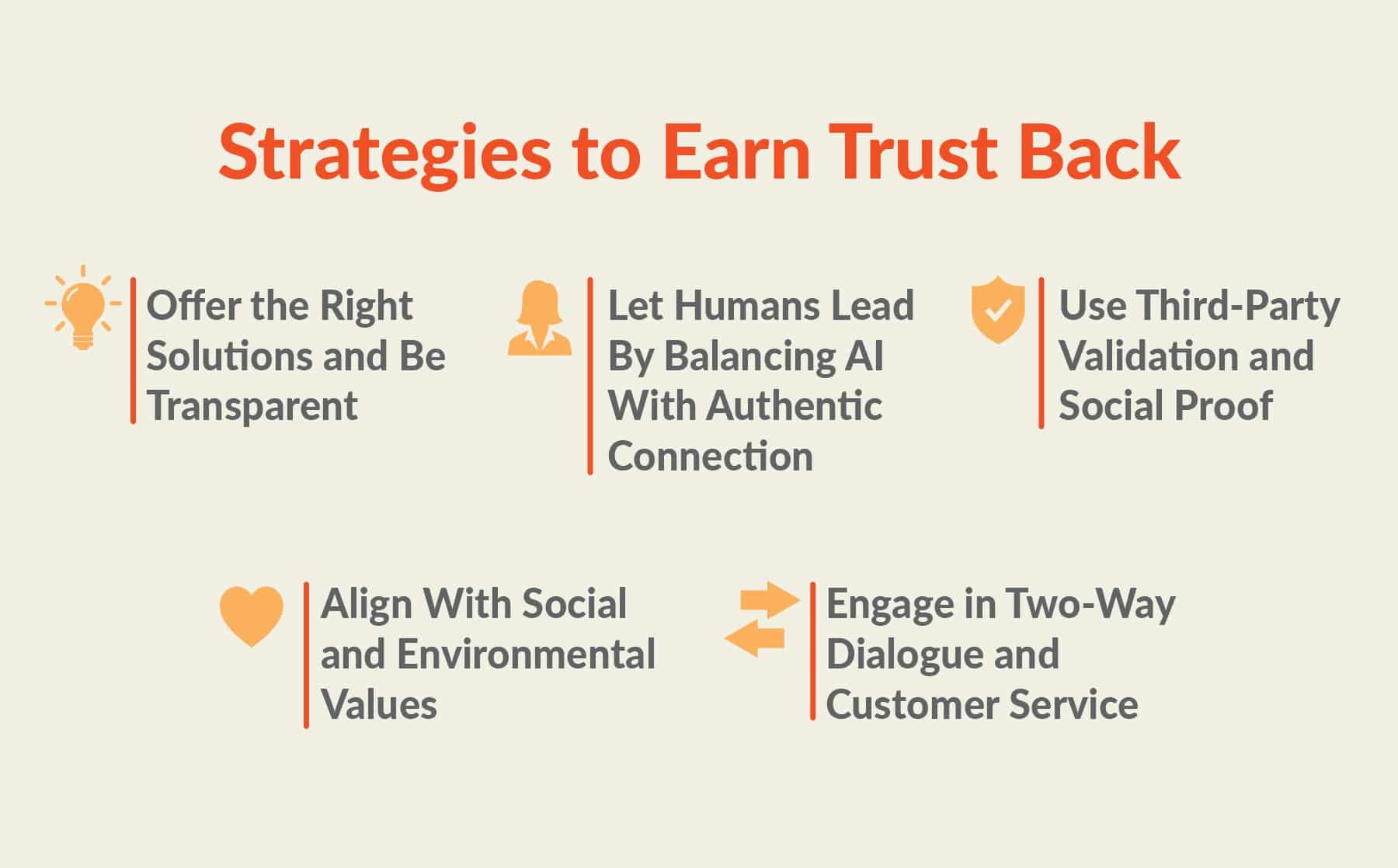
According to the Edelman report cited earlier, “Trust isn’t won with purpose statements — it’s earned through relevance, responsiveness, and relentless clarity of action.” If you’ve noticed that confidence in your brand has begun to slip, then focusing on those three things can be the best way to re-strengthen your relationships with your audience.
Here are a few ways you can boost trust and earn back trust you’ve lost:
Offer the Right Solutions and Be Transparent
The first thing most people look for in a brand is whether it can solve their problems, and do so while communicating openly and consistently. It’s no longer enough to merely meet your audiences’ basic needs, you also need to prove you’re capable of continuing to meet (and even exceed) their needs well into the future. Ask yourself, how can I show prospects that they’re making the right choice and that they can depend on me to continue delivering a top-notch experience?
For example, a university might use texting to remind prospective students of application deadlines and keep them in the loop on admission decisions, financial aid awards, and other important details. This shows students that the school supports their journey and wants to make sure they have all the information they need to stay on track.
Let Humans Lead By Balancing AI With Authentic Connections
According to a Salesforce report, only 42% of customers trust brands to use AI ethically (a significant drop from 58% in 2023). So, as organizations rush to harness the power of AI, it’s important they do so mindfully and pay close attention to how this technology affects direct brand experiences.
If you’re introducing AI into your workflows, do so in a way that still keeps human connections at the center of the experience. While many audiences are still leery of AI‘s ability to solve their problems, they feel much more comfortable when they know a human expert is still heavily involved. For example, a brand may use an AI-powered chatbot to assist with very basic customer service inquiries, but quickly escalate to a live agent when a customer’s question or concern is complex or requires sensitivity.
Use Third‑Party Validation and Social Proof
According to data shared by CapitalOne Shopping, reviews influence a whopping 93% of consumers’ purchasing decisions. But if you stop to consider your own purchasing habits, this probably isn’t too shocking. Before you invest in a product or service, you want to make sure there’s evidence that the brand can deliver on its promises.
As a brand, you can use this appetite for social proof to your advantage. For example, a B2B software provider might text case studies, customer success stories, and quotes from third-party review sites to prospects on the fence, or existing customers who are wavering over a renewal or upsell.
Engage in Two‑Way Dialogue and Customer Service
Customers want to be heard, acknowledged, and validated. According to the Salesforce State of Marketing, 83% of marketers see a demand for two-way conversations, but 69% say they struggle to respond promptly. As a result, too many customer questions and concerns are met with hasty canned responses and lengthy wait times.
For consumers, sending an email to customer support can feel a bit like tossing a message in a bottle into a vast ocean. Will the request even reach the right person? And, if so, will they be able to solve the problem in a timely manner?
Two-way messaging allows brands to show up quickly and authentically, and help contacts feel valued. For example, an entertainment venue might use one-on-one text messaging to help fans resolve ticketing issues quickly, thereby alleviating the frustration of waiting days for an email reply or navigating a complicated phone tree and sitting on hold for untold amounts of time.
Align With Social and Environmental Values
For years, it’s been clear that consumers prefer to buy from brands that align with their personal values. But as trust in various institutions has dwindled, buyers have become increasingly suspicious of whether brands are actually living up to their claims. For example, customers are much more aware of attempts at “greenwashing” and are looking for hard evidence of environmental impact.
One of the best things you can do is make it clear exactly how your brand lives its values. For example, instead of a brand merely telling an audience that it’s committed to sustainability or community outreach, it might highlight real-life examples and share real data points. A sports venue, for example, might share how many tons of plastic it’s saved by switching to water refill stations or selling water in aluminum cans instead of plastic bottles.
SMS and RCS Text Messaging Tips for Building Trust

Just as in any relationship, communication is essential to building, maintaining, and even regaining trust. Fortunately, text messaging makes it easy for brands to establish a direct line of connection with their audiences and ensure open, ongoing communication.
Here are a few things you can do to make sure your text messaging program is set up to foster confidence in your brand:
Comply With Texting Laws and Respect Privacy
Unfortunately, text-based spam and scams have increased substantially over the past several years, which makes it even more difficult for legitimate organizations to reach their audiences. To help, regulators have established laws and guidelines that protect consumers from spam and fraud while also ensuring that the brands willing to follow the rules can reach their contacts on this channel.
SMS compliance covers a lot of ground, but here are a few core requirements you’ll want to keep in mind:
-
Always get contacts’ explicit permission before texting
Consent is vital to regulatory compliance. Before you send a single text message to someone, make sure you have explicit permission. Some brands create simple digital sign-up forms where people can share their mobile number and check a box to confirm they want to receive marketing and/or transactional messages. Other brands ask interested contacts to text a specific keyword to their number to opt in.
-
Provide clear disclosures
Your first message should always include a disclosure that states your organization’s name, the type of message you’ll be sending, the frequency of messages your contact can expect, how to opt out, and a note about message and data rates.
-
Don’t bombard your audience with messages
Having access to your audience’s text messaging inbox is a privilege, and you don’t want to wear out your welcome by overcommunicating or interrupting them after hours. (In fact, according to our 2025 SMS Marketing Stats report, the highest number of unsubscribes came from conversations that began after 9 p.m. ET.)
Be mindful of how often you message your audience and remember that the Telephone Consumer Protection Act (TCPA) prohibits businesses from sending promotional messages between 9 p.m. and 8 a.m. in the recipient’s local time zone.
-
Make it easy for contacts to unsubscribe
You never want your audience to feel trapped by your brand, and neither do industry regulators. That’s why you need to make it clear how contacts can opt out, and keep the process easy. For example, they should be able to unsubscribe by responding “CANCEL” or “STOP.”
And when a contact opts out, make sure you confirm they’ve unsubscribed, end all texts immediately, and remove them from all text messaging lists so no one inadvertently sends them another message.
H3: Personalize Messages Without Over‑Automating
Your messages should feel like a genuine conversation, and fortunately, a reliable RCS and SMS marketing platform makes it easy to personalize messages at scale.
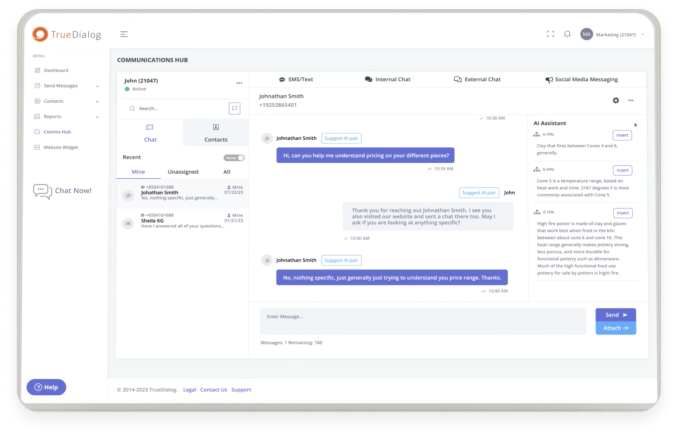
For example, with TrueDialog, brands can segment their audiences and leverage dynamic content to further customize messages based on contacts’ interests, preferences, geographic location, and other relevant factors. And because the platform integrates seamlessly with leading CRM and marketing automation tools, it’s easy to leverage existing customer data to tailor messages further and send highly targeted communications.
That said, it’s important not to over-automate in ways that create frustrating experiences, and make sure there is always an easy path to reach a human being.
An example of over-automation might be a healthcare organization that sends automated appointment reminders, but only recognizes certain responses. For example, if a patient replies with a question, they might receive a generic autoresponse like, “I didn’t understand your request. Please reply YES to confirm or NO to reschedule.”
A better approach would be to give contacts a third option to easily connect with someone who can help. Or, better yet, automatically route questions and concerns to a staff member who can jump into the conversation and help.
Leverage RCS Security and Trust Signals
One of the biggest advantages of RCS is that it makes it easier for a brand to prove its legitimacy thanks to something called a verified sender profile. This tells contacts that mobile carriers have verified your brand and includes a checkmark to confirm this status. Brands can also include their logo and brand colors within the messaging experience to further boost audience trust and recognition.
RCS messages are also encrypted in transit, which means they’re protected between devices and the messaging infrastructure (such as your text messaging software). Encryption helps prevent messages from being intercepted and reduces the risk of your customers’ data falling into the wrong hands.
Trust as a Competitive Advantage
In a time when people are losing trust in institutions and expecting negative experiences with brands, delivering confidence-boosting experiences can help you stand out from the crowd. By focusing on building and regaining consumer trust, you can help your audience feel comfortable, and in turn, they’ll be more likely to remain loyal and even recommend your organization to their peers.
Interested in learning how to use text messaging to grow audience trust? Request a demo to see TrueDialog in action.