Chapter 01
Getting Started: When Starting Out with Text Marketing (keep the
If your business is new to text marketing, you want to take some time at the beginning to start your program out strong. These first 15 tips cover the main steps to help you get started right, from your first plan to your first test message.
98%
of people in the U.S. own cellphones
85%
of U.S. adults text or use messaging apps multiple times a week
19%
say text is their preferred way to hear from brands

1. Create a text marketing plan
Before you send your first text, you want to establish a text marketing plan. Start by clarifying what your goals are. What do you hope to get out of SMS (short message service) marketing? How do you see it fitting into your larger marketing strategy?Think through the types of text messages you want to send. Will you stick with transactional messages to start (things like order confirmations and tracking information), or do you want to send promotional messages (like coupons and product release announcements)?It’s OK to have big ambitions, but it’s smart to start small. Don’t try to do too much on day one, dip your toe into text marketing before you head for the deep end.
2. Learn from past marketing campaigns
Even if text messaging is an all new frontier for your brand, the analytics you’ve gained from marketing on other channels are a valuable starting point. There’s probably a lot of overlap in what works for your audience across social, email, and online advertising and what they’ll respond to via text. Review your past results to identify takeaways you can apply to your text marketing plan.
3. Listen to your customers
Data can provide some valuable information about what your audience may want from a text messaging strategy, but you’ll always benefit from going straight to the source to fill in the fuller picture. The easiest way to hear from your customers is to send out a survey that specifically asks them what they’d like to see from a text marketing program.Then go a step further and set up customer interviews so you can hear directly from customers in their own words. You can gain valuable intel on what kind of marketing texts they like getting, which annoy them, and what messages most consistently get them to take action.
4. Clarify who your audience is
You have to know who you’re talking to before you can figure out what to say to them. Analyze who your customers are and what kind of messaging they respond to. The surveys and interviews from the last step will be valuable here. If you haven’t yet, create a buyer persona (or multiple buyer personas, if relevant) so you can better visualize who you’re talking to when writing each message.
5. Learn about relevant regulations
Business text messaging must comply with government regulations. Text messaging regulations focus on limiting behaviors like spam, unwanted contact, and data misuse — in other words, things that would be bad for business anyway. You want to stick with texting people who actually want to hear from you with the kind of messages they want to receive. That, plus using a text messaging platform designed with compliance in mind will go a long way toward keeping you on the right side of the law.
6. Invest in the right SMS platform
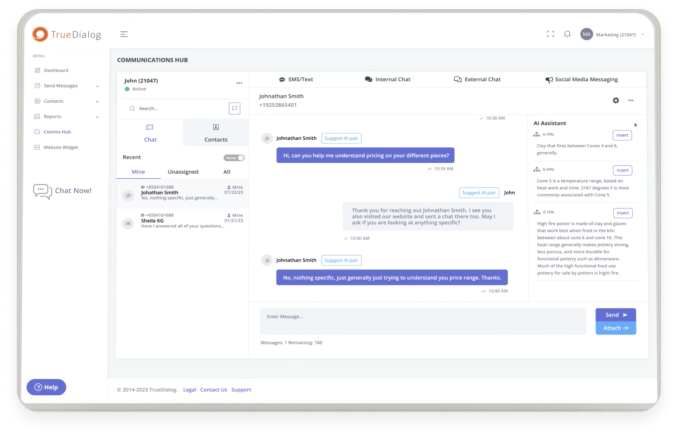
A good text messaging platform will provide you with features that make many of the other tips on this list much easier to manage. That includes (but isn’t limited to):
- Managing opt-ins and opt-outs
- Maintaining your list
- Using segmented lists for personalization
- Tracking analytics on campaign performance
- Including rich media, suggested responses, and CTA (call to action) buttons in your texts
- Maintaining compliance with minimal effort
The right platform can make a big difference in what feels possible for your text messaging campaigns. For a head start on this step, set up a demo to check out TrueDialog.
7. Register for 10DLC
Any business sending A2P (application-to-person) text messages (another way of saying mass texts) in the U.S. needs to register for a 10DLC (10-digit long code). 10DLC distinguishes your brand from scammers. Businesses are expected to register your brand and each campaign you launch with the Campaign Registry, so they can ensure brands stay within required guidelines when texting consumers. You can often do this within a portal on your text messaging platform.
8. Get registered for RCS
RCS (rich communication services) registration isn’t required like 10DLC, but using it opens up new features that create better opportunities for connecting with your audience. RCS messages can include rich multimedia features, like images, videos, and audio. You can also include elements that encourage recipients to take action, like CTA buttons and suggested responses.Plus, RCS messages are fully encrypted (unlike SMS), which brings a higher level of security to your communications — that’s good for all businesses, but especially important for anyone in regulated industries, like health care or finance.
9. Always get an opt-in
Always obey the golden rule of text messaging: only message people who have consented to hear from you. If recipients see your messages as a nuisance, that hurts your brand reputation and your relationship with that particular customer. That’s already a good enough reason to abide by the opt-in, but it’s also legally required.
Even so, 84% of people say they’ve received SMS messages from a company they don’t remember signing up with. Don’t be that guy (er, business). Only message someone after they’ve opted in.
10. Connect your SMS platform with your CRM
A strong text messaging plan is good; one that connects natively to your larger marketing campaigns is better. Integrating your text messaging platform with your other marketing software products, particularly your customer relationship management software (CRM), lets you run omnichannel campaigns.It also gives you more tools for personalization. If you can easily pull information about customers from the CRM when setting up your text campaigns, you can tailor your messages based on what’s relevant to them. For example, when you make a big update to a product, you could easily text everyone on your list who previously trialed that product with the news.
11. Promote your text messaging program and build your list
You know to only text people who opt in. But for a business new to text messaging, that creates a problem: how do you go from zero opt-ins to actually having people to text?You have to build your list. That means promoting your text messaging program everywhere you can: your website, your social feeds, your loyalty program, and your email list. Start with people you already have a relationship with — that’s your low-hanging fruit. From there, you may need to try out some different strategies like running contests or offering incentives to add new people to the list.
12. Provide an incentive for sign-ups
People have a lot of brands and publications competing for their attention. Handing over their phone number isn’t a small decision. For anyone who may be hesitant, you can give them an extra nudge by offering something valuable in return.Often that means a financial incentive like a discount on their next order. 49% of consumers say discounts are the main reward they consider worth sharing their data for. And the discount amount doesn’t necessarily have to be high. 50% say 10% off is enough to get them to sign up.
13. Be transparent with your audience
Tell people upfront what they can expect when they sign up for your list. That can include information on how often they’ll hear from you, what kind of messages to expect, and how you’ll use their data. Or more importantly, how you won’t use their data — be clear that you won’t sell or share it without their permission.
14. Establish consistent branding
You want your text messages to align with how you present your brand across your marketing strategy. Some of that falls to having a clear style guide that clarifies your overall tone. But if you use RCS, you can also add your logo, website, and brand colors to your account. Your text messages will visually look like all your other marketing materials, while also being clearly linked to your familiar online brand properties.
15. Do testing
Before you start contacting customers, do some internal testing to make sure everything works the way it should. Test out your opt-in and opt-out systems as well to make sure they work correctly. Send some test text messages to internal devices to see how they look. Ideally, you want to check how they show up on different types of devices and with different carriers, to get a full view of what your audience will see.