
Your SMS (Short Message Service) list is a valuable business resource. You may be tempted to gauge its value based on size — the more people receiving your text messages, the more opportunities for them to convert, right? That’s a common and understandable error, but in this context, more isn’t necessarily better.
SMS list quality isn’t about the quantity of numbers you have. It’s about the quantity of subscribers who genuinely want to hear from you. If you’re texting people who don’t actually care about your text messages — or who can’t even receive them because they have a landline — you’re wasting money.
Worse, if you’re texting people who already told you they don’t want your text messages, you’re risking hefty professional consequences on top of the wasted spend. Any organization doing SMS marketing has to take SMS compliance seriously, and list hygiene has an important role to play.
Building a strong SMS list the right way to start is important, but it’s just as important to do the work of maintaining your SMS list hygiene over time.
Why Your SMS List Quality Matters
SMS list hygiene isn’t something you can treat as a low-priority nice-to-have. It’s a business necessity. Staying on top of it is important for a few main reasons.
- It impacts your business reputation. When someone receives a text message from you, the last thing you want is for them to feel annoyance or anger. If your list includes people who didn’t sign up (or didn’t mean to) or who already tried to unsubscribe without success, your texts are likely to evoke negative feelings toward your brand. That’s bad for your long-term brand reputation.
- It affects your sender reputation. At first glance, this may sound like a repeat of the last point but in the context of SMS compliance, sender reputation is actually something distinct. It refers to a score carriers apply to phone numbers based on their text history that impacts message deliverability. In other words, if recipients frequently treat your text messages like spam, your score gets dinged and you may have a harder time reaching inboxes in the future.
- Non-compliance can bring big fines. Any organization that performs text message marketing has to treat SMS compliance as a top priority. And only texting people who want to hear from you is one of the most important tenets of compliance. Violate the Telephone Consumer Protection Act (TCPA) and it won’t just put your SMS deliverability at risk, you could face fines of up to $1,500 per message.
- Sending unwanted text messages is a waste of budget. In addition to potential fines, sending people messages they don’t want to receive has another ongoing cost that’s easier to overlook. Every text message you send through an SMS platform costs you money. When those messages are landing in the inboxes of people who don’t want them, or when they’re failing to send because it’s a junk number or landline, that money’s wasted.
- A strong SMS marketing list equals better results on the metrics that matter. An SMS list of strong leads is more likely to click on your links, reply to your interactive RCS (Rich Communication Services) messages, convert into more sales, and practice long-term loyalty. A long list of people who never read or interact with your messages is no use to you, especially if any of them are replying only to opt out or report your messages as “junk.”
What Good SMS List Hygiene Looks Like
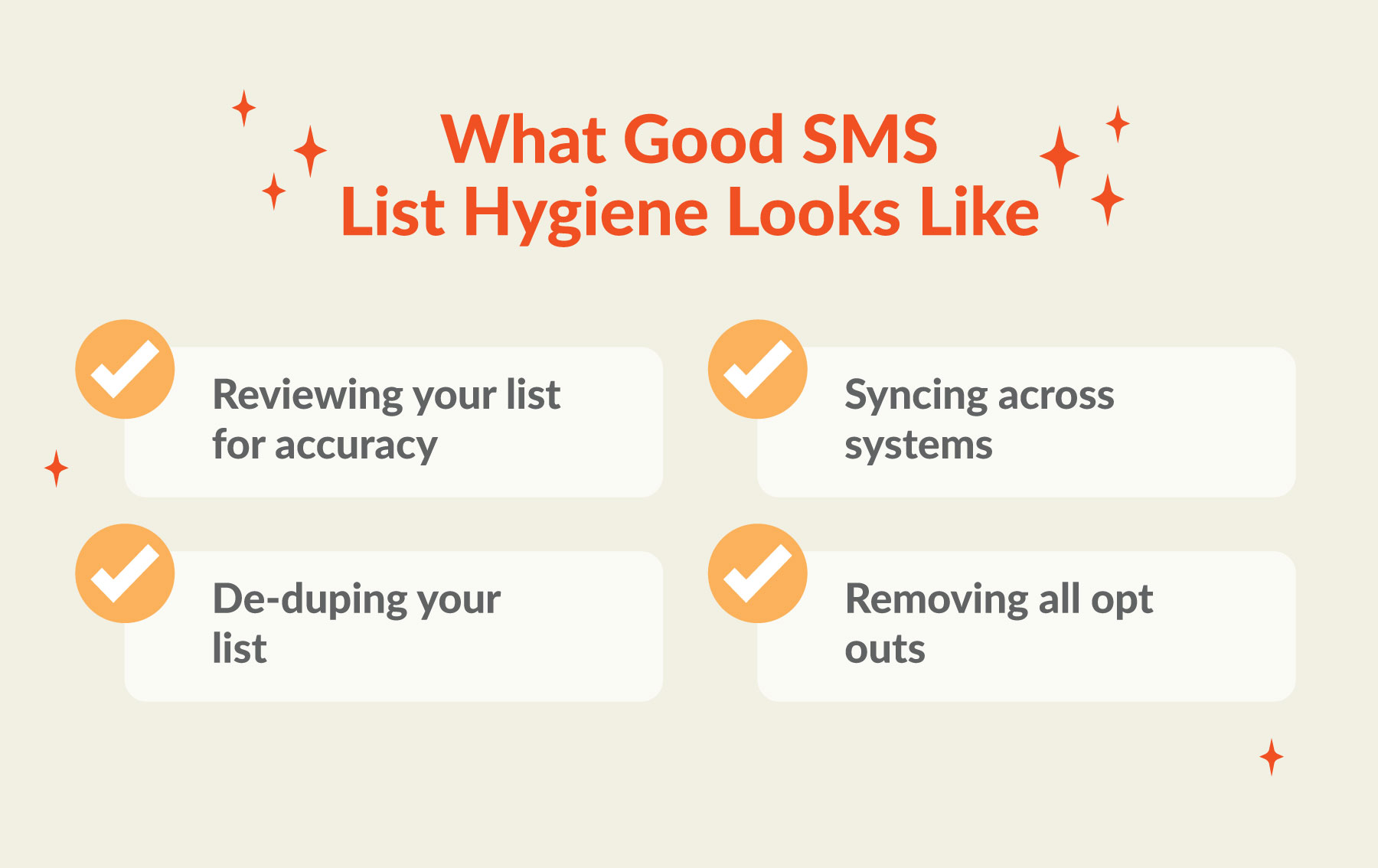
Maintaining SMS list hygiene is an important goal you should treat as an ongoing project. What that looks like in practice includes:
- Reviewing your list for accuracy – Regularly look for fake numbers and landlines to remove.
- De-duping your list – Identify any numbers that are listed more than once and remove the duplicates.
- Syncing across systems – Make sure every time you add or remove a number it’s removed across all your systems (e.g. any customer database you maintain, your CRM (customer relationship management system), etc.).
- Removing all opt outs – Every time someone requests an opt out (even if they use unconventional language instead of “stop” or “unsubscribe”), you want to remove them promptly and permanently.
This process works better with the right software. A mass text messaging platform with reporting that helps distinguish message failures by type (e.g. landline, undeliverable, carrier-blocked) will help you identify numbers to remove. Any good SMS platform should also handle unsubscribes automatically to help you stay in compliance.
That’s table stakes, but TrueDialog actually goes one step further. TrueOptOut uses AI to catch opt-out requests in everyday language that keyword filters miss, so unsubscribes don’t slip through.
TrueDialog also helps to see your SMS activity everywhere your teams work. With TrueConnect, every text you send and receive will be visible on the matching record across the systems you already use. That ensures your SMS program integrates seamlessly with your main marketing, sales, and customer service tools. You can effortlessly keep your list accurate across all the platforms your teams use, and keep your larger marketing strategy consistent across channels.
6 Tips to Improve Your SMS List Hygiene
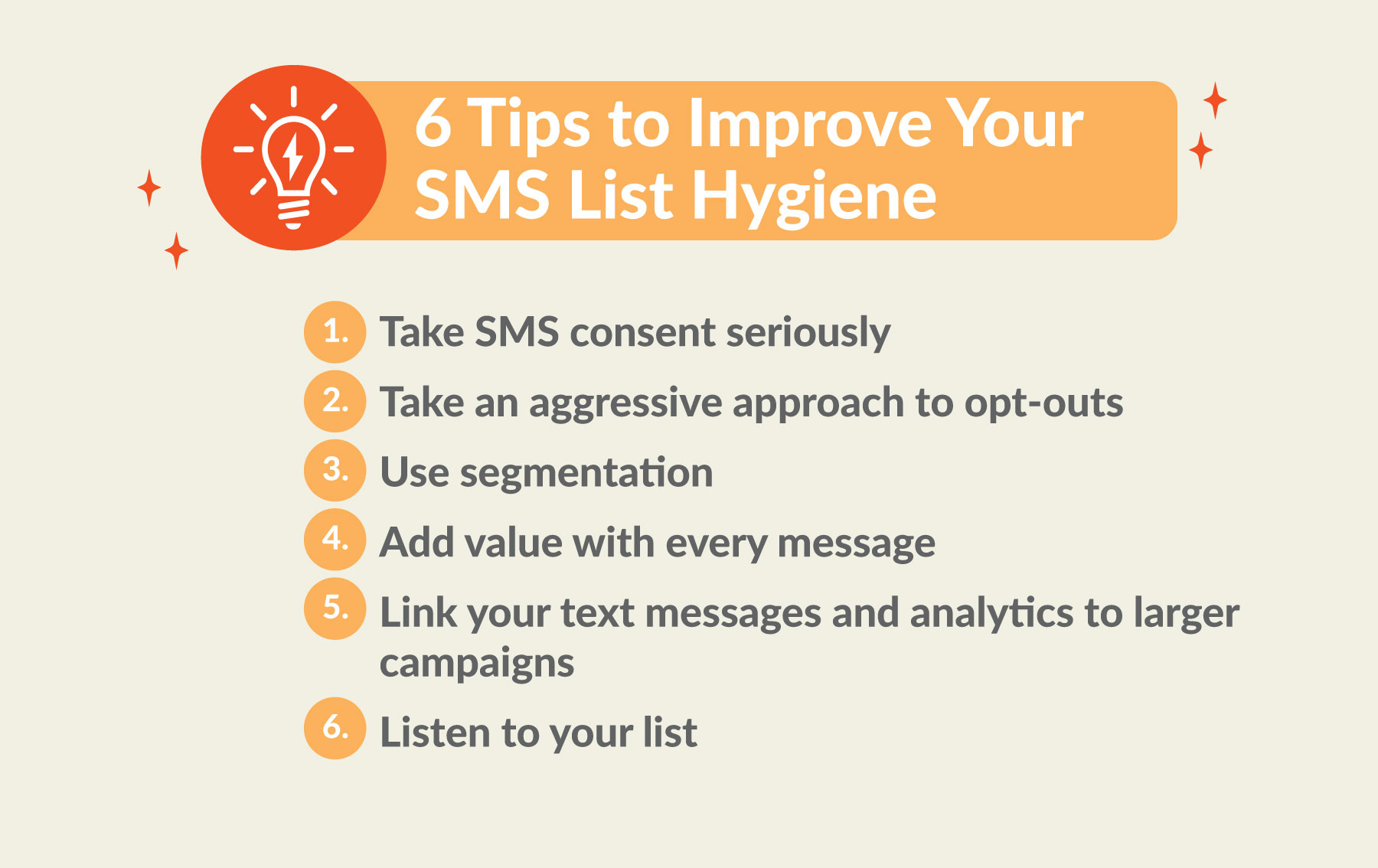
Keeping your SMS list clean, compliant, and effective is doable, but it does require intention. Following a few best practices can help you maintain an SMS marketing list that gets the kind of results you value most.
-
Take SMS consent seriously
The only valid way for a person to end up on your SMS list is for them to actively request it. Never buy a list of phone numbers. Never add someone because you got their phone number another way (like during the online checkout process). Only include them in your mass texts after they actively opt in.
SMS consent isn’t a suggestion, it’s the law. But more than that, it’s good business. People who are annoyed by your texts aren’t going to convert, and they’re more likely to mark your texts as spam. Many brands use a double opt-in process just to be extra sure. People have to not only sign up, but then also reply to a follow-up text confirming that they want to join. While this isn’t legally required, it’s a good practice for making sure everyone on your list wants to be there. -
Take an aggressive approach to opt-outs
For the same reason you don’t want ambiguity when it comes to opt ins, you don’t want any hesitation when it comes to opt outs. SMS compliance with TCPA doesn’t just mean respecting opt outs that use the most common keywords (like “stop,” “unsubscribe,” and “opt out”). You’re also expected to remove people from your list when they use less obvious or more conversational language (like “take me off your list,” “stop texting me,” or “pls stop txting”).
Unfortunately, those are harder for most opt-out filters to catch and honor. TrueDialog just recently added TrueOptOut to its features specifically to address these kinds of requests. TrueOptOut knows how to recognize the vast majority of opt-out requests, regardless of the language your recipients use. And in cases where the language is ambiguous, it flags the message for human review. That keeps you in compliance and protects your sender reputation.
-
Use segmentation
Once you get an opt out, you have to respect it, so your goal should be to reduce opt outs as much as possible. One strategy to help with that is only sending contacts text messages that are relevant to their needs and interests. You can improve relevance by creating segmented lists.
Depending on your brand and marketing strategy, that could mean segmenting lists by product, by topic interest, or by frequency (e.g. asking contacts how often they’d like to receive text messages). For example, a brand that hosts sports events could create different lists for each sport, so someone really into tennis won’t feel like they’re getting a barrage of football messages they don’t care about. Giving people some control over the type and frequency of messages they receive ensures they’re more likely to appreciate each text, rather than seeing them as a nuisance.
-
Add value with every message
You want to send messages that keep people opening and responding, ideally while feeling like they’re getting something valuable out of the relationship. That can include sharing deals and promotions they find alluring, providing information about new products or events they’re interested in, and sending personalized messages tailored to their interests.
But it also means being very careful to avoid sounding or looking like spam. Using certain types of link shorteners or the wrong type of language in a message can get your messages flagged as spam by carriers even before they reach consumers (although you still end up having to pay for the message — the worst of both worlds).
TrueDelivery®, a feature of TrueDialog, helps with that part. It pre-checks every message you send before it goes out to give you a head’s up if it’s likely to get caught in spam filters. That gives you the opportunity to improve SMS deliverability before you hit send, so your messages will actually reach your recipients. And by keeping spammy-looking messages from going out to begin with, TrueDelivery also helps protect your sender reputation.
-
Link your text messages and analytics to larger campaigns
Another smart way to improve message relevance and results is to remember that your contacts aren’t just an SMS number. The people on your SMS list likely interact with your brand in other contexts as well — your email list, your social media accounts, in-person visits to your stores or events, etc. Your messages will perform better if you consider SMS as one part of the whole experience each customer has with your brand.
That’s only possible if your text messaging platform connects with your other customer systems, like your CRM. TrueConnect® from TrueDialog posts every message you send and receive to the matching record in every connected system you use. That means everyone on your marketing, sales, and customer service teams all have access to an up-to-date record of your SMS interactions, without the need for middleware or custom development. That enables you all to create better holistic customer experiences, as well as view more comprehensive reporting to gain better insights into what’s working across the board, as well as for each individual recipient.
-
Listen to your list
Possibly the most important tip you can follow to avoid opt outs is listening to your recipients. People are often willing to provide information on the kind of text messages they want to receive from you, the type they don’t, the frequency of texts, and whether they’re happy with your brand overall. So get in the habit of asking.
There are a few common text message features you can use for this. SMS polls can help you gain data on simple questions like checking whether recipients find your messages valuable or if they’d like to see more or fewer texts. And RCS interactive features like suggested responses make it easy for customers to respond with their opinions.
Asking recipients what they want (and doing it) is basically a way to supercharge SMS consent. The more control you give them over their experience with your brand messages, the more likely they are to appreciate the texts they get. That means a better experience for them, and a better performance for your SMS marketing.
SMS List Hygiene Made Easy
Building and maintaining a strong SMS list is no easy feat, but access to the right text messaging features makes a big difference. Tools like TrueOptOut, TrueDelivery, and TrueConnect can all help you make sure you’re reaching people who want to receive your messages, with messages that are actually valuable to them. That’s good for your budget, your business reputation, and your overall SMS performance. See how all these features (and more) work in practice by setting up a TrueDialog demo today.