
Sometimes the biggest hurdle to better marketing is trusting outdated best practices. Too often, we miss opportunities to drive better results because we assume the change isn’t worth the risk. When something works for long enough, it’s easy to believe it’s still the best option.
But audiences are always evolving, and if you don’t stop to consider what might’ve changed, you might miss a chance to boost your success.
That’s why, when we hit 1 billion text messages sent through our enterprise SMS platform last year, we knew it was the perfect time to dive deep into our data and identify the latest SMS benchmarks based on what’s working and what today’s audiences actually prefer.
While some of what we uncovered matched our predictions, we also stumbled upon a few surprises. Today, we’re sharing SMS marketing stats that bust a few common myths, plus guidance based on what’s working for leading brands.
SMS Benchmarks: Key Takeaways
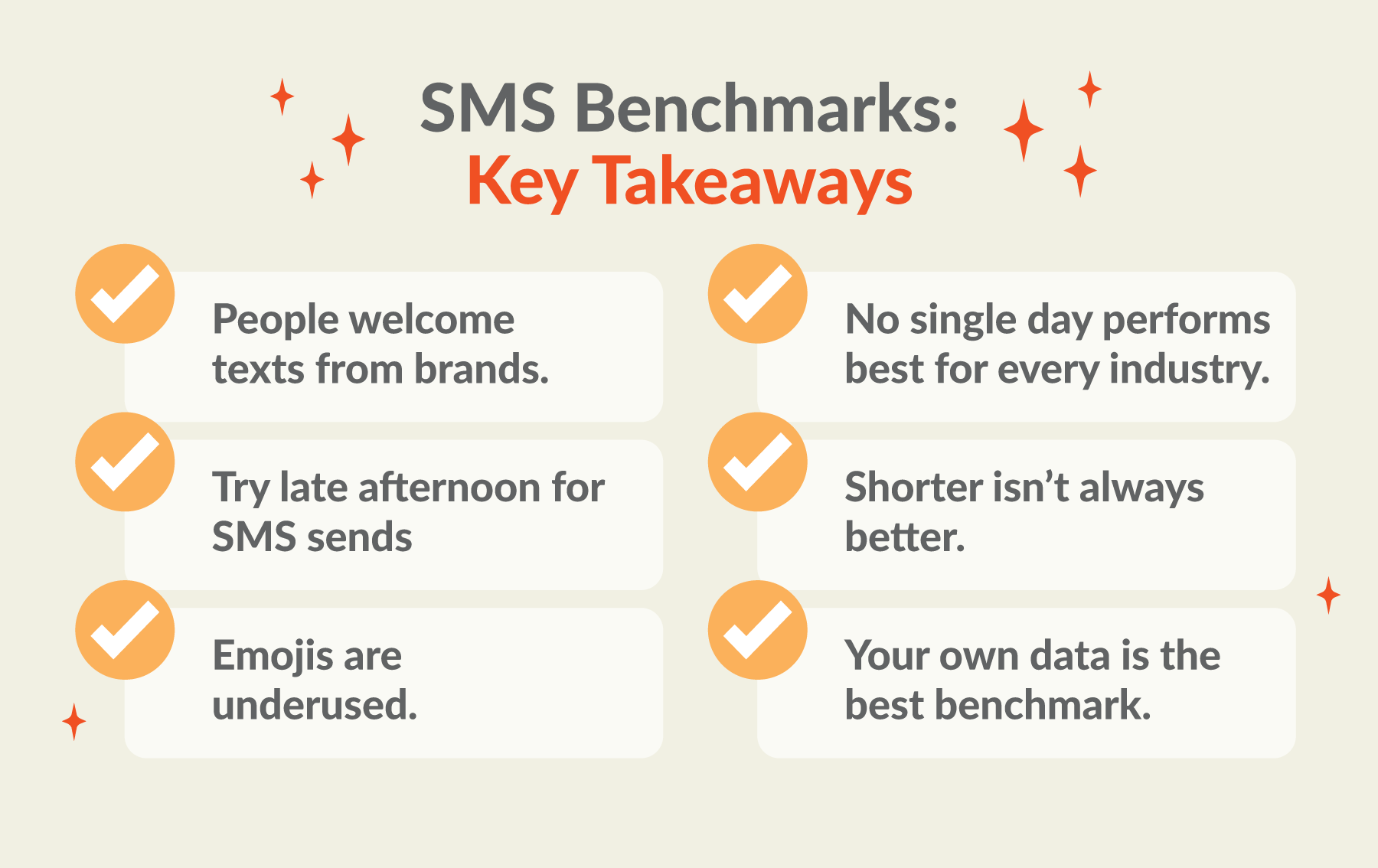
Short on time? Here’s what our data showed:
- People welcome texts from brands. 94% of messages got a neutral or positive response, and 87% of recipients stayed subscribed through a week-long conversation.
- No single day performs best for every industry. Most brands send on Tuesdays between 11 a.m. and 1 p.m. ET, so sending just outside that window can help you stand out.
- Try late afternoon for SMS sends. Opt-outs are lowest between 4 and 5 p.m. ET and peak at 9 p.m. ET.
- Shorter isn’t always better. Messages average 153 characters, just under the 160-character SMS limit. RCS gives you more than 3,000 characters when you need more room.
- Emojis are underused. Fewer than 2% of messages include them, mostly because a single emoji drops the SMS limit to 70 characters. Save them for short messages or RCS.
- Your own data is the best benchmark. Use these numbers as a starting point, then test send times, message length, and emojis with your own audience.
Common Myths vs. What the SMS Benchmarks Say
We’ve come across plenty of misconceptions about SMS marketing over the years, and they usually come from one of two places. In some cases, businesses borrow best practices from other channels without realizing text messaging follows different rules than email or social media. In other cases, myths develop from outdated ideas about digital marketing and how today’s audiences interact with brands. (Or, more aptly, how audiences want brands to engage with them.)
Here are five common myths, and how our data tells a different story:
Myth 1: People Hate Getting Text Messages from Brands
For years, one of the biggest hurdles preventing brands from leveraging SMS marketing wasn’t cost or a lack of skill, but the pervasive idea that receiving a text from a brand was disruptive and unwelcome. Because text message inboxes have long been seen as personal spaces, some business leaders still worry that texting their audience is invasive and could hurt their brand’s reputation.
But, as it turns out, people are not only totally fine with receiving texts from brands, but often respond positively. And many consumers favor SMS over other platforms.
When we evaluated message sentiment, we found that a whopping 94% were neutral to positive. And when you account for opt-outs (which make up about 80% of negative responses), less than 1% of messages had a negative sentiment. Furthermore, over the course of a week-long conversation with a brand, 87% of recipients chose not to opt out.
These findings align with data shared by Emarsys, which found that 91% of consumers are willing to opt in to SMS communications (as long as it improves their brand experience) and 75% prefer receiving promotional content via text messages over other marketing methods.
In other words, if you’re not texting your audience, they probably wish you were.
Myth 2: Messages Sent on Popular Days Drive the Highest SMS Open Rate
As marketers, we’re always trying to optimize for engagement. Often, that means following hard-and-fast rules about when to schedule communications. For example, some studies show Wednesday is the best day to post on Instagram and LinkedIn, while Tuesdays and Thursdays traditionally earn higher email open rates.
So, what’s the best day to text your audience?
As it turns out, there’s no single day that earns a significantly higher SMS open rate than others. While most brands send their texts on Tuesday (followed closely by Monday and Wednesday), trends vary by industry. For example, sports and entertainment brands overwhelmingly choose Thursday for the lion’s share of their sends, while finance organizations opt for Fridays.
We also found that most brands send their messages late morning and mid-afternoon (specifically, between 11 a.m. and 1 p.m. ET).
That said, the most popular days and times aren’t always best for driving engagement. After all, if you send your messages within the same window as everyone else, you’re competing with other brands for your audience’s attention. If you want to stand out from the crowd, it may be best to send just outside of popular timeframes.
Myth 3: Recipients Prefer Evening Texts
You can’t avoid unsubscribes entirely. Even when people enthusiastically sign up to receive text messages from a brand, they might eventually change their mind. As a marketer, your goal is to reduce the likelihood of people unsubscribing by making sure your messages are relevant, engaging, and sent at a time that makes sense for your audience.
It’s easy to assume evening hours are ideal for brands to send a text since nighttime is often prime time for phone use. In fact, according to YouGov, 62% of U.S. adult citizens report using their phone “sometimes,” “often,” or “always” 10 minutes before falling asleep.
But while most people may be sneaking a late-night scroll before bed, that’s also when they’re most likely to unsubscribe. Our data shows unsubscribes peak at 9 p.m. ET at 22.5% (with 10 p.m. and 11 p.m. ET unsubscribes not far behind). Perhaps because receiving a non-personal text at bedtime feels disruptive?
On the flip side, unsubscribes are lowest between 4 p.m. and 5 p.m. ET, likely because this is when people are wrapping up their workday and may be more receptive to brand messages.
But unsubscribes aren’t the only reason to avoid late-night texts. Sending evening messages may also violate the Telephone Consumer Protection Act’s quiet hours regulations, which prohibit sending promotional messages after 9 p.m. or before 8 a.m. in the recipient’s local time zone. Some states also have their own restrictive mandates on when businesses can send marketing texts.
To play it safe across all time zones, we recommend avoiding sending messages between 9 p.m. and 11 a.m. ET.
(Note that quiet hours regulations exclude transactional messages, such as appointment reminders or shipping notifications.)
Myth 4: Longer Messages Always Perform Worse
Over the past few years, marketing thought leaders have consistently proclaimed that, when it comes to content, shorter is better. With waning attention spans and a constant flood of distractions, it’s no surprise that brands are striving to keep their messaging concise.
But that doesn’t mean you should chop your messages short just for the sake of it. While brevity is important, you also want to get as much as you can out of the space you’re allotted. And our data shows most brands are doing just that. Sent messages averaged 153 characters, which is just 7 characters short of SMS’s 160-character max.
Of course, 160 characters still isn’t much, and it still takes a little bit of finessing to pack everything you want to say into such a short space. But exceeding this limit will cost you. Because carriers bill by segment, texts over 160 characters can quickly increase campaign costs.
If you need significantly more space to get your point across, it may be better to explore Rich Communication Services (RCS), which is the newer texting protocol that allows you to include over 3,000 characters. (That said, it’s still important to keep those aforementioned short attention spans in mind.)
Myth 5: Emojis Look Unprofessional
Communication experts have long debated whether brands and professionals should use emojis in their messaging. Opponents argue the tiny digital images come across as silly and unserious, while the pro-emoji camp posits they help humanize brands and make content feel more relatable.
According to data shared by Helios, emojis increase SMS marketing open rates and engagement, suggesting emoji advocates may be on to something. However, when we reviewed our data, we were surprised to discover that less than 2% of all messages included emojis. Why?
It likely comes down to length limits. SMS messages are confined to 140 bytes of data per segment, which works out to about 160 characters when using GSM-7 coding (the standard for most English characters). But add an emoji, and the SMS message converts to UCS-2, which reduces the limit to just 70 characters.
In short, using an emoji means you have less space to get your message across, and you may need to send it in multiple segments (which, as we outlined above, can dramatically increase campaign costs).
So, what should you do?
Since emojis can help boost engagement and opens, we recommend using them when your message is already short or when you’re using RCS and don’t have to worry about restrictive character limits. Just make sure that your emojis are appropriate and match the tone of your message.
Best Practices for Succeeding with Text Messages in 2027

As we close out 2026, many marketing pros are wondering how text messaging should fit into their strategy in the year ahead. How can your brand avoid falling prey to myths and follow modern best practices?
As always, we recommend sticking with proven SMS marketing facts, following real data, and keeping your eye on the latest trends. Here are five things you can do to help prepare your text messaging program for a successful new year:
Focus on Building Your Subscriber Base
No matter what your campaigns look like in 2027, one thing is for certain: you’ll need a robust contact list if you want your texts to drive powerful results. Fortunately, since audiences want to connect with brands via SMS, growing your text messaging subscriber base shouldn’t be too challenging. All you have to do is make it easy.
One of the best ways to grow your list is to use an SMS platform that offers a text-to-join feature. This way, instead of having to fill out a clunky web form, contacts can simply text a keyword (like “JOIN”) to your 10-digit number or short code. And, depending on the SMS solution you choose, you can set up an auto-response that automatically replies to new subscribers to let them know they’re officially added to the list and reiterate how they can unsubscribe. (I.e., “Reply STOP to opt out.)
By promoting your text-to-join campaign in high-visibility areas, like your website, social media, or events, you can quickly grow your subscriber base and scale your texting program.
Prioritize RCS
If you aren’t already implementing RCS, now is the time to start.
RCS gives brands the ability to deliver rich, immersive, app-like experiences within their audience’s native texting inbox. As mentioned above, it offers significantly higher character limits and supports sending high-resolution images, high-definition videos, GIFs, PDFs, and customized CTA buttons. It includes typing indicators, read receipts, and message reactions, so conversations feel more personal and interactive. And you can also send all messages from a branded profile featuring your logo and brand colors, plus a verified checkmark to prove you’re not a spammy imposter.
Just make sure you choose an RCS provider that sets you up for success. For example, TrueDialog equips teams with a no-code visual composer to build RCS campaigns without developer assistance, plus automatic SMS fallback so messages can be delivered as SMS if a recipient’s device or carrier doesn’t support RCS.
Be Smart About Scheduling Sends
We shared a few SMS marketing stats and data points about the most popular days and times to send messages. But remember: every audience is different. For example, B2B tech pros might be more receptive to a text in the middle of the workday, while college students may be more likely to read and reply to messages delivered in the late afternoon. Determining the right time to engage can take some trial and error. Just make sure you avoid quiet hours and keep an eye on opt-outs.
Explore Your Data to Set Your Own SMS Benchmarks
One thing we discovered while combing through our data is that there are exceptions to most rules. Best practices are helpful, of course, but they’re usually generalized across industries and audience demographics. Whenever possible, set your own SMS benchmarks based on your text messaging program’s performance and your industry’s unique trends.
Make sure your texting platform offers robust reporting so you can track the KPIs that matter most for your brand. Review opens, click-throughs, and other engagement metrics to see what’s working and where you can optimize for better results. And take time to A/B test different send dates and times, different message lengths, and messages with and without emojis to get a better feel for what your audience prefers.
Choose the Right Enterprise SMS Solution
As with most digital marketing efforts, the technology you use for your texting efforts can make or break your success. If your SMS software isn’t up to the task, it can limit your ROI. Here are a few things to look for when choosing a mass texting service:
-
Scalability
Some solutions are built for small organizations, while others are designed for larger, fast-growing businesses. Make sure you choose one that aligns with your needs and goals, and won’t limit your ability to scale. For example, ensure your solution supports high message volumes, large contact databases, and growing teams without sacrificing performance.
-
Industry fit
Every industry has its own unique set of needs. Before adopting an SMS solution, make sure the provider has a strong track record of supporting organizations in your vertical.
-
Security and compliance
Not only is text messaging highly regulated, but organizations in industries like financial services, healthcare, and higher ed have to follow additional rules. So it’s vital you choose a solution that makes it easy to comply with legal requirements (like streamlined opt-out management and data privacy) and has the appropriate security certifications (like SOC 2).
-
Integrations
Introducing new software into your environment often comes with challenges, but it’s much easier when the solution connects seamlessly to your existing tech stack. Take time to make sure the texting platform you adopt can integrate with essential systems, like your CRM and marketing automation tools.
-
RCS enablement
RCS adoption has grown substantially over the past year, and we expect it to continue expanding in the year ahead. Even if you aren’t prepared to launch an RCS campaign today, it’s crucial you choose a solution that has the infrastructure and know-how to support RCS messages and help your organization make the most of this newer messaging protocol.
FAQs
What are SMS benchmarks?
SMS benchmarks are averages for metrics (like open rates, click-throughs, opt-outs, etc.) that you can use as a baseline for assessing campaign performance.
What is a good SMS open rate?
People are much more likely to open SMS messages than messages on other platforms like email, and businesses often see open rates as high as 98%. If you’re seeing rates significantly below 90%, be sure to re-evaluate your list quality as well as message relevance and timing.
What SMS marketing stats matter most?
The most important stat varies depending on your goal. But in most cases, opens, click-throughs, conversion rates, response rates, and opt-outs are the best metrics for evaluating campaign performance.
Why do SMS marketing open rates drop?
A drop in your SMS open rate often means you’re sending messages too often or at the wrong time, or your message content isn’t resonating with your audience.