
Today’s college and university communications teams have a lot on their plates. Not only are you expected to reach students across several channels simultaneously, but you’re also required to keep up with students’ expectations and communication preferences (which seem to evolve by the minute).
Fortunately, while social media platforms and email habits might be forever in flux, text messaging remains one of the leading ways students communicate.
And, to launch effective campaigns and keep students engaged, institutions rely on higher education texting platforms: business SMS software that’s specifically designed to meet college and university needs. These solutions include built-in features and capabilities that support everything from personalized outreach and two-way conversations to emergency alerts, time-sensitive reminders, and opt-out and subscription management.
Of course, not all platforms are made equal, and determining which solution is best for your institution can feel confusing.
To help simplify your decision, we’re diving into the best higher education texting platforms and tips for choosing the right platform for your needs.
Top Higher Education Texting Platforms in 2026
When it comes to SMS for universities, there’s no shortage of options. Here are several of the best-rated solutions that support higher education texting:
-
TrueDialog
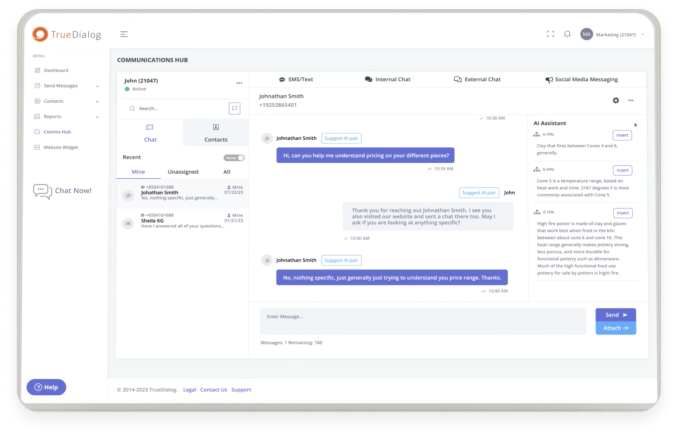
TrueDialog is the gold standard when it comes to SMS for higher education. After spending years collaborating with some of the largest colleges and universities in North America, the TrueDialog team created an ultra-user-friendly solution that combines the functionality, reliability, and scale of enterprise SMS with the bespoke features schools depend on to power unified campus communication. Flexible integration options include Salesforce, HubSpot and Dynamics, plus an API to connect with higher-ed specific solutions ranging from recruiting tools to fundraising platforms.
-
Mogli
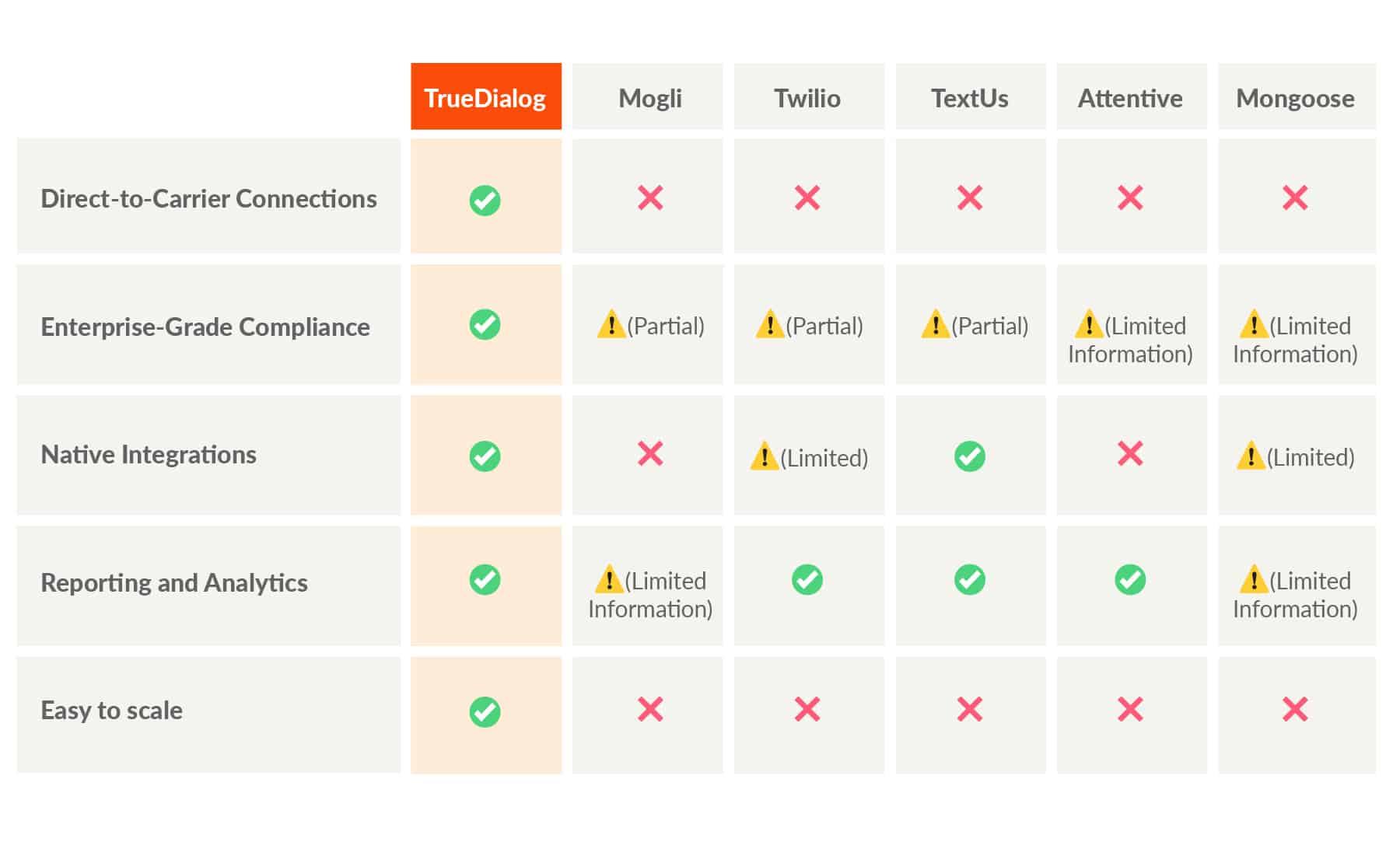
Mogli is an excellent option for schools that depend on Salesforce. Since it’s tightly bound to the Salesforce environment, it’s easy to integrate with this leading CRM software and offers a user-friendly interface. However, it may not be the right choice for schools that use another CRM or SIS, or for those who want the flexibility to integrate with other platforms in the future.
-
Twilio
Twilio is another powerful mass texting platform with plenty of positive reviews. Although the solution primarily supports healthcare, retail, hospitality, and ecommerce organizations, it also works with educational institutions. However, schools that struggle with a backlog of IT projects may want to avoid adding another complex technical integration to the requirements. If you’re looking for a solution you can use right out of the box, this isn’t the best choice.
-
TextUs
TextUs is another popular and user-friendly SMS solution. Initially built to support team chats, it’s a great choice for smaller schools that only need basic SMS capabilities. However, because it relies on third-party aggregators to deliver messages to carriers and lacks more sophisticated infrastructure, it may not be the right option for universities seeking to leverage SMS for multiple mission-critical communications.
-
Attentive
This popular eCommerce SMS platform is feature-rich, easy to use, and has a track record of working with several large consumer brands. They don’t list higher education among their top-served industries, but those familiar with SMS platforms can tailor it to their needs. However, teams that are not interested in building custom configurations or don’t have the technical expertise to oversee integrations may not want to embark on this challenge. Attentive’s high cost of entry may also be a barrier for smaller institutions or those who want to start small with SMS and scale up, or across teams, over time.
-
Mongoose
Mongoose is a texting software built for universities (not just a tool built for other industries that can be retrofitted for higher ed), and reviews mention highly responsive customer service. However, it does have a few technical limitations, such as relying on a shared inbox (rather than the unified threading you’ll get with solutions like TrueDialog), and reviewers mention it’s not the best at supporting personal one-on-one conversational experiences.
-
Slate (Technolutions)
Slate is the dominant admissions CRM in U.S. higher ed, used by 48 of the top 50 universities, with native bidirectional SMS built in — no separate integration required. It’s a convenient choice if Slate is already your CRM, but the SMS layer runs on Twilio underneath, has no documented deliverability engine, and manages opt-outs by keyword matching rather than intent detection.
-
Mainstay (formerly AdmitHub)
Mainstay is a behaviorally-informed AI chatbot for higher ed student engagement, with SMS as the delivery channel rather than the product itself. It’s research-backed and effective for enrollment and retention nudges, but it isn’t built for bulk campaign sends, shared-inbox staff messaging, or the broader institutional communication needs (alumni, faculty, campus safety) that a full messaging platform covers.
-
Signal Vine (Modern Campus Message)
Signal Vine, now part of Modern Campus, is a two-way texting platform built specifically for higher ed and used by 1,700+ institutions. It pairs AI-driven automation with 1:1 conversation threads and a chatbot-style Virtual Advisor, and connects to Salesforce and SIS data for targeting.
-
Element451
Element451 is a higher-ed-specific enrollment CRM with SMS built in as one channel among several (application tracking, event management, email, chatbots). It’s a strong option if you’re selecting a CRM from scratch, but a poor fit if you already have one and just need best-in-class SMS on top of it.

What to Look for in a Higher Education Texting Platform
At first glance, many higher education mass texting tools might look similar. But once you start to compare them more closely, you’ll discover that features and functionality can differ dramatically between solutions.
Here are a few essentials to keep in mind as you make your decision:
-
Enterprise-grade deliverability
Colleges and universities frequently need to send high volumes of time-sensitive messages, and don’t have time for carrier throttling or third-party complications. That’s why it’s crucial you choose a platform that owns its messaging infrastructure end-to-end, rather than routing through a third-party aggregator, ensuring speedy, reliable delivery (no matter how many messages you send at once).
-
Compliance support
Compliance is especially crucial when it comes to text messaging. Failing to meet regulatory requirements can result in legal trouble, hefty fines, and even being blocklisted by mobile carriers. That’s why it’s imperative you opt for a solution with built-in compliance tools to keep your students’ data safe and ensure your efforts align with the guidelines set by the Cellular Telecommunications Industry Association (CTIA) and the Telephone Consumer Protection Act (TCPA), as well as FERPA-aligned expectations around student data specifically.
-
Integrations
Integrating your higher education texting platform with your CRM or marketing automation solution makes it easy to build workflows and keep your data clean and up to date. And the best platform will natively integrate with popular software (like Salesforce Education Cloud, HubSpot, Dynamics 365, and more) as well as a powerful SMS API to connect your texting efforts with your school’s SIS.
-
Reporting and analytics
Monitoring and measuring your performance is critical to building a successful text messaging program and proving your program’s value to senior decision-makers. Make sure your higher ed texting solution allows you to track key metrics, analyze campaign performance at a granular level, and easily generate reports. (Also, make sure it offers a user-friendly interface so everyone on your team can dive into the numbers together!)
-
Scalability
Even if your texting program starts small, you never want to restrict your growth by choosing a platform that struggles to perform when demands rise, or breaks when you need to get a critical alert out campus-wide. Choose a solution designed to grow with your program and your school.
How TrueDialog Compares to Other Higher Ed Texting Platforms
Here’s how TrueDialog compares to other texting software for colleges:
Use Cases: How Colleges and Universities Use Texting Effectively
Here are a few ways top universities use texting software to keep students engaged from admissions through graduation (and even beyond):
-
Student enrollment and admissions reminders
Admissions and enrollment processes can be complex, but texting is a great way to keep students on track. For example, you can support students with application and financial aid questions via two-way SMS messaging, and, using TrueDialog’s easy integrations and robust API, you can set up workflows to automatically nudge them about missing documents or upcoming deadlines. Instead of waiting for students to find your messages in cluttered email inboxes, you can stay in front of them through a channel they’re using several times a day.
-
Development and fundraising
Advancement offices are competing for donor attention against a flooded inbox — SMS gives them a channel alumni actually open, with open rates around 98% versus roughly 20% for email. Personalized text templates turn stewardship touches, giving-day pushes, and event invitations into messages that read one-to-one, while CRM integration keeps gift officers working from the same donor record. For schools that have made the switch, texting has driven measurable gains in both enrollment and alumni engagement.
-
Athletic Events
Athletics runs on urgency: a rained-out kickoff, a gate change, a ticket reminder that has to land before tip-off. Bulk SMS reaches an entire fan base at once, without throttling, so game-day updates and ticket alerts arrive when they matter — keeping students, fans, and families connected from kickoff to final whistle.
-
Event updates and campus alerts
From boosting attendance for orientation activities and career fairs to reducing academic advising appointment no-shows — and even sending critical alerts to keep students safe amid weather events and other emergencies — SMS makes it easy to stay in touch. The right platform will make it easy to send all types of campaigns and ensure communications reach students’ phones immediately. And since TrueDialog offers an owned messaging infrastructure and 99.99% uptime, you can rest assured your messages will reach students when they need them most.
-
Retention campaigns and academic support messages
Texting can be an essential tool for keeping students on course academically and gives them a direct line to faculty and campus resources when they need extra support. With two-way messaging, you can build strong connections with students, guide them through challenging moments, and ensure nobody’s questions or concerns fall through the cracks.
For example, TrueDialog makes it easy to quickly route incoming messages to the most qualified specialist, whether that’s an admissions officer, an academic advisor, a mental health counselor, or someone else with the expertise to help. By eliminating the obstacles that prevent students from getting the help they need, you can boost retention and strengthen graduation rates. Post University saw 46% growth in enrollment after adopting TrueDialog for outreach and team coordination.

Frequently Asked Questions About Higher Ed Texting Platforms
-
What is a higher education texting platform?
Higher education texting platforms are communications solutions developed to help colleges and universities connect directly with current and prospective students (as well as faculty and staff) via text messages. It allows you to send mass texts and engage in two-way communications at scale, and offers other functionality to help you keep students engaged.
-
How do colleges use texting platforms to improve student engagement?
Schools use texting platforms to deliver targeted messages quickly, via a channel students use several times a day. It can help support applicants through enrollment, boost attendance at campus events, remind students about important deadlines, support students with questions and concerns, and deliver critical alerts during emergencies.
-
Which higher education texting platform is best for large universities?
Large universities will gain the most from enterprise-level platforms like TrueDialog, because they’re built to handle high message volumes, meet strict compliance guidelines, and scale with schools’ evolving needs.
-
How does TrueDialog compare to other higher-ed texting platforms?
TrueDialog leads in mass texting for universities because the platform offers advanced, enterprise-level features combined with specific functionality that higher ed institutions need to engage students on a personal level. Among the ten platforms compared in this guide, it’s also the only one built on owned messaging infrastructure end-to-end rather than routing through Twilio or another aggregator, which supports reliable deliverability whether you’re sending texts to 100 recipients or 100,000.
-
Can SMS platforms integrate with CRMs?
Higher education texting platforms vary in their software integrations. For example, some may offer an extensive list of integrations, but some require you to invest in middleware like Zapier to connect your systems, while others require advanced developer support. TrueDialog offers native integrations with leading CRMs (so you don’t need developer assistance to connect your systems) and a powerful SMS API to enable more customized use cases.
A Final Word on Higher Ed Texting Platforms
Like most audiences, students want quick, clear messages delivered to their mobile devices, and SMS is the best way to reach them — whether they’re on campus or logging in to class from halfway across the world. And, with the right higher education texting platform in your toolbox, you can reliably connect with students across their lifecycle and keep them engaged at every turn.
Request a demo to explore TrueDialog’s higher education SMS platform and learn how it can help power your student communications at scale.