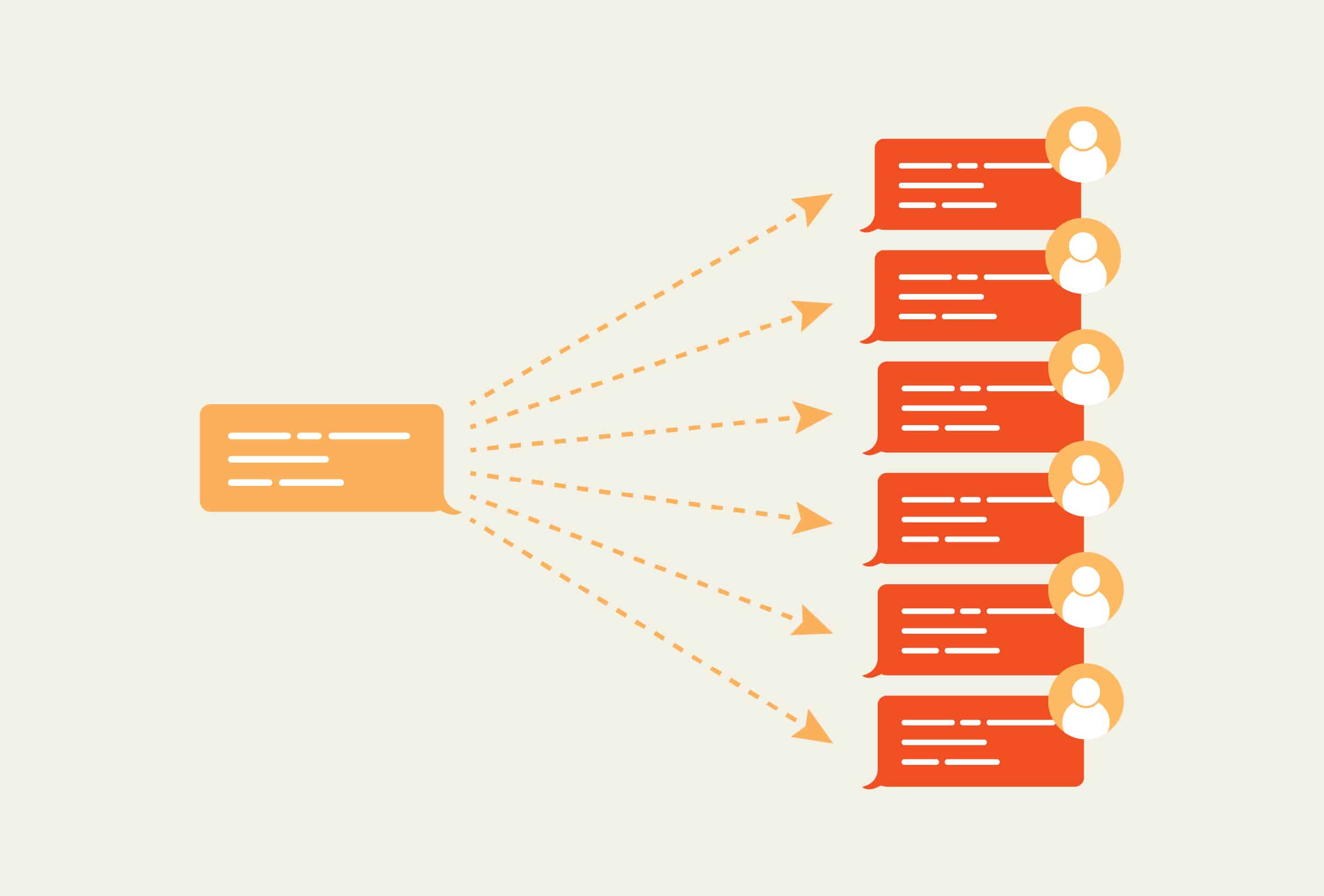


SMS marketing works — and the numbers prove it.
With 98% of Americans owning a cell phone, according to Pew Research, your audience is never far from their inbox. We check our texts hundreds of times each day — far more than email or social media — making SMS one of the most direct, high-engagement channels available to modern marketers.
The organizations that aren’t leveraging SMS marketing are handing a significant competitive advantage to the brands that are. If you need to make the case internally — or just want to set smarter benchmarks — these SMS marketing statistics have you covered.
By the Numbers: SMS Marketing at a Glance
- SMS boasts a 98% open rate — compared to an average of 25% for email
- For every $1 spent, SMS marketing generates an average of $71 in revenue (a 7,000% ROI)
- 75% of consumers prefer SMS over other promotional channels
- Business adoption of SMS marketing jumped from 55% to 80% in just two years
- 90% of texts are opened within three minutes of receipt
Why SMS Marketing Remains Powerful in 2025
On December 3, 1992, British test engineer Neil Papworth sent the world’s first SMS message (a short and sweet “Merry Christmas” to his colleague) and unknowingly kick-started a communication revolution. This two-word greeting became the first of trillions of SMS messages sent and received in the coming decades, transforming how we connect, share information, and keep in touch.
Today, texting is second nature. It’s woven into the fabric of our daily lives — our default channel for interacting with friends, family, colleagues, and classmates. For brands, it offers a mother lode of potential. Unlike email inboxes (where communications quickly become buried in a vast sea of unread messages) or social media platforms (where your brand is at the mercy of ever-changing algorithms), SMS offers modern marketers a high-engagement, two-way communication channel where messages are practically impossible to miss.
In 2025, when it’s more challenging than ever to cut through the noise and grab your audience’s attention, having this direct line to your prospects and buyers can provide a rare competitive advantage. And, as other marketing channels become more saturated, expensive, and harder to navigate, mastering SMS will soon become essential.
Key SMS Marketing Statistics You Need to Know
Take a quick look around any public space, and you’ll notice no one is far from their favorite mobile device. We keep our phones on our desks, dinner tables, and nightstands. We use them to occupy ourselves in waiting rooms and on public transit, and sneak furtive glances at our notifications in the middle of movies, meetings, and date nights. So, it shouldn’t surprise you that SMS texts boast sky-high engagement.
Here are a few SMS marketing stats to prove it:
-
SMS Open Rates and Engagement Stats
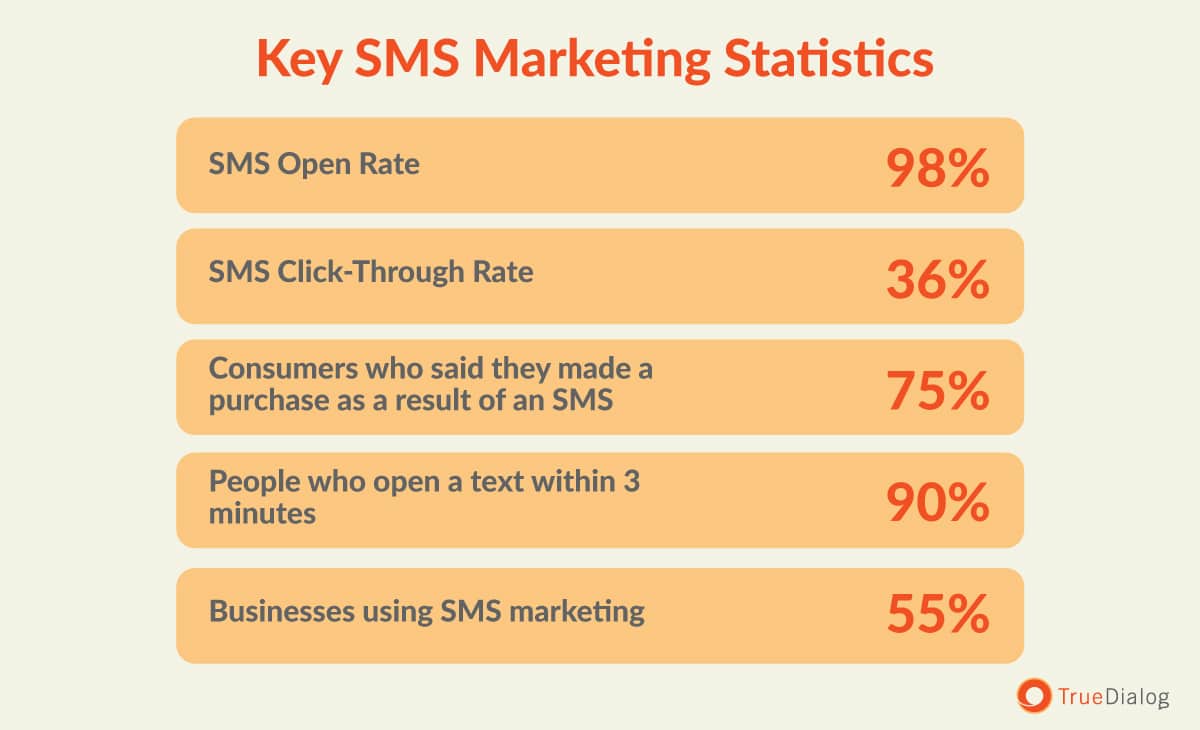
SMS has an astonishing 98% open rate (which means nearly all texts are eventually opened). This can be especially shocking to anyone who has ever managed an email campaign — a channel that rarely sees an average open rate over 25%, according to Omnisend.
-
Click-Through Rates and Conversion Rates
People don’t just open their texts, though. They interact with them too. Links within SMS texts earn an average click-through rate (CTR) of about 36%, according to MessageDesk — meaning more than one-third of recipients tap the link. And most industries see average conversion rates between 20 and 30%, according to SimpleTexting.
But how do texts translate into cold, hard revenue? According to SMS marketing data shared by Martech, a staggering 75% of consumers said they made a purchase as a result of an SMS from a brand.
Of course, this trend is less surprising when you learn that more than two-thirds of consumers (68%) said they only agree to receive messages from companies they plan to buy from. In other words, the contacts who opt in to your SMS marketing may be your most loyal and engaged customers, and strategic texts can become one of your most reliable revenue drivers.
Moreover, SMS messages can also slash a customer’s purchasing timeline. According to a survey by Klaviyo, 65% of people who purchased from an SMS text bought something they’d planned to buy in the future, but the promotional message sped up their decision. (And 14% of respondents who made a purchase hadn’t been in the market at all.) -
SMS vs. Email: Response Rates and Speed
But what about responses? How do SMS messages compare to email or other popular channels? According to data shared by SlickText, 90% of people open a text within three minutes, and Text-Em-All reports that the average response rate is a mind-blowing 45% (compared to just 10% for email).
Consumer Behavior and Texting Trends
You already know that most people are attached to their phones, and that texting has become the default digital communication mode. But to truly understand the power of SMS marketing, it’s helpful to consider how consumers use their phones to engage with brands — or, more specifically, how they prefer that brands engage with them.
-
How Consumers Prefer to Receive Information
When asked how they’d like to receive promotional content, three-fourths (75%) of consumers chose SMS over other marketing methods, according to data shared by Emarsys. And 91% of consumers said they’d opt in to SMS communications from a brand if it improved their experience.
(That said, 23% noted they’d ditch a brand for spamming them with excessive marketing messages, so remember that engaging with contacts via SMS is a privilege, and abusing this liberty will have an adverse impact.) -
Demographics and Mobile Usage Insights
While we might consider texting an activity for young people, it has increasingly become more popular across generations.
According to data from AARP, 73% of people 50 and older text daily (up from 61% in 2021). And Pew Research found that 94% of people 65+ own a cellphone (79% of which are smartphones). Furthermore, data shared by Attentive shows baby boomers engage more with branded text messages than any other age group.
Of course, younger generations aren’t far behind. And given that nearly all children in the U.S. have a cell phone by age 15, according to ConsumerAffairs, it’s unlikely that mobile engagement with brands will slow anytime soon. In fact, by 2027, purchases completed via mobile phones are expected to reach $856 billion.
Looking at mobile phone adoption by education and income bracket, published by Pew Research, also demonstrates high usage rates across the board. While the data shows smartphone ownership is highest among college-educated adults (97%), it’s still prevalent at all levels of education, and 83% of people with a high school diploma or less also own a smartphone.
Additionally, smartphones (and cell phones in general) have become more affordable over the past couple of decades, making the technology more accessible across income levels. Today, 79% of people with an annual household income below $30k own a smartphone, as do 90% of people reporting a household income between $30k and $69,999So consumers are ready and waiting — but are businesses keeping up?
Business Adoption and ROI Statistics
From engagement rates to mobile usage, there’s no shortage of data illustrating the business potential of SMS. But if you’re still unconvinced, consider that SMS marketing adoption has skyrocketed in recent years. In other words, there’s a good chance your competitors are already using it.
For example, SimpleTexting compared a few text marketing stats and discovered that business use of SMS marketing software rose 45% in two years. (In 2022, 55% of businesses were using SMS marketing. In 2024, that number jumped to 80%.)
Here’s a breakdown by industry use, plus ROI benchmarks that prove SMS is worth the investment:
-
Industries Leading in SMS Marketing
A SimpleTexting survey found that customers are most likely to opt in to texts from e-commerce and retail brands (48%), followed by healthcare (36%), finance (24%), and consumer services (23%). But that doesn’t mean there isn’t incredible potential in other verticals and sectors.
While the B2B space has historically hesitated to leverage SMS marketing at the same rate as B2C brands, the tides are shifting. About 90% of business leads say they’d prefer to be contacted by text rather than a phone call, according to Selling Power. And given how challenging it’s become to reach B2B audiences via email and social platforms, SMS marketing may be just what your brand needs to connect with your contacts and move the needle.
-
ROI Benchmarks for Text Campaigns
One of the first questions most senior decision makers ask when evaluating a potential marketing investment is, “What’s the ROI?” In this case, it’s pretty substantial.
According to G2, for every $1 spent on SMS marketing, brands earn an average of $71 in revenue ( which calculates to a return of 7000%). Compare this to email, which has an ROI of $36 for every dollar spent, according to Litmus — or social media marketing, which yields a 200% return (or $3 return for every dollar spent), according to data shared by SEO.com, and it’s clear why SMS belongs in your marketing arsenal.
Of course, SMS marketing ROI varies depending on several factors, including which mass texting service you choose and whether it has the features to support your campaign needs. That’s why it’s important you consider your options carefully and choose a solution proven to drive success in your industry.
The Future of SMS Marketing: AI, RCS, and What’s Next
In the three decades since that first fateful SMS holiday greeting reached its recipient, we’ve seen the evolution of emojis, the progression from T9 to QWERTY keyboards, and the rise of multimedia messaging. Most recently, we’ve seen an uptick in devices and carriers supporting Rich Communication Services (RCS) — a next-generation messaging protocol designed to accompany SMS. In late 2024, Apple added RCS support to its Messages app with the iOS 18 update, and all three major U.S. carriers now support RCS on iPhone — further boosting adoption and underscoring its potential to change how we communicate via text. For those new to the technology: RCS builds on SMS — think texting with the visual richness of an app, supporting images, carousels, branded sender profiles, and read receipts, all without requiring recipients to download a separate app.
As technology advances and new texting trends surface, we’ll likely see much more.
-
AI, Personalization, and Automation in SMS
Machine learning (ML) is advancing at a meteoric pace. In less than a decade, it’s dramatically changed marketing by helping us automate rote tasks, analyze giant sets of behavioral data, streamline content creation, and achieve personalization at scale. Time will tell what the future has in store, but we predict AI will only become more essential, and those who learn to master AI-powered tools now will be more likely to leapfrog their competition in the years to come.
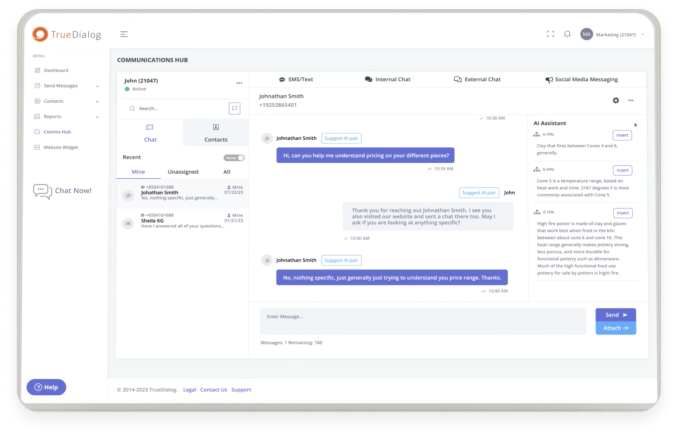
When it comes to SMS marketing, that means choosing a platform with AI-enabled features and advanced automation. For example, TrueDialog’s TrueDelivery® pre-checks every outbound message against current carrier spam filters before it sends — flagging content likely to be blocked so teams can fix it and resend. Beta customers reported 50–80% fewer false positives.
Marketers can also use AI to generate a vast library of SMS responses and personalize message content — which, according to Klaviyo, can increase a contact’s likelihood of subscribing to SMS by 33%.
Additionally, it’s helpful to choose an SMS platform with a developer-grade SMS API. This will help you automate campaign workflows for better team efficiency, integrate the platform more easily with other marketing and sales tools, and deploy dynamic messaging to boost contact engagement.
-
Regulatory Changes and Privacy Concerns
As SMS marketing has grown, so have the regulations governing it. The Telephone Consumer Protection Act (TCPA) sets key requirements for businesses — including obtaining explicit consumer consent, offering easy opt-out paths, and respecting quiet hours (9 p.m. to 8 a.m.). Non-compliance carries hefty fines, so choosing an SMS platform that supports compliance best practices is essential. For a full breakdown of SMS marketing regulations, review our comprehensive compliance guide.
Final Thoughts: Leveraging SMS Statistics and the Growing Power of SMS Marketing
As a marketer, you know there’s nothing more powerful than building strong, meaningful connections with your audience — and having a reliable one-on-one channel is essential for growing and maintaining those relationships. By adding SMS marketing to your toolbox, you can strengthen your multi-channel campaigns, get your message directly in front of your warmest leads, and drive measurable results.
Ready to see what SMS can do for your business? Schedule a demo to get started.