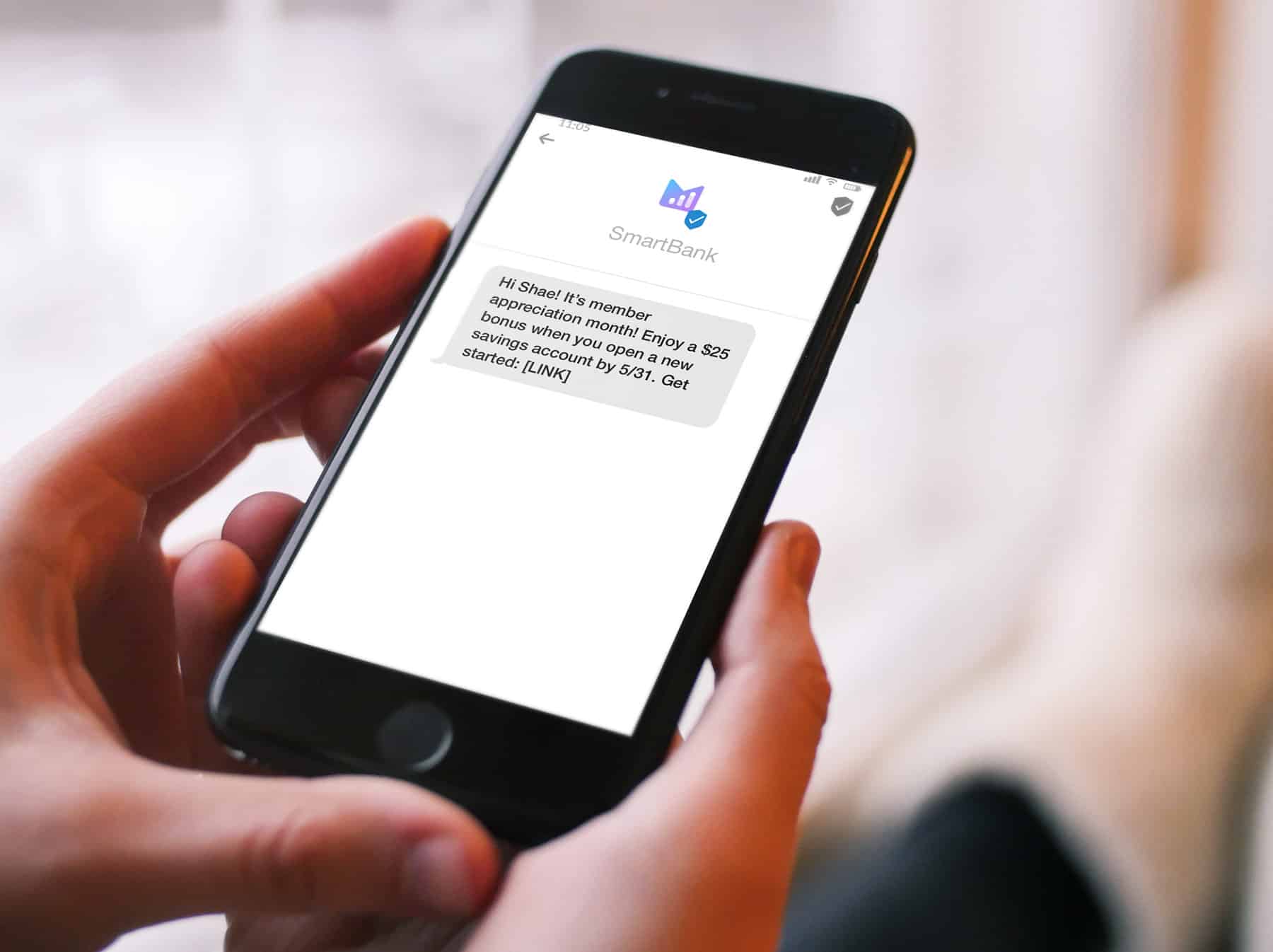


To your audience, your text messages seem simple. But, behind the scenes, you’re making dozens of carefully calculated decisions.
As marketers, we spend a lot of time and energy fine-tuning copy, tailoring offers to each segment’s interests, and adding just the right amount of personalization to spark meaningful engagement. We’re constantly poring over old campaign data and strategizing new ways to boost performance.
Unfortunately, even after all this hard work, a poorly timed send can still leave you with feeble responses and subpar conversion rates.
To help you avoid this painful fate, we’re delving into the best time to send SMS marketing messages, ideal send times by industry, and other data-driven scheduling best practices to help you drive a stronger ROI.
Why Timing Matters in SMS Marketing
In marketing, timing is everything. It’s why networks charge significantly more for Super Bowl commercial spots right after kickoff, when the highest number of viewers are tuned in. It’s also why most B2B brands avoid sending emails on Friday afternoons, when their audience has mentally checked out for the weekend, and may not revisit their inbox for days.
But what about when it comes to text messaging? Is there truly a best time to send SMS campaigns, or can you be more flexible since we know people check their text inboxes countless times throughout the day (and night)?
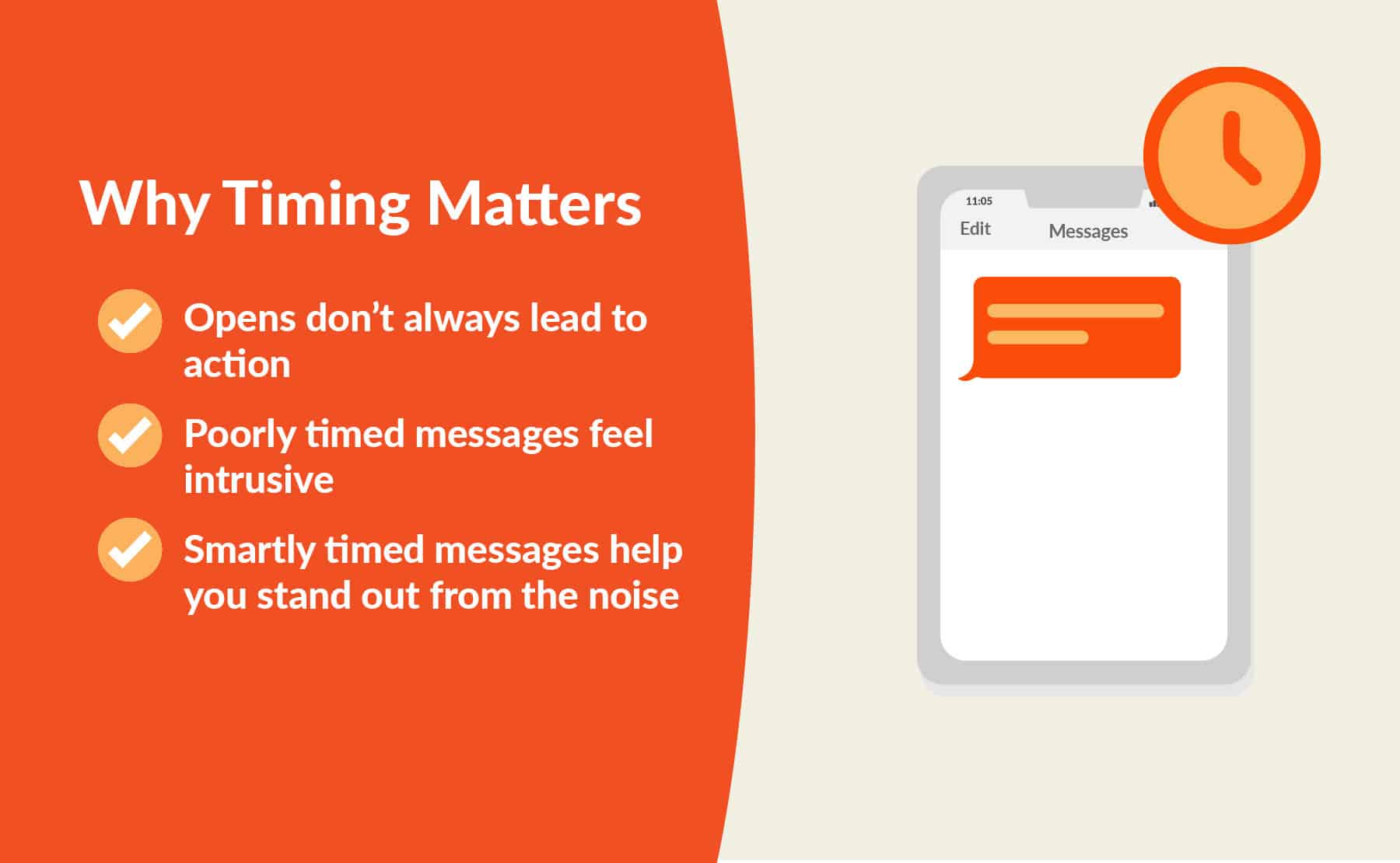
Here are a few reasons timing still matters:
-
Opens don’t always lead to action
You’ve probably heard that the vast majority of text messages are opened within minutes of being received. However, while a staggering 98% of text messages are opened (often shortly after the text arrives), an open doesn’t always guarantee meaningful engagement — particularly if your message arrives at an inopportune time.
As a sender, your goal is to send a message not only when your recipients are most likely to open it, but also when they’re most likely to fully engage with the content and take action.
-
Poorly timed messages feel intrusive
The time of day when your message arrives can also impact how a recipient perceives your brand. And an ill-timed message can leave a bad impression.
To protect consumers from disruptive practices, regulators have established “quiet hours” (a period during which organizations are prohibited from sending marketing text messages). For example, the Telephone Consumer Protection Act (TCPA) set a national standard for quiet hours from 9 p.m. to 8 a.m. (local time), but some states have slightly stricter rules.
In addition to observing quiet hours, it’s also important to consider your recipients’ daily habits, cultural norms, and lifestyles. For example, while sending a message smack-dab in the middle of morning rush hour might comply with industry regulations, it’s probably unwise if you’re trying to reach a segment of people who work traditional hours.
-
Smartly timed messages help you stand out from the noise
Of course, you also don’t want to send messages at the exact same time as your competitors, or your text might get lost among the flurry of activity. Instead, be intentional about sending messages when they’re most likely to deliver value and drive action.
For example, suppose a university has a campus event planned for a Saturday. To drive the most RSVPs, they might send invites on a Thursday afternoon, when students are beginning to plot their weekends, rather than on a Friday evening when they’ve likely already made their plans.
General Best Times to Send SMS Messages
One of the most common questions marketers ask when they build their first text campaign is, “When is the best time to send SMS marketing messages?”
The answer (frustratingly) is that the “right time” depends on several factors, like the type of message you’re sending, your audience’s personal preferences, and your goals. That said, when we analyzed data for our recent report, we discovered that most brands prefer to send campaigns on Tuesdays around 11 a.m. ET.
We have a couple of theories about why Tuesday mornings have become such a popular send time:
-
Tuesday is a workweek sweet spot
Generally speaking, people who work traditional, 9-to-5 jobs spend their Mondays playing catch-up. Many of us kick off the week by wading through a backlog of emails and obligations (while fighting off the cobwebs left behind from our weekend activities). But by Tuesday, we’re freshly settled into our weekday routine, clear-headed, and ready to give new communications our full attention.
-
Tuesday mornings are (historically) a popular time for marketing engagement
As any seasoned marketer will tell you, Tuesdays are typically a great time to send an email or publish a social media post (particularly if your goal is to get as many eyeballs on your content as possible).
According to HubSpot, the best time to send an email is Tuesday from 9 a.m. to noon, while Hootsuite data ranks Tuesday mornings as a prime time for publishing to Facebook or LinkedIn. So, it’s easy to assume that SMS engagement would follow the same trends.
However, before you start habitually scheduling Tuesday morning sends, we recommend taking your industry and audience into account.
Industry-Specific Timing Insights
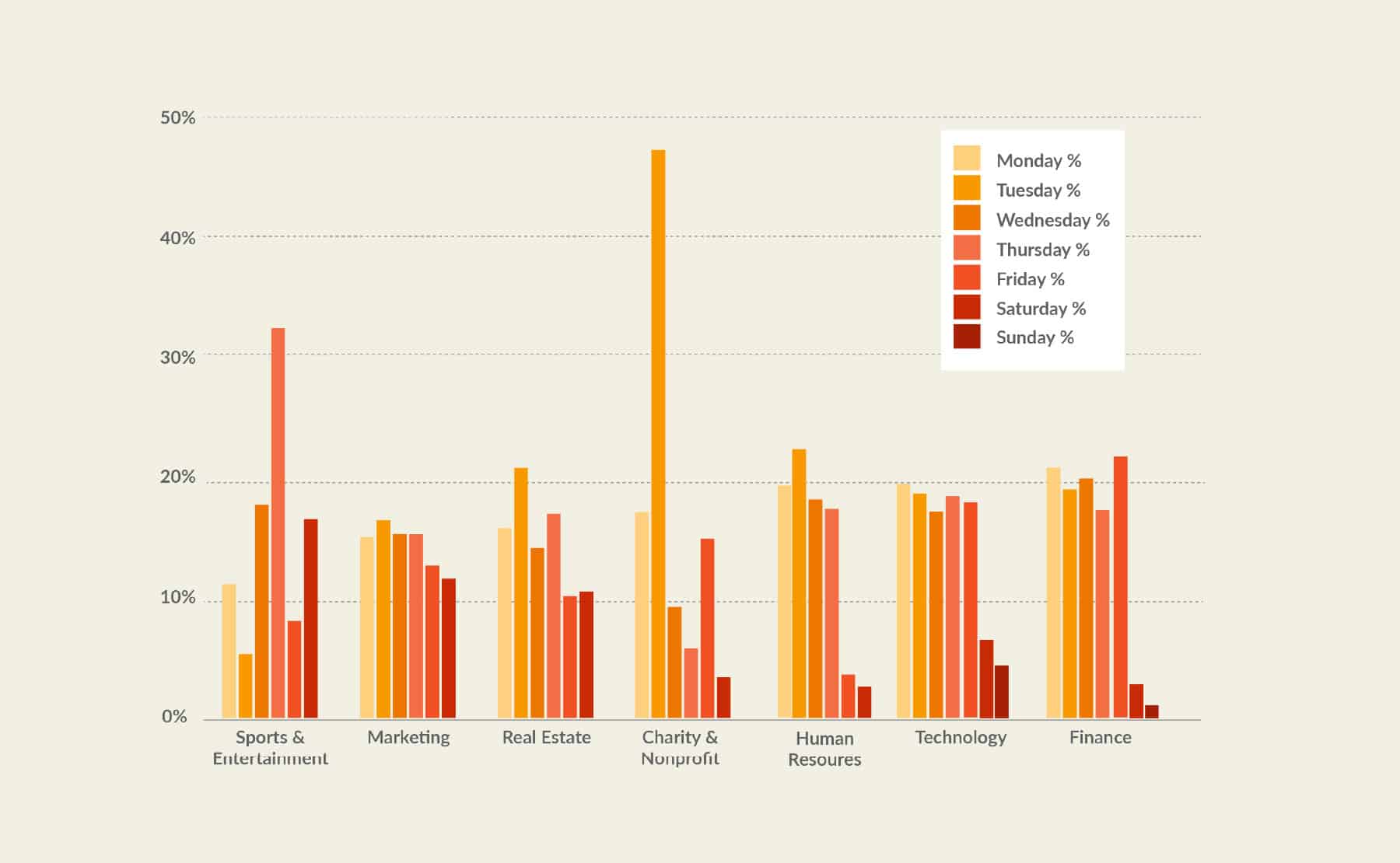
Every audience is unique, and the practices that drive massive engagement for one group may not resonate as strongly with another. To help, here are a few insights and ideas to help you determine the best time to send SMS messages within your industry:
-
Sports and entertainment
According to our data, while Tuesday is a popular choice for other industries, it’s actually the least popular day to send SMS messages in the sports and entertainment sector. Instead, the vast majority of brands send their messages on Thursdays (likely in preparation for weekend events). And while Sunday is a quiet day for many marketing teams, it’s another favorite day in this industry.
-
B2B software
Unsurprisingly, technology brands stick to weekday sends. (However, messages are distributed pretty evenly across most days, with only a slight spike earlier in the week.) Naturally, communications die off over the weekend, when B2B customers and prospects are less likely to be thinking about software purchases.
-
Finance
Like tech brands, financial companies also stick to weekday sends, with a slight increase in activity on Fridays. This could be because many people receive their paychecks on Fridays, and that leads to an increase in balance update notifications and two-factor authentication texts. Additionally, marketers might be capitalizing on this high-engagement time by targeting customers who are checking their budgets before weekend spending.
-
Higher education
Higher education trends are a little trickier to pin down because these audiences are highly diverse, often including traditional and non-traditional students, as well as campus faculty and staff. Trends can also vary between schools that offer two-year, four-year, and graduate-level programming.
In this case, we recommend leveraging a more custom approach to finding the best time for SMS marketing, which we outline below.
Data-Driven Approaches to Finding the Best Time
Often, determining the best time of day to send marketing SMS messages can feel like guesswork: throwing spaghetti against the wall until, finally, something sticks. Fortunately, when you have access to campaign data, patterns become much clearer. In many cases, your audience is already showing when they’d prefer to hear from you, and by delving into your own performance insights, you can uncover that magic window.
Here are a few ways you can use your data to determine not only the best day to send SMS marketing, but also the best hour:
-
Analyze your engagement metrics
Start by taking a peek into your open rates across several of your most recent campaigns. Once you zero in on the window(s) with the highest number of opens, check for click-throughs and responses. Keep a close eye on when people are most likely to engage with your message content in ways that actually move the needle.
-
Check engagement across all segments
As a marketer, you know every audience is different. But even within audiences, each segment may have its own patterns. For example, a university might find that traditional undergraduate students are more likely to engage with SMS messages in the early afternoon, while grad students are more likely to click or respond mid-morning. Alternatively, non-traditional students (such as those taking night courses) might be less receptive at those times because they’re busy with work or family obligations.
By checking insights within each segment, you can tailor send times to the moments when each group is most likely to engage.
(And depending on the enterprise texting platform you use, you can leverage an SMS API to build customized workflows that deliver texts based on customer behavioral triggers. For example, TrueDialog has both native integrations and a powerful SMS API that empowers teams to create personalized customer journeys.)
-
Leverage A/B testing to gather more data
Don’t worry if you don’t yet have enough data to inform your decisions, or if your data isn’t yet revealing any compelling patterns. You can still glean a lot by running simple A/B tests. For example, try sending a campaign to a portion of your list on one day, and another portion on another day. Or, split your list across two different send times. Over time, these incremental insights will add up and give you a clearer picture of when your audience is most receptive to SMS messages and most likely to engage with your texts.
When Not to Send SMS Marketing
So, now that you have a better idea of the best time to send marketing text message campaigns (or, at least, how to determine your audiences’ preferred windows), the next logical question is, when should you avoid scheduling your sends?
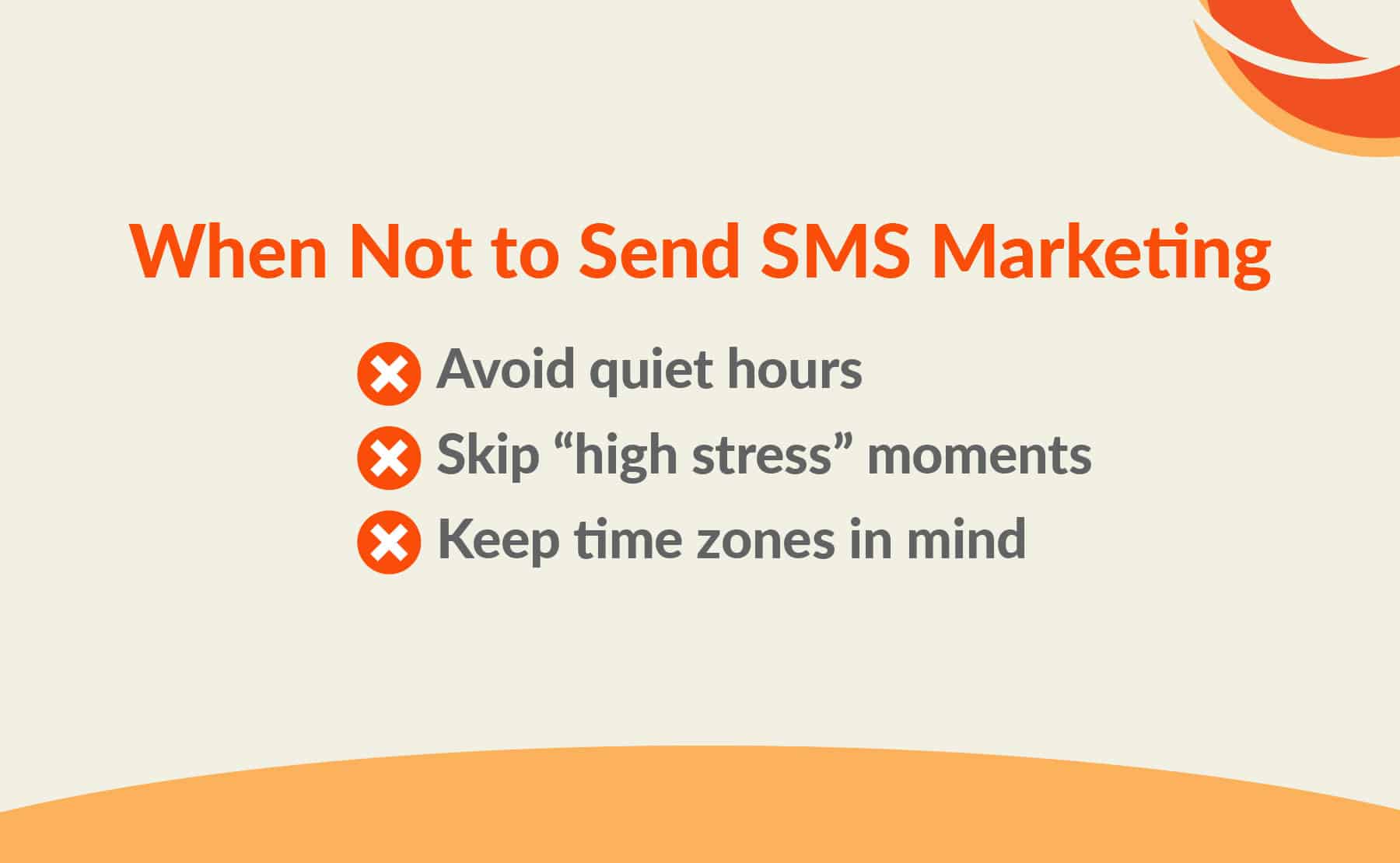
While this can vary considerably across industries, audiences, and even segments, there are three rules you should follow to avoid sending a text at the wrong time:
-
Avoid quiet hours
Quiet hours aren’t a suggestion; they’re part of a regulatory mandate. And, as with other compliance requirements, ignoring this rule can lead to hefty fines and serious legal consequences (not to mention that carriers may block brands for violating quiet hours regulations).
Also, keep in mind that some states, including Florida and Oklahoma, have even tighter quiet hours restrictions. So it’s crucial you familiarize yourself with both federal and regional rules in your audience’s locations before you schedule a send.
(Note that quiet hours only apply to promotional messages. Transaction messages, including notifications and alerts, are generally permitted even during these times.)
-
Skip “high stress” moments
There are times when your audience may not only be less responsive but even frustrated by your communications.
For example, early Monday morning may be an inopportune time to promote a software webinar, since that is when most B2B buyers feel rushed, harried, or overwhelmed. Similarly, tax deadlines are likely not the best time to market a new financial service to small businesses (though the weeks afterward may be).
Meanwhile, interrupting students with a marketing text during mid-term or finals crunch time probably isn’t wise (unless you’re marketing free coffee!)
-
Keep time zones in mind
A perfectly timed message can build trust and a positive association with your brand, but a too-late (or too-early) text may do precisely the opposite. That’s why you must always consider your audience’s time zone.
For example, suppose a sports venue is offering special pre-sale access for playoff tickets to a select group of VIP fans living across the country, and decides to promote the pre-sale at 10 a.m. ET. However, while this timing may be ideal for East Coast fans, it could make the promotion less accessible for those living in Mountain Time and even violate quiet hours on the West Coast. Instead, it would be best to find a time that works across time zones or segment the audience by region and hold multiple pre-sales.
TrueDialog’s Scheduling and Analytics Features
Of course, finding the best time to send SMS blast campaigns is only half the battle. The other half is finding a reliable platform that can send hundreds, thousands, or even millions of messages at once without deliverability issues. You also want to ensure your solution makes it easy to schedule texts across segments and even automate scheduling. And, of course, you should choose a platform with user-friendly analytics features so you can make data-driven decisions about your sends.
TrueDialog offers all of the above, including a native integration with HubSpot SMS, so you can monitor text campaign activity and message logs within HubSpot and optimize for better results.
The platform also integrates with Marketo SMS, so you can effortlessly scale your campaigns and automate lead-nurturing sequences. (Plus, connect to other leading CRM and marketing automation solutions, such as Eloqua, Salesforce, Microsoft 365, and more.)
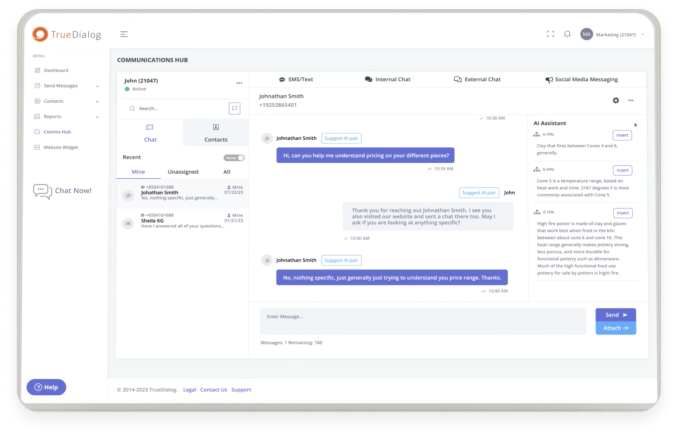
Additionally, TrueDialog delivers real-time insights via an easy-to-use dashboard and gives you the power to generate custom reports in just a few clicks. This way, you can view performance for your entire SMS program, drill down on specific campaigns, and even zero in on specific metrics.
Final Thoughts: Perfect Timing for Stronger SMS ROI
Unfortunately, driving engagement isn’t as simple as determining the most popular time to send and scheduling all of your campaigns during that window. To pinpoint the best time to send SMS marketing, it’s smart to consider broader trends across your industry and also analyze micro-patterns within your own audience. The good news is that by keeping these best practices in mind and following the data, you can reach your recipients when they’re most likely to open, engage, click, and convert.