
As any higher ed comms leader knows, managing student and alumni communications without a CRM is a recipe for disaster. After all, there’s only so much spreadsheets can do, and without the right tech, things can easily fall through the cracks. But you also can’t expect just any CRM to get the job done.
When you have a thoughtfully chosen, well-integrated, intuitive, and user-friendly platform, it empowers your team to communicate effectively and confidently across all of the channels students prefer. (A list that seems to grow by the way.)
But the wrong higher education CRM creates data silos, limits visibility, and introduces unnecessary complications and risks. If you can’t successfully integrate your solution with your SMS for higher education platform, email tool, and other essential applications, it leads to poor student experiences and constant headaches for you and your team.
If this sounds familiar and you’re considering making a switch, we’re here to help. We’ve rounded up the best higher education CRM software platforms on the market today, plus plenty of tips and pointers to help choose the best solution.
What Is a Higher Education CRM?
A higher education CRM (customer relationship management) solution is a platform that helps colleges and universities manage communications and relationships with prospective and current students, alumni, parents, and other stakeholders throughout the student lifecycle. While many traditional CRMs are built to support sales teams, higher ed platforms are designed to meet the unique needs of academic institutions.
Also called a student engagement platform, a higher ed CRM centralizes student data (including contact information, application or enrollment status, engagement history, and communication preferences) in a single location. This way, teams can stay better aligned, easily see who has engaged with contacts (and when), and find the details they need at any time.
The best CRMs also integrate with other systems in your tech stack to enable automated workflows. For example, suppose a prospective student fills out a request-for-information form. In that case, the CRM may update the contact record and trigger your SMS platform to send a text message guiding the prospective student toward the next step, such as scheduling a call or a campus visit.
Core Features to Look for in a Higher Education CRM

Not every CRM for higher education is created equal, even though, at first glance, their differences can be hard to distinguish. Here are a few essential features you should keep an eye out for as you evaluate your options:
-
Centralized student data
Your CRM should be your primary system of truth, and offer a unified view of students’ entire lifecycle — from the moment a prospective student connects with your institution through enrollment, graduation, and beyond. It should help teams organize data such as student contact details, communication preferences, engagement history, and academic milestones in a single accessible location.
-
Intuitive user experience
Sometimes, buyers focus so much on factors like cost and niche features that they forget to ask one vital question: “Will my teams be able to use this?” A platform’s user experience isn’t just about aesthetics (although that may play a role), but also about whether the software is streamlined, intuitive, and easy to use. Even the most powerful and robust CRM in the world won’t do your school much good if it’s too confusing to use efficiently.
-
Advanced segmentation and audience targeting
Your ability to segment audiences by criteria such as graduation year, program, location, or engagement history is vital to delivering relevant, timely messages across multiple channels.
-
Native integrations with communication platforms
Integrating two systems can be complicated, especially if you have to rely on third-party tools like Zapier or several hours of developers’ time to make it happen. This is why native integrations (i.e., built-in connections between platforms that the provider maintains) are so useful. When shopping for a new higher education CRM, pay close attention to whether the platform offers native integrations with other tools, like your SMS platform, email solution, and event management tool.
(Alternatively, check to see whether these solutions offer seamless integrations with the CRM you’re considering. For example, the TrueDialog SMS platform natively integrates with leading CRMs like Salesforce, HubSpot, and more.)
-
Automation and workflow management capabilities
Opt for a CRM that modernizes your communications efforts while boosting team efficiency. In other words, choose software that offers automations, such as triggering a message or task based on a specific action or event. For example, your CRM might trigger your SMS and email platforms to send reminders when a financial aid deadline approaches or when a student is due for an advisement session.
-
Role-based access and admin controls
While you want your CRM to be easily accessible, you also want to keep student data secure, which often means ensuring that individuals have access only to the data and features required to do their job. Ensure your software provides strong administrative controls and permission settings to protect student information and comply with regulatory requirements.
-
Reporting and analytics
Reporting capabilities and analytics are where your CRM software for higher education should really shine. One major benefit of keeping all student data in a centralized location is that you can gain insights into how your efforts are performing. For example, you should be able to see which campaigns and channels are driving the most engagement, and how quickly individuals are progressing from prospect to enrolled student. The better the reporting features, the better you can pinpoint what’s working (and what’s not).
-
Scalability
Just as with any tool or application you invest in for your institution, you should consider not only your needs today but also your anticipated needs in the future. Make sure your CRM can grow with you and support your teams as demands (and students’ preferences) evolve. For example, while you may still be building your database and have smaller lists now, it’s still wise to opt for a CRM that can support larger-scale communications and a higher volume of contacts.
Top Higher Education CRM Platforms

Now that you know a little bit more about what to look for, here are our top 10 picks for the best CRM for higher education:
-
Salesforce Education Cloud
Salesforce is the leading CRM in the world for a good reason: it offers some of the most powerful functionality on the market. For higher education institutions, the provider provides a deeply unified platform that brings together your data and applications in a single, easy-to-access location. Users can leverage agentic AI, built-in automations, and unmatched scalability to reach goals faster than ever. In fact, the platform boasts a 5.5% increase in student enrollment and 15% rise in first-year retention rates. TrueDialog integrates natively with Salesforce, and the CRM also integrates with most top-ranked marketing and communications apps.
-
HubSpot for Education
HubSpot has long been known as a leading marketing automation platform and sales CRM solution for the B2B sector, but is now also an excellent choice for higher education. The highly intuitive platform unifies scattered student data to streamline communication efforts and integrates quickly with tools such as Calendly, Fundraise Up, SurveyMonkey, and more. Additionally, TrueDialog natively integrates with HubSpot for seamless automations and frustration-free workflows.
-
LeadSquared
Earning an impressive 4.5 stars on G2 (out of hundreds of reviews), LeadSquared has risen to become one of the most-trusted CRM platforms for sectors like education, finance, and healthcare. It’s built for high-volume needs and promises to boost outreach, streamline workflows, and deliver custom analytics all without requiring coding skills (so you and your team can get started faster).
-
Slate by Technolutions
Slate has a long track record of supporting admissions and enrollment teams and has also begun introducing AI-powered tools to improve higher education outcomes further. As an all-in-one platform, the provider promises to handle everything modern admissions offices need, from application management to sophisticated data integrations.
-
Ellucian CRM
Designating itself “Higher Education’s AI-Enriched Platform,” Ellucian has become one of the most popular purpose-built higher education CRMs on the market. It currently serves 2,600 customers across 50 countries, powering the end-to-end student lifecycle for numerous leading institutions. Thanks to its innovative automations, trusted deployment support, and features to help identify students at risk of falling behind, the easy-to-use solution has received many accolades and awards.
-
Element451
Element451 combines an AI agent platform and unified CRM to help busy teams get more done in less time. It offers a modern, user-friendly interface and aggregates data from several platforms and channels to help teams move in lock-step. Its automations and AI-driven tools can help you monitor student progress, flag potential risks, and move applications forward faster, while also engaging alumni through timely outreach.
-
TargetX
As an out-of-the-box CRM solution, TargetX is a favorite among higher ed professionals across disciplines. The solution focuses on both improving recruiting experiences and boosting long-term student retention, earning loyalty from several leading schools. According to the Chief Digital Officer at Georgetown University, since implementing TargetX, some of the institution’s conversion metrics have reached all-time highs.
-
Pipedrive
Another user-friendly favorite, Pipedrive, isn’t purpose-built for higher ed, but it does have some convenient and relevant features — especially for smaller institutions. It also offers more than 500 integrations, including many of the apps your institution may already use, like Slack, Zoom, Asana, Microsoft Teams, and more.
-
Blackbaud CRM
Blackbaud is a well-known SaaS provider that serves not only educational institutions, but also nonprofit and accounting organizations. Like others on the list, this highly flexible platform offers modern automations and seamless integrations while supporting alignment across enrollment, admissions, alumni relations, marketing/communications, and operations teams.
-
Zoho CRM
Zoho CRM is another tried-and-true, comprehensive solution originally built for B2B use cases that also performs well as a CRM for universities. This all-in-one, scalable solution boasts a user-friendly interface, onboarding and training support, and secure integrations with over 1,100 applications. It also includes a powerful AI component that optimizes operations and streamlines daily workflows.
How TrueDialog Complements Higher Education CRMs

Your higher ed CRM is one of the most vital pieces of software any institution can have, but it’s not always the best for sending time-sensitive, high-impact communications. This is where an enterprise SMS platform like TrueDialog offers tremendous value.
While students’ social media and communication channel preferences seemingly change by the day, data overwhelmingly show that college-age adults consistently spend a lot of time texting. In fact, according to a report from IBM, 73% of Gen Zers say texting and chatting are their primary mobile phone activities. In other words, if you want to reach and engage younger adults, you need to have a robust SMS program.
Here’s how integrating your CRM with TrueDialog will benefit your institution:
-
Leverage student data to send more personalized, relevant, and compliant communications
Using the data in your CRM, you can create highly tailored campaigns for each segment of your list, helping drive engagement. For example, you can send a reminder about application deadlines to students who have recently attended campus visits or info sessions but have not yet applied, or trigger a friendly nudge to students who are due for an advisement session but have not yet scheduled an appointment with an advisor.
Additionally, TrueDialog offers built-in compliance support to help your school comply with regulations set by the Telephone Consumer Protection Act (TCPA) and the Cellular Telecommunications Industry Association (CTIA).
-
Break through the noise during critical moments
Although email is still an essential channel, it’s much easier for notifications, reminders, and important communications to get lost in crowded email inboxes than text inboxes. TrueDialog supports short code texting to ensure you can get critical information in front of students before it’s too late. With better deliverability and higher throughput, short code SMS is one of the most reliable and compliant methods for reaching contacts quickly. (This is especially useful in emergencies, such as when you need to share details about closures due to inclement weather or campus safety concerns.)
-
Enable two-way communications at scale
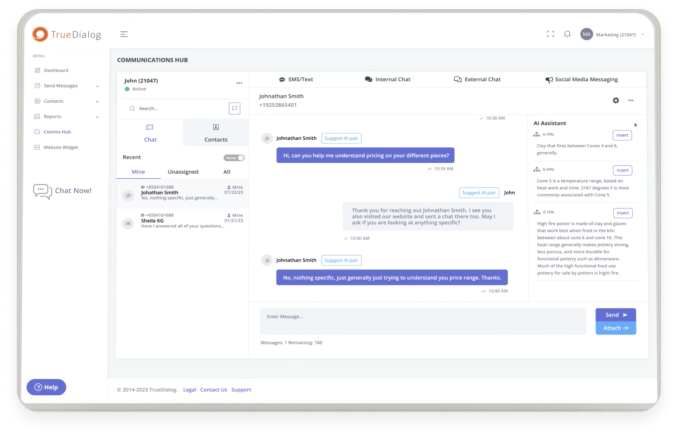
The idea of connecting directly with thousands of students at once might seem impossible, but TrueDialog makes it easy. With one-on-one texting and our centralized communications hub, you can engage in numerous real-time conversations simultaneously. Our powerful AI assistant offers a library of AI-generated responses that are custom-built for your institution, while the message forwarding feature helps you quickly route student questions or concerns to the most qualified expert.
How to Choose the Best CRM for Your Institution

The best CRM for education will vary by each institution and depends on factors like your school’s size, your budget, and the legacy tech you’ll need to integrate. Here are four steps we recommend to help you and your team select the right platform for your needs:
-
Identify your team’s goals and priorities
First, it’s important to get clear on what, exactly, you want to accomplish. For example, some universities may be hoping to increase inquiry-to-enrollment conversion or improve student retention, while others may be more focused on strengthening alumni engagement. Defining your top priorities will help you narrow your choices and ensure the CRM you choose can help you achieve those outcomes.
-
Assess integration needs and scalability
Your CRM is one of the most essential pieces of technology you have, so it’s crucial that it fits well into your tech ecosystem and connects easily with your SIS platform, marketing tools, and other applications. Make sure to select CRM software that can scale as your institution grows and your needs evolve, effectively supports multiple departments, and won’t require constant workarounds or headaches to manage.
-
Consider security, compliance, and support
A CRM contains a significant amount of sensitive student data and other confidential information, so it’s vital that you choose a platform that prioritizes security. Look for tools with role-based access and experience working with highly regulated industries, such as education.
-
Evaluate how communication tools (like SMS) fit within your CRM strategy
In addition to ensuring your CRM flawlessly integrates with your SMS platform, you also need to make sure you can enable timely communication through automations and behavioral or event-based triggers. Otherwise, you might be stuck with fragmented outreach and unreliable workflows.
Use Cases: How Universities Use CRMs to Drive Results
It’s easy to understand why a business might use a CRM to boost sales and drive customer loyalty, but it may be less obvious how higher education institutions use this technology to achieve their goals. Here are a few common ways that colleges and universities use CRMs to drive consistently positive and measurable results:
-
Streamlining admissions and inquiry follow-ups
Often, admissions teams use CRMs to track prospective student inquiries, monitor application progress, and manage follow-up communications. Admissions officers might use this software to determine when prospective students need a gentle nudge to get back on track. For example, your CRM might trigger a workflow to remind disengaged students about upcoming info sessions or application deadlines, which can help reduce drop-off rates.
-
Improving communication across departments
A CRM helps admissions, financial aid, advising, communications, student services, and other teams stay aligned and prevents departmental silos. When everyone has a shared view of student interactions, it reduces duplicate outreach and ensures students are receiving consistent messaging (no matter which department reaches out). For example, a financial aid officer might see that a member of the admissions team has already reached out to a student about an upcoming deadline, and avoid bombarding the recipient with more messages about the same event.
-
Supporting alumni relations and fundraising
You can use your CRM to group your alumni audience by criteria such as graduation year, interests, and giving history, and then tailor messaging that will resonate with each segment. By personalizing your outreach, you can boost participation and donations, and support more targeted fundraising campaigns. (For example, a university building a new performance hall might start by appealing to alumni of fine arts programs or to those who have recently attended a campus performance.)
-
Enhancing retention through personalized engagement
Your CRM can help you track engagement signals and academic milestones to identify which students may need additional support, and connect them with the appropriate team or services to deliver that support. These early interventions can help reduce dropout rates and ensure more students reach graduation.
Frequently Asked Questions
-
What makes a CRM “higher education friendly”?
A higher ed CRM offers features and functionality to support long-term, relationship-driven lifecycles (as opposed to short, one-time transactions). The best CRM for education industry professionals is one that also offers automations to reduce manual tasks and seamlessly integrates with the tools that your institution already uses.
-
How do CRMs help colleges improve student enrollment and retention?
A CRM helps higher ed institutions deliver more timely, relevant, personalized, and coordinated communications across the student lifecycle. By centralizing student data and engagement history, this software gives teams better visibility into each contact and ensures they receive the right communications at the right time.
-
Do you still need an SMS platform if your CRM already offers SMS?
While some CRMs offer very basic, entry-level texting features, these are usually insufficient to support the higher-impact campaigns that modern universities rely on to drive student and alumni engagement. Given how essential texting is to communication success, it’s a good idea to adopt a mass texting service for business (especially one that integrates with your CRM).
-
Are higher-education CRMs compliant with FERPA and data privacy laws?
While most higher education CRMs are built with the Family Educational Rights and Privacy Act (FERPA) and other data privacy and regulatory requirements in mind, compliance depends on how the platform is configured, used, and managed. This is why it’s so important to leverage role-based controls and data encryption, and ensure any solutions integrated with your CRM also prioritize security and compliance.
Looking for a powerful, secure, and reliable SMS solution to integrate with your higher education CRM? Discover how TrueDialog can support your school’s objectives. Request a demo today!